
Story Summary
A merchant strolling by the seashore encounters a mysterious figure measuring out each person's daily food. When told this is Bidhata - Fate - the merchant issues a bold challenge: withhold my lunch today, if you can. What follows is a quietly devastating lesson in humility that has delighted readers for generations.
Full Story
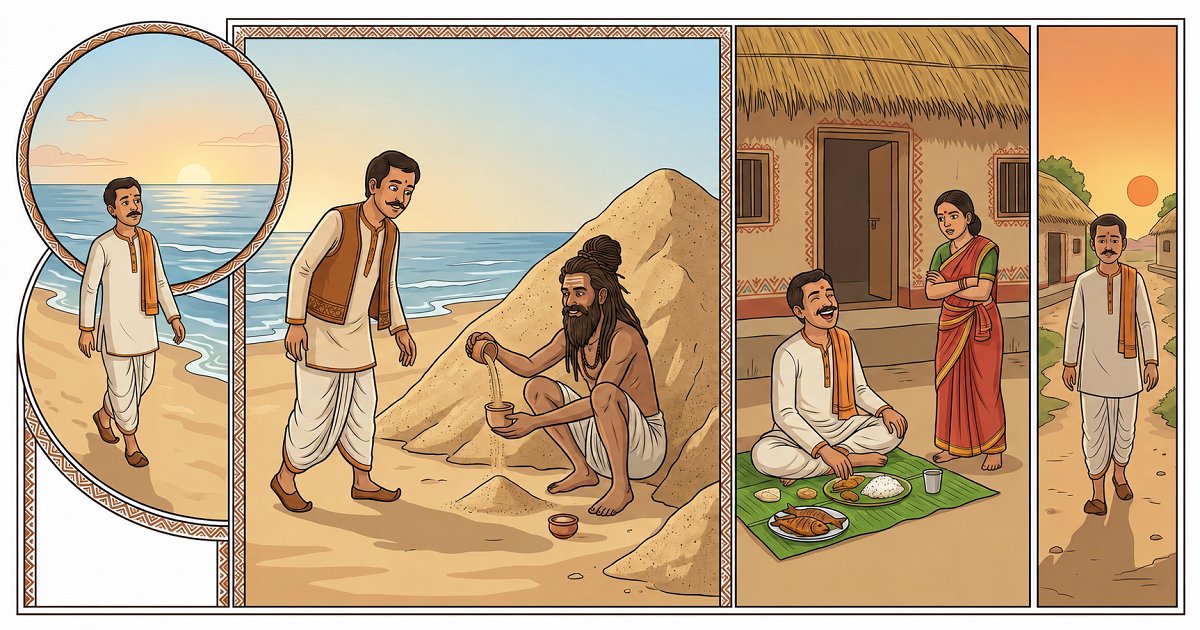
There once lived a merchant in a village in Orissa. One morning, he was taking a stroll by the seaside. Some distance away, he saw a man squatting on the beach and filling a cup with sand. What is he doing?
the merchant wondered.
He walked towards the man and watched him. The man filled the cup, turned around and emptied the contents on a large heap of sand behind him. Then he again turned towards the sea and began filling the cup with sand.
This went on for a while. As the merchant watched, the man continued to fill the cup with sand and empty it behind him. Finally, curious and puzzled, the merchant went up to the man and asked, Who are you, O good man? And what are you doing?
The man continued to fill the cup and replied, I am Bidhata! I am Fate! I am measuring out the food each man is to receive today.
The merchant was even more curious now. Can you really do that?
he asked. Yes!
Bidhata nodded. If I miss out on even a single person, he or she will have to go hungry today!
Do you mean to say that if you don't keep aside my measure of food for today, I will have to go hungry?
the merchant asked, mockingly. That's right!
said Bidhata. Then I challenge you to withhold my afternoon meal for today!
said the merchant. As you wish,
said Bidhata, smiling.
The merchant then went to the market, bought a fish and took it home. Cook this for lunch,
he said to his wife. Hah! That Bidhata! Let me see how he withholds my afternoon meal from me.
And so thinking, the merchant left for his workplace.
By noon, he was back home and sat down to eat. As soon as his wife served the fish, the merchant thought, I challenged Bidhata to withhold my lunch, but he couldn't succeed! Poor Bidhata…
And he began to laugh - Hahahahaha!
Now, the merchant's wife thought that he was laughing at the way the food had been prepared. She was upset and started shouting at the merchant. They had a quarrel and finally, the merchant got up and stormed out of the house in anger.
It was only when he calmed down that he realised how Bidhata had succeeded in making him forego his lunch.
Key Characters
- The Merchant: A prosperous and proud tradesman
- Bidhata: The deity who determines each person's destiny
- The Merchant's Wife: An unwitting instrument of fate.
Moral of the Story
Human pride cannot outwit the workings of fate. Destiny does not force its will upon us from the outside - it weaves itself into our own actions and choices. The merchant's downfall came not from Bidhata, but from his own arrogance.
Why Kids Love This Story
- A satisfying twist - The story's ending surprises readers every time - Bidhata succeeds without lifting a finger, which feels both funny and thought-provoking at once.
- A vivid, memorable image - The scene of a god filling a cup with sand on an empty beach is strange and poetic - the kind of image that sticks in the mind long after the story ends.
- Relatable silliness - Children recognise the merchant's bragging immediately - most of us have felt that I'll show you! impulse. Watching it backfire so neatly is deeply satisfying.
- Rich discussion potential - The story invites big questions: is fate real? Can people control what happens to them? These conversations make it ideal for classroom read-alouds.
- A window into Indian mythology - Meeting Bidhata introduces young readers to a fascinating figure from Odia and Bengali folklore who appears in many other stories across eastern India.