
Story Summary
A lazy man who steals from a temple thinks he has found the easy life. But his sharp-witted wife has other plans. With nothing but a pan of fish and her own untied hair, she stages the most dramatic intervention in Orissan folk tale history - and changes her husband's life for good.
Full Story
Long ago, there lived a lazy man. He never wanted to work, and was always looking for an easy way to get food. One day, as he was passing by a temple, he saw a mango tree full of juicy mangoes. He climbed up on the compound wall of the temple to steal the mangoes.
The temple also had a pond full of fish. As soon as the lazy man noticed the fish, he jumped into the compound. Being lazy, he didn't even bother to bend. He used his hands to pluck the mangoes and his feet to catch the fish. Stuffing both into his bag, he ran home.
Here, I have brought some good food today,
he said to his wife, taking out the fish and the mangoes from his bag.
At first, his wife was excited to see such delicious food, as they had not eaten mangoes and fish for a long time. But then she thought: He never goes to work; how did he manage to bring home the mangoes and the fish?
She took the bag from her husband and asked, Where did you get these from, dear?
The husband said with pride, I stole them from the temple compound.
The wife was shocked. Earlier my husband was lazy, now he has become a thief too! How shameful!
she thought.
So the clever wife decided to teach her lazy husband a lesson. She pretended to be happy and said, Good that you brought them! There are plenty of mangoes and fish there. I will prepare a delicious feast today. Go and take a bath in the meantime.
With happy thoughts of the feast, the man went to take a bath while his wife went into the kitchen to cook the fish. As she prepared the meal, its mouth-watering aroma spread through the entire house. I can't resist the temptation!
thought the lazy man, finishing his bath quickly. His mouth began to water.
Come quickly, dear!
called out his wife. The food is almost ready.
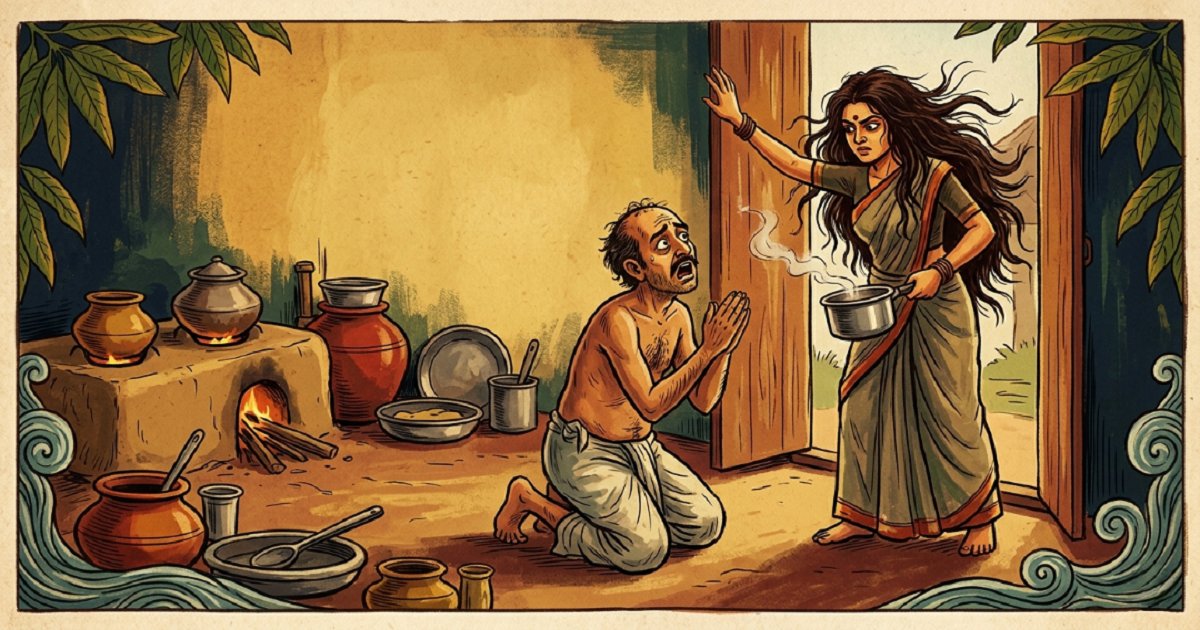
Just as she heard her husband's footsteps approaching, she quickly untied her hair, picked up the pan of fish and stood squarely in the middle of the kitchen.
As soon as her husband entered, he saw a wild-haired, terrifying figure staring back at him. How dare you steal from my temple?
yelled the wife. W - what! Your temple?
stammered the man, stumbling backwards. Yes, I am the Goddess of the temple,
replied the wife, furiously. I saw you stealing from my mango tree and my pond! Now I have taken possession of your wife's body. And I am going to punish you!
Hearing this, the man fell to his knees and begged for mercy. Then go and throw this vessel of fish back into the pond,
said the wife, and swear by me that you will never be lazy again, that you will work hard, and that you will never steal again.
I promise, O Goddess!
cried the man.
He carried the vessel of fish back to the temple pond, threw it in, and made his solemn vow. From that day on, he was a changed man - no longer idle, no longer dishonest. Thus, the clever wife had taught her husband the most valuable lesson of his life.
Moral of the Story
Laziness and dishonesty lead only to shame. Sometimes the most powerful change comes not from punishment, but from a moment of clarity - even if that clarity takes a little dramatic staging to achieve.
Key Characters
- The Clever Wife: The true hero of the story.
- The Lazy Husband: A man more interested in shortcuts than honest work.
- The Temple Goddess: Not a real deity, but the wife's inspired performance.
Why Kids Love This Story
- A clever plan in action. Children love watching a character outsmart someone - especially an adult who thinks they are getting away with something. The wife's disguise is pure theatrical genius, and young readers feel the delicious tension of waiting for it to unfold.
- Comic drama without cruelty. The husband's terrified reaction - falling to his knees, begging a "goddess" for mercy - is genuinely funny. The humour is warm and universal, not mean-spirited.
- A female hero who uses brains, not brawn. In an era of physical heroes, the clever wife stands out as someone who solves a big problem with nothing but quick thinking and household props. She is endlessly relatable and admirable.
- A satisfying, hopeful ending. Unlike stories where wrongdoers are simply punished, this one ends with genuine transformation. The husband changes, and the family is better for it. Children find this uplifting and encouraging.
- A rich, sensory world. The smell of fish frying, the sound of footsteps, the dramatic kitchen confrontation - the story unfolds in vivid detail, making it easy to visualise and perfect for reading aloud or acting out.
FAQs About the Story
How did the wife disguise herself as a goddess?
With remarkably simple props. She untied her hair - wild, loose hair being a classic symbol of divine possession or supernatural fury in Indian iconography - and stood holding the pan of fish with a terrifying expression. In the dim kitchen, with the dramatic timing of her husband's approach, the effect was entirely convincing.
Where does this folk tale originate?
The story comes from Orissa (now Odisha) on India's eastern coast. It is part of a rich oral tradition of tales featuring clever women, divine intervention, and everyday village life, which have been passed down through generations of Odia families.
What does the loose hair symbolise in the story?
In Indian iconography and folklore, a woman with dishevelled, unbound hair often signals a divine or supernatural state - possession, wrath, or divine power. Goddesses like Kali are typically depicted with wild hair. The wife deliberately uses this symbolism to heighten the illusion, knowing her husband would immediately associate the image with godly fury.