
Story Summary
Four bored craftsmen - a carpenter, goldsmith, weaver, and vermilion hawker - spend a night in the woods and, one by one, transform a piece of dry wood into a beautiful living woman. When dawn breaks and she stands before them, each man claims she is his to marry. A wise man who passes by has the final word - and his answer, rooted deep in Indian tradition, surprises everyone.
Full Story
Once, there lived four friends. One was a weaver, the other a carpenter, the third a goldsmith, and the fourth a hawker who sold vermilion. Every evening, they would meet in the woods and share the day's experiences.
One such evening, they were feeling sad and restless. "Life is so boring!" said the weaver. "I spin thread, weave clothes, and the day comes to a close!"
"It is the same with me, friend," said the hawker. "I buy vermilion from the wholesaler, go hawking through the village, and the day is over."
"My life is boring too!" said the carpenter. "I chop wood and make furniture. Is this the best way to spend a day?"
The goldsmith agreed: "I am no better, friends! I melt gold, mould it into beautiful designs, and that is the work I do the whole day." So the four planned to travel to the town in search of new lives.
"Let's sleep here tonight and start early in the morning!" they decided. "But we must take turns keeping watch for wild animals."
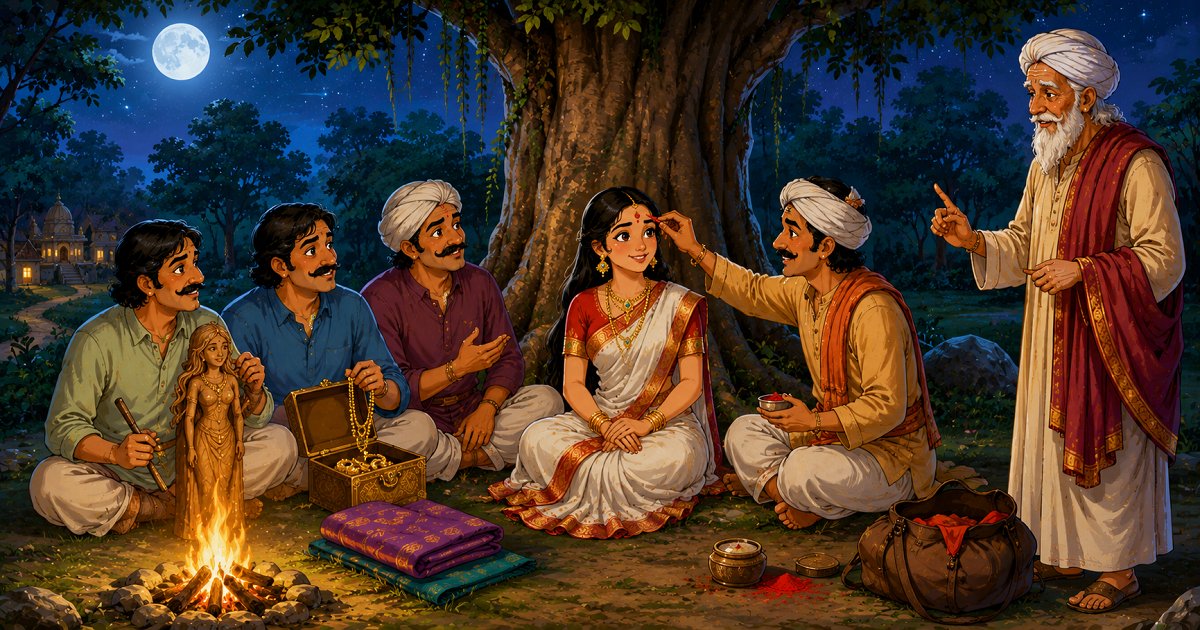
The carpenter was first to keep vigil while the others slept. Suddenly, he noticed a lovely pile of dry wood. He chiselled it, carved a statue of a woman, and placed it gently on the ground beneath the tree. Then he woke the goldsmith and went to sleep.
"Ah, I feel so refreshed!" the goldsmith sat up with a yawn. He stretched his limbs - and then noticed the wooden figure. "Beautiful!" he exclaimed. "But she needs ornaments!" So he made a gold chain and put it around her neck, fashioned bangles and a pair of earrings, and adorned her with great care. Then he woke the weaver and went to sleep.
The weaver sat up, rubbing his eyes. As he looked around, he spotted the wooden statue - dressed now in gold, but nothing else. "Something is missing," he thought. "Yes - clothes! She should wear a sari." And so he wove a sari and wrapped it around the statue with a contented smile. Then he woke the hawker to take his turn.
When the hawker sat up, he saw the beautiful statue under the tree - carved, adorned, and clothed. "This is indeed a masterful work of art!" he cried softly. "I wish someday to marry a girl as beautiful as her."
He reached into his bag and took a pinch of vermilion. He placed it gently on the statue's forehead. Much to his astonishment, the statue stirred - and transformed into a charming, living woman! She was smiling at the hawker.
As dawn broke, the other three friends woke up. Seeing the beautiful woman standing before them, they all began to quarrel about who should wed her.
"I made her," said the carpenter, "so I am the correct match for her!"
"No, I am the correct match, since I adorned her," insisted the goldsmith.
"I gave her the clothes," said the weaver, "so she is mine."
"She wears my vermilion," claimed the hawker, "so I shall wed her."
As they quarrelled, a wise man happened to pass by. After listening to the whole story, the wise man spoke calmly:
"He who made her is her father. He who adorned her is her uncle. He who clothed her is her brother. But he who put vermilion on her forehead - he is her husband."
The other three friends fell silent, then nodded in agreement. And so the hawker married the woman, and they lived happily ever after.
Moral of the Story
Wisdom sees beyond effort and ownership. All contributions matter and are honoured - but only the one whose act holds sacred meaning holds the true claim. This story teaches children that fairness isn't always about who did the most, but about understanding the deeper meaning behind each deed.
Key Characters
- The Carpenter: A skilled woodworker who carves the statue of a woman from a dry log during his night watch.
- The Goldsmith: He fashions a gold necklace, bangles, and earrings for the wooden figure.
- The Weaver: He weaves a beautiful sari and clothes the statue with dignity.
- The Hawker: A seller of vermilion who places a pinch of sindoor on the statue's forehead - the act that miraculously brings her to life.
- The Wise Man: A traveller who arrives at dawn and resolves the quarrel with a single, profound statement rooted in Indian cultural tradition.
Why Kids Love This Story
- A Statue That Comes to Life - The magical moment when vermilion brings the wooden woman to life is the kind of wonder that makes children hold their breath and re-read the sentence.
- Teamwork Without Knowing It - Each friend adds to something beautiful without planning to - a perfect lesson in how different skills complement each other, even among rivals.
- The Surprise Twist - Children try to guess who the "correct match" is before the wise man speaks - and many are surprised. It makes for a brilliant discussion starter.
- Pride in Indian Craftsmanship - The story celebrates four traditional crafts - carpentry, goldsmithing, weaving, and trading - making children proud of India's artisan heritage.
- Fairness Done Differently - The resolution isn't about voting or fighting - it's about a deeper kind of logic. Children learn that the wisest answer is often the most unexpected one.
- A Glimpse of Tribal India - Set in the forests of Jharkhand, the story introduces children to a part of India shaped by nature, craftsmanship, and the wisdom of village elders.
FAQs About the Story
Where does the folk tale "The Correct Match" come from?
The Correct Match originates from Jharkhand, a state in eastern India rich in tribal culture and oral storytelling traditions. Stories like these were passed down by village elders to teach children about wisdom, fairness, and the significance of cultural customs.
Why did the statue come to life when vermilion was applied?
In Indian culture, vermilion (sindoor) placed on a woman's forehead by a man is the sacred act of marriage - it is considered a spiritual completion of a woman's identity as a wife. In the folk tale, this sacred gesture is so powerful that it brings the wooden statue to life, symbolising that she was now fully "whole" in the eyes of tradition.
What age group is this story suitable for?
This story is best suited for children aged 7-13. Younger children love the magical element of a statue coming to life. Older children and teenagers can engage with the deeper question of fairness, cultural meaning, and what makes a contribution truly significant. It is also a wonderful classroom story for discussions on Indian traditions and values.