
Story Summary
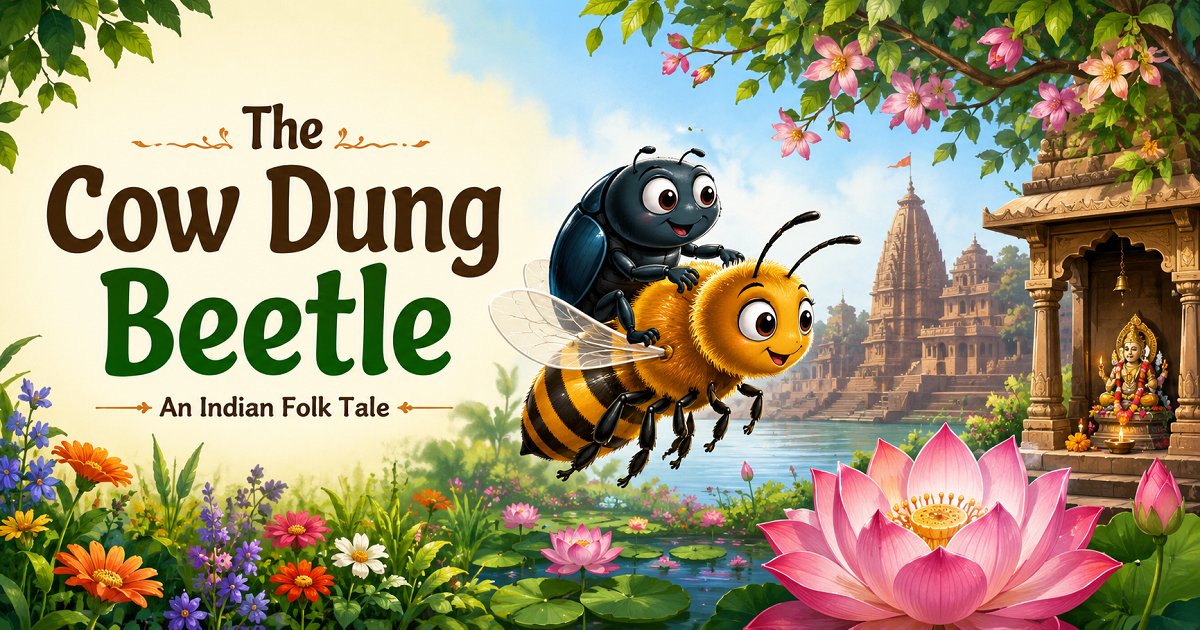
A contented dung beetle who spends his days rolling balls of cow dung convinces a proud bee from the king's garden to befriend him. Their adventure leads the beetle onto a sacred lotus, into a temple as an offering to God, and finally into the holy Ganga River - which the beetle considers the greatest blessing of all.

Full Story
In a sun-drenched field far from the city of Varanasi, there lived a dung beetle. All day he remained happily immersed in the sweet-smelling (to him) cow dung, rolling great balls of it and playing with abandon.
"Surely, this is heaven," he would think to himself every single day, perfectly at peace with his humble world.
One afternoon, as he lay there in his usual contentment, a bee came buzzing around, curious and bright-winged.
"Hello there, Mr. Beetle!" the bee called out.
The beetle responded excitedly. "Look - we are both insects! We could be the best of friends!"
The bee was not pleased with the suggestion. "We cannot be friends! You lie in that foul-smelling dung all day! I live in the king's garden, surrounded by lovely fragrances and enchanting flowers. How can you ever be my equal?"
The dung beetle was not discouraged. He looked up at the proud bee and said quietly, "Is it not the duty of great personalities like you to think and act for the poor ones like me? Where would we helpless souls be without your help?"
The bee was moved by this argument. "You are right, Beetle. Come with me - I'll show you wonderful things!" The beetle climbed onto the bee's back, and together they flew towards the king's garden.
The two new friends flew over the pretty garden for hours, and the beetle was enchanted by every sight. Rows of flowers in every colour, fountains, and the hum of a hundred bees filled the air.
"It is the most beautiful garden I have ever seen!" the beetle declared with delight.
After a while, the bee grew tired. He flew to the garden pond and gently set the beetle down upon a large, open lotus blossom.
"Rest here awhile, my friend, and I'll be back soon," he said, and flew away into the garden.
The beetle, lulled by the soft fragrance of the lotus petals and the warmth of the afternoon sun, soon fell into a deep and peaceful sleep. But the bee did not return on time - and as the sun dipped below the horizon, night fell.
As is the nature of lotuses, the petals slowly closed around the sleeping beetle, folding him inside in a gentle but firm embrace, trapping him in sweet-scented darkness.
The next morning, before the petals had a chance to open again with the sun's first rays, a priest arrived at the pond to collect flowers for the temple. He reached out and plucked the lotus - beetle and all - and carried it carefully to the temple.
There, he placed the lotus reverently upon the idol of God, where it rested the whole day, sweet and sacred. The beetle, still locked in the flower's heart, was unknowingly offered before the divine.
The following day, the priest removed the now-wilting flower and carried it to the banks of the Ganga River, the holiest of rivers, and immersed it in the sacred waters.
The lotus floated on the current for a while. When the morning sun's warm rays finally touched it, its petals slowly, gently opened - and there sat the dung beetle, safe and sound, blinking in the golden light.
Looking around from the surface of the river, he saw his friend the bee buzzing frantically nearby, searching the banks.
"I've been looking for you for three whole days! Where have you been?" the bee cried, overjoyed with relief.
The beetle smiled and replied, "Thanks to you, my dear friend, I have had the most marvellous time! First, I rested in the lap of a beautiful lotus - it felt like heaven. And then I was offered before God Himself at the temple. And finally, I had the great good fortune to bathe in the holy Ganga! Blessed are we lowly mortals, my friend, when we are fortunate enough to have great friends like you!"
Moral of the Story
The humble and the lowly are uplifted when they have noble friendships. A good companion can carry you - even unknowingly - to divine places you could never have reached alone.
Key Characters
- The Dung Beetle: A cheerful, humble creature perfectly happy living in cow dung.
- The Bee: A proud, fragrant inhabitant of the king's garden.
- The Lotus: More than a flower - the lotus is the story's spiritual vehicle.
- The Priest: A devout man who, unknowingly carrying the beetle inside the lotus.
Why Kids Love This Story
- The beetle's cheerful contentment - he finds joy in the simplest life, and children find this surprisingly relatable.
- The underdog wins - the "dirty" beetle ends up having a far grander adventure than the proud bee.
- A mystery inside a flower - being trapped in a closing lotus is deliciously spooky and exciting.
- The accidental pilgrimage - each step of the beetle's journey gets more dramatic and more sacred without him trying.
- The twist ending - the beetle doesn't complain about being "lost"; he celebrates every mishap as a blessing.
- It teaches empathy - children see how quickly the bee's pride melts when someone appeals to his sense of duty and kindness.
FAQs About the Story
Where does this folk tale come from?
The Cow Dung Beetle is a traditional folk tale from Varanasi (also known as Kashi or Banaras), one of the world's oldest continuously inhabited cities, located on the banks of the Ganga River in Uttar Pradesh, India. The story's spiritual setting - a temple offering and a sacred river - reflects the deeply devotional culture of Varanasi.
Why did the bee hesitate to befriend the dung beetle?
The bee was proud of living in the king's garden, surrounded by beautiful flowers and lovely fragrances. It looked down on the dung beetle for living in smelly cow dung and felt they were not social equals. This reflects a common theme in Indian folk tales - the danger of pride and the importance of compassion across social divisions.
How did the dung beetle convince the bee to be his friend?
The beetle appealed to the bee's moral sense of duty, asking whether it was not the responsibility of great personalities to help the poor and helpless. This clever argument - flattering the bee while appealing to its conscience - moved the bee to agree. It shows that wisdom, not strength, is the beetle's greatest asset.
What does the lotus symbolise in the story?
In Hindu tradition, the lotus is a symbol of purity, spiritual awakening, and divine grace. It grows from muddy water yet remains pure - which is itself a metaphor for the dung beetle's journey. In the story, the lotus acts as a spiritual vehicle, carrying the humble beetle from the worldly garden to the sacred temple, and finally into the holy Ganga.