
Story Summary
A royal barber discovers the king's son has the ears of an ox and is sworn to secrecy on pain of death. Unable to bear the burden, he confides in his drummer friend - who devises a brilliantly clever plan to reveal the secret through his drum without any person technically speaking a word. The king is left completely outwitted.
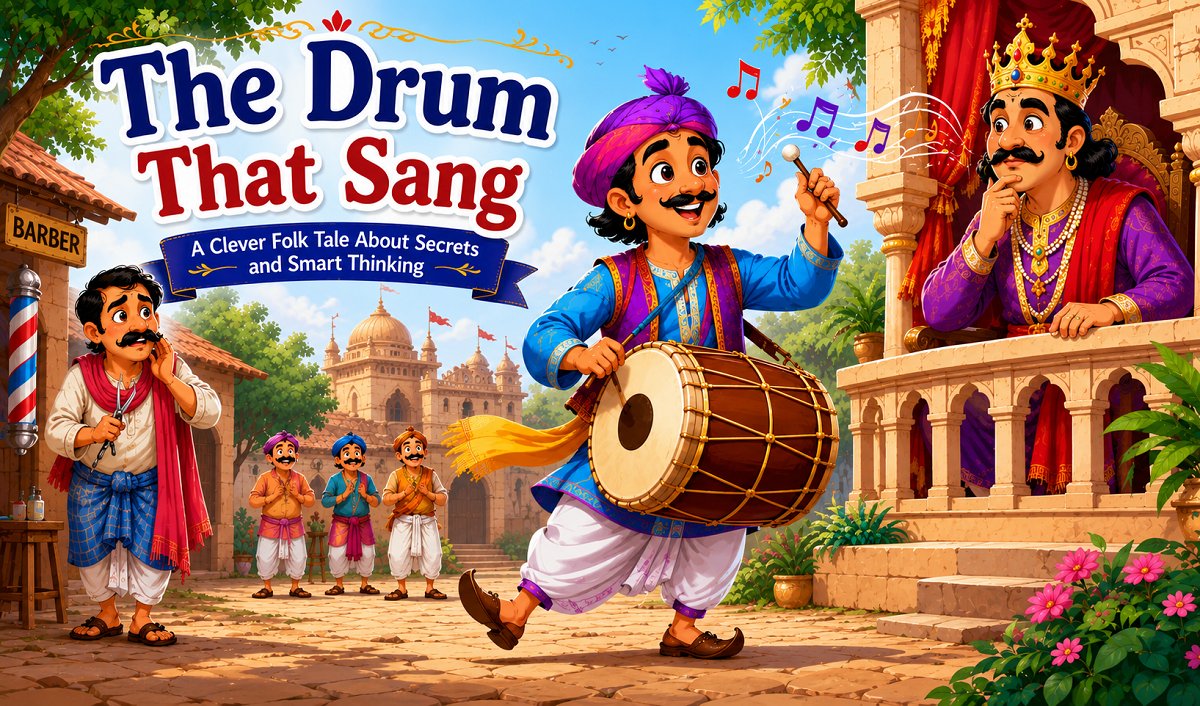
Full Story
Once upon a time, there was a king who had a child with the body of a perfectly normal baby - but the ears of an ox. The king kept his child's ears carefully covered at all times and allowed no one to see or speak of them.
But the day came when the child was to be tonsured - the sacred ceremony in which a young child's head is shaved for the first time. The king grew worried. "The barber will surely notice my child's ox ears. If he spreads the news, people will mock my son!"
So when the barber arrived to shave the child's head, the king drew him aside and said in a low, serious voice, "You must never speak about what you are going to see."
The barber was puzzled but began his work. Then he saw the child's ears and was absolutely stunned. The king repeated firmly, "You must never speak about what you saw." The barber understood now what the king meant. He kept his expression calm and pretended he had seen nothing unusual at all. Before he left, the king added a final warning: "Keep it to yourself - or I will have you hanged."
For several days, the barber kept the secret entirely to himself. But the secret was a strange and enormous thing to carry. His body could not bear the weight of it. His stomach slowly began to swell, growing larger and more uncomfortable with each passing day.
One afternoon, his friend the drummer spotted him shuffling through the street, looking wretched.
"Why is your stomach swollen so, dear friend?" asked the drummer, alarmed.
The barber looked around quickly and then blurted out, "Because I shaved the king's son - and he has the ears of an ox!"
Even as he spoke the words, his stomach began to shrink, returning slowly to its normal size. He sighed deeply with relief. "Ah, what a relief! But please, I beg you - keep it to yourself, or the king will have me executed."
Now the drummer was in a pickle of his own. "If I keep the secret to myself," he thought, "my belly will swell up just like the barber's. But if I tell anyone, the king will surely punish my friend."
He thought carefully. Then a smile crossed his face. He had a plan.
The drummer went out into the streets of the town. He beat his drum loudly and sang out: "The son of the king has the ears of an ox! The son of the king has the ears of an ox!" He danced and drummed and sang it all through the marketplace, and the song spread from ear to ear like a warm breeze.
Soon enough, the song reached the king's own ears. He stormed out of his palace gates, face red with fury.
"How dare you sing that ridiculous song! I will have you hanged - and that barber too, for letting the secret out!"
The drummer stopped, looked up at the king with wide and innocent eyes, and said calmly: "I don't sing, Your Majesty. It is my drum that sings. I have no idea what it says. By the way - which barber are you speaking of? And what secret has been let out?"
The king opened his mouth. Then closed it. The drummer was right: to punish either man, the king would first have to publicly confirm that his son indeed had ox ears. He would be admitting the very thing he had tried so desperately to hide. Every eye in the crowd was watching. The king stomped away furiously, without another word.
The cunning drummer went on singing happily: "The son of the king has the ears of an ox! The son of the king has the ears of an ox!"
And that is how the secretive king was outwitted - not by a soldier or a minister - but by an ordinary man with a clever mind and a drum that sang the truth.
Moral of the Story
Truth cannot be silenced by power or threat. It always finds a voice - sometimes in the most unexpected and clever of places. Wit and resourcefulness can triumph over even the highest authority.
Key Characters
- The King: Proud and fearful, the king tries to suppress the truth about his son through threats and intimidation.
- The Barber: An honest man caught in an impossible situation.
- The Drummer: The story's hero - clever, resourceful, and quick-witted.
- The King's Son: Present at the heart of the story but never speaking.
Why Kids Love This Story
- The swelling stomach - the idea that keeping a secret can literally make you ill is vivid, funny, and strangely believable to children.
- The brilliant trick - kids love the drummer's clever solution, especially how it traps the king in his own web of secrecy.
- The commoner wins - an ordinary drummer outsmarts a powerful king, which children find deeply satisfying.
- The repetitive song - "The son of the king has the ears of an ox!" is the kind of chant children love to repeat and play with.
- The king's wordless defeat - watching the powerful king open his mouth, say nothing, and stomp away is comic gold.
- The deeper truth - older children can appreciate the story's message: that courage and cleverness together are more powerful than authority.
FAQs About the Story
Where does The Drum That Sang folk tale come from?
The Drum That Sang is a traditional folk tale from Bengal - present-day West Bengal, India. Bengali folk literature has a rich tradition of clever commoner stories in which ordinary people such as barbers, drummers, and weavers use quick thinking to outsmart kings and nobles.
Why did the barber's stomach swell up in the story?
The barber's swelling stomach is a folk metaphor for the physical and psychological burden of holding a secret that feels too large and strange to contain. Many Indian folk tales use this device to show that suppressing truth harms the person carrying it. Once the barber spoke the secret aloud, his stomach returned to normal - symbolising the relief of release.
How exactly did the drummer outwit the king?
The drummer sang the secret while beating his drum, then - when the angry king confronted him - claimed that he had said nothing, and that it was the drum singing, not him. To punish the drummer or the barber, the king would first have to publicly confirm that his son did indeed have ox-like ears. That would expose the very secret he was trying to protect, leaving him powerless.
Is this similar to the King Midas story from ancient Greece?
Yes - The Drum That Sang is remarkably similar to the Greek myth of King Midas, whose barber whispered the king's donkey-ear secret into a hole in the ground. Reeds grew there and whispered it to the wind. The Bengali version uses a drum instead of reeds, but the core idea - a secret too dangerous to speak, yet impossible to keep - is the same, suggesting this is a universal human story found across many cultures.
What is the tonsuring ceremony mentioned in the story?
The tonsuring ceremony is called Mundan or Chudakarana in Hindu tradition - a sacred rite of passage in which a young child's head is shaved for the first time, usually between ages one and three. It is considered auspicious. In the story, it is this ceremony that forces the king to call a barber, creating the situation where the royal secret is inadvertently discovered.
What does the story say about power and truth?
The story suggests that power can silence people through fear, but it cannot silence truth itself. The king's threats successfully keep the barber quiet, but truth finds another path - through a drum, through a clever friend, through the streets of the town. Truth, the story teaches, is more persistent and resourceful than power.