
Story Summary
A young girl named Tanaiya lives beside a lake and befriends a mysterious eel. Their daily swims become the most joyful part of her life - until the eel reveals he is Ambu, the God of Eels, and must leave. But first, he offers her a gift unlike any other: the first coconut tree, born from sacrifice and love.
Full Story
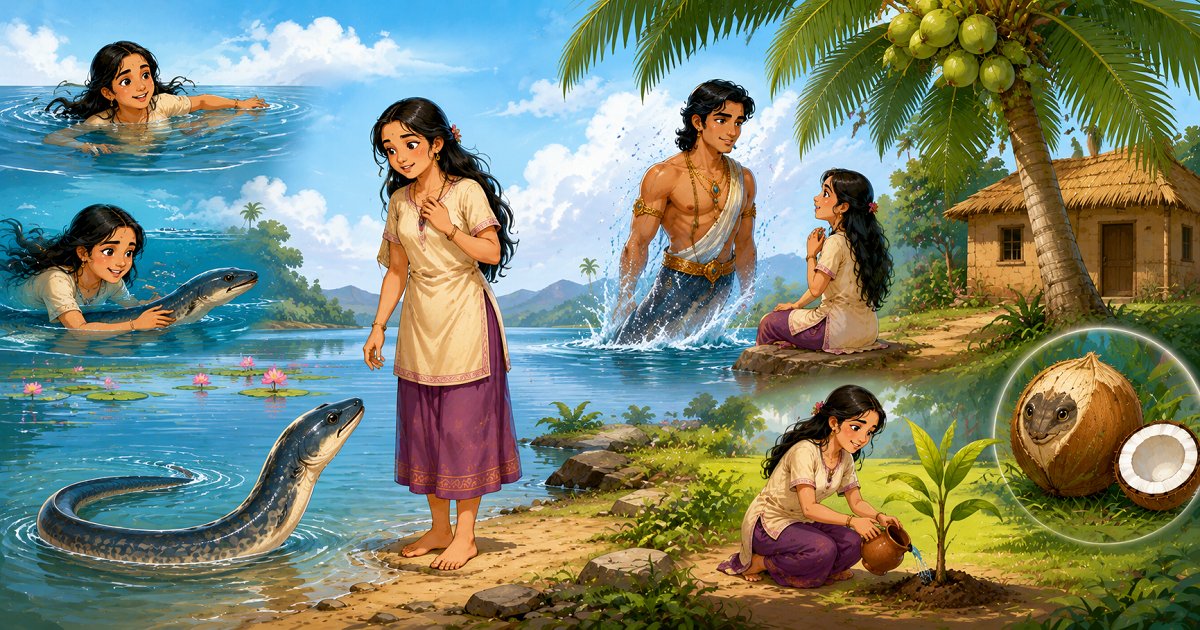
A very long time ago, there was a young girl named Tanaiya. She lived in a small hut by a beautiful lake. Tanaiya loved water and would swim in the lake all day long. "Ah, how lovely!" she would sigh with joy.
One day, while Tanaiya waded into the water, something unusual touched her body. "What was that?" she wondered.
Suddenly, she saw a snake-like creature. But its head was much larger than that of a snake. Though frightened, Tanaiya went closer and observed the creature. It was an eel - a kind of fish.
Tanaiya jumped out of the lake and ran towards her hut. The next day when she went for a swim, the eel was swimming around a rock, as if it was waiting for Tanaiya. As soon as the eel saw Tanaiya, it began to swim faster. Tanaiya was surprised. She swam towards the eel and gently touched it. It was smooth and cold. "What a wonderful creature!" she thought to herself and smiled.
From that day on, it became a regular practice. The eel would be waiting for Tanaiya every morning and both of them would swim side by side for hours together.
Tanaiya would gaze at the wonderful patterns on the eel's body, and before leaving, she would gently pat it.
One day, after a long swim, when Tanaiya came out of the water and sat on the bank, the eel also swam out of the lake. "How can a fish swim out of water… and why?" thought Tanaiya, in wonder.
Suddenly, much to her surprise, the eel transformed itself into a young man! And he was very handsome. She was wonder-struck and could not utter a word.
The young man spoke, "I am Ambu, the God of Eels. I like you very much and would like to remain by your side forever, but the time has come for me to leave you." Hearing this, Tanaiya was deeply troubled. "What? Are you going away?"
"Yes! I have to," replied Ambu, "but before leaving I wish to give you a gift that will always remind you of me. To get that gift you will have to do as I say." Tanaiya agreed.
"Tomorrow I shall come to your hut in the form of an eel. You must cut off my head and bury it near your hut," saying this, Ambu dived into the lake. A shocked Tanaiya returned home.
The next morning, she saw the eel lying at her doorstep, with its head placed upon the threshold. Tanaiya stared at it, surprised. "Why is the eel ready to die?" she wondered. But she had promised to do as the eel said, so she did not hesitate.
The eel looked at Tanaiya as if trying to say, "Do as I said! Please don't hesitate!" Tanaiya gazed at the eel for a while, took a deep breath, raised her axe, and hacked off the eel's head. Then she buried it behind her hut. From that day on, Tanaiya became sad and depressed.
Every day, she would sit near the place where she had buried the eel's head and cry. After a few days, she noticed a sapling growing at the spot. Tanaiya was thrilled! She watered the sapling and nurtured it every day. Soon, it grew into a tall and magnificent coconut tree. It swayed majestically, its long leaves singing the sweetest melody Tanaiya had ever heard. Its sweet, milky water was refreshing and wonderful to taste. Tanaiya was now very happy - she danced around the tree. "Indeed, it's the best gift I could get!" she thought.
It is therefore believed that the coconut palm - every part of which is useful - is a gift from the God of Eels. They say, when the fibrous shell of the fruit is removed, one can see the face and eyes of an eel upon it, as if Ambu is still watching over the one he loved.
Moral of the Story
True friendship is selfless and enduring. Even after we are parted from those we love, the gifts they leave behind - kindness, memories, and the things that grow from our shared grief - continue to nourish us. Like the coconut tree, the best gifts come from the deepest love.
Key Characters
- Tanaiya: A curious, gentle young girl who lives alone by a beautiful lake.
- Ambu: The God of Eels, who takes the form of an eel to experience the world and form a deep friendship with Tanaiya.
- The Coconut Tree: Not just a tree, but a living gift - the final form of Ambu's love for Tanaiya.
Why Kids Love This Story
- A Magical Underwater World - The lake, the eel, and the mystery of the deep water spark a child's imagination about hidden worlds beneath the surface.
- A Shape-Shifting God - Ambu transforming from eel to handsome young man is pure magic - the kind of surprise that makes children gasp and re-read the page.
- Nature Has a Story - After reading this, every coconut becomes a wonder. Children look for the "eel's face" on the shell.
- Friendship Beyond Difference - A girl and a magical fish-god becoming best friends teaches children that true friendship crosses all boundaries.
- Safe Emotional Exploration - The story gently introduces loss and grief, then resolves it with beauty and hope, helping children process big feelings in a safe, story-shaped space.
FAQs About the Story
Where does the folk tale "The Eel and the Coconut Tree" come from?
This story originates from Kerala, a coastal state in southern India. It forms part of the rich oral storytelling tradition of the region, and explains the origin of the coconut palm through a magical tale of friendship between a young girl and the divine God of Eels.
Why does the coconut represent the eel?
According to the folk tale, when the fibrous outer husk of a coconut is removed, the inner nut has two dark eyes and a rounded shape that resembles the face of an eel. This is said to be the face of Ambu still watching over Tanaiya - a beautiful detail that connects the story to the real coconut you can hold in your hands.
What is an eel, and why is it important in Indian mythology?
An eel is a snake-like fish found in rivers, lakes, and the sea. Unlike snakes, eels are fully aquatic and have large heads and smooth, cold skin. In Indian mythology and folk traditions - particularly in Kerala's coastal culture - eels and other water creatures are associated with divine presence and mystery, making them perfect vessels for stories about gods who walk the earth in disguise.