
Story Summary
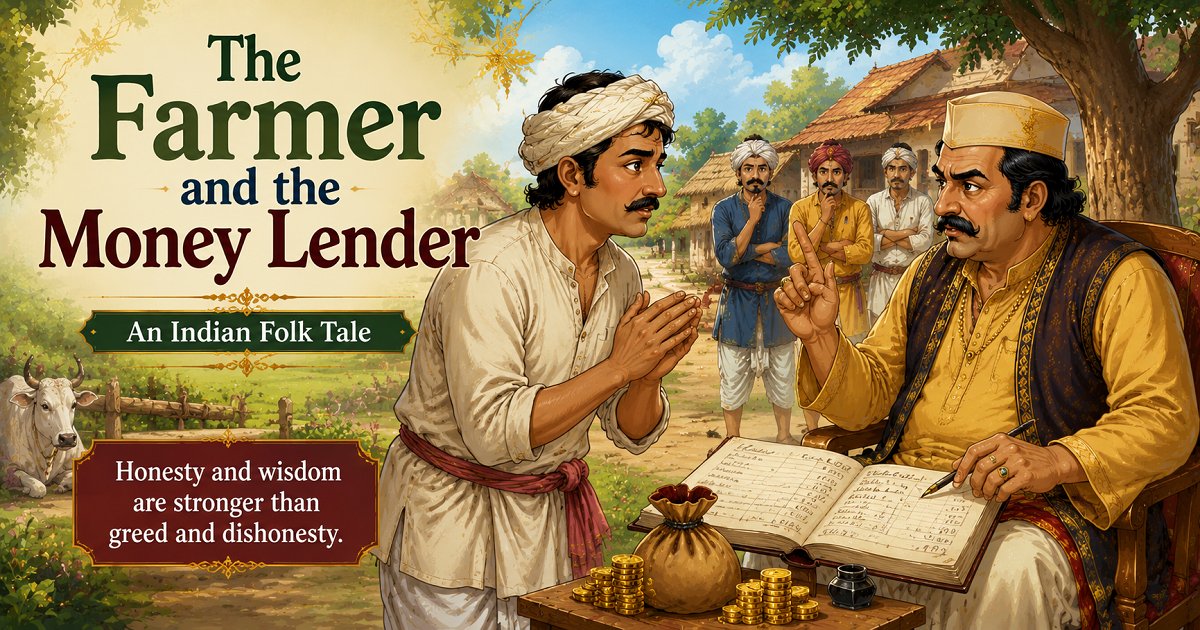
"The Farmer and the Money Lender" is a traditional Indian folk tale about a poor farmer who struggles under the burden of a greedy money lender. Desperate to improve his life, the farmer sets out to seek help from Lord Ram. Because of his kindness and generosity toward others, he receives a magical conch shell that grants wishes. However, the cunning money lender soon discovers the secret and tries to benefit from it for himself.
Through clever thinking and determination, the farmer eventually finds a way to outsmart the money lender. The story highlights the importance of kindness, intelligence, honesty, and justice while showing how greed often leads to one's downfall.
Full Story
Here was once a farmer who suffered much at the hands of a money-lender. Good harvests, or bad, the farmer was always poor, the money-lender rich. At the last, when he hadn't a farthing left, farmer went to the money-lender's house, and said, "You can't squeeze water from a stone, and as you have nothing to get by me now, you might tell me the secret of becoming rich."
"My friend," returned the money-lender, piously, "riches come from Ram—ask him."
"Thank you, I will!" replied the simple farmer; so he prepared three girdle-cakes to last him on the journey, and set out to find Ram.
First he met a Brahman, and to him he gave a cake, asking him to point out the road to Ram; but the Brahman only took the cake and went on his way without a word. Next the farmer met a Jogi or devotee, and to him he gave a cake, without receiving any help in return. At last, he came upon a poor man sitting under a tree, and finding out he was hungry, the kindly farmer gave him his last cake, and sitting down to rest beside him, entered into conversation.
"And where are you going?" asked the poor man, at length.
"Oh, I have a long journey before me, for I am going to find Ram!" replied the farmer. "I don't suppose you could tell me which way to go?"
"Perhaps I can," said the poor man, smiling, "for I am Ram! What do you want of me?"
Then the farmer told the whole story, and Ram, taking pity on him, gave him a conch shell, and showed him how to blow it in a particular way, saying, "Remember! whatever you wish for, you have only to blow the conch that way, and your wish will be fulfilled. Only have a care of that money-lender, for even magic is not proof against their wiles!"
The farmer went back to his village rejoicing. In fact the money-lender noticed his high spirits at once, and said to himself, "Some good fortune must have befallen the stupid fellow, to make him hold his head so jauntily." Therefore he went over to the simple farmer's house, and congratulated him on his good fortune, in such cunning words, pretending to have heard all about it, that before long the farmer found himself telling the whole story—all except the secret of blowing the conch, for, with all his simplicity, the farmer was not quite such a fool as to tell that.
Nevertheless, the money-lender determined to have the conch by hook or by crook, and as he was villain enough not to stick at trifles, he waited for a favourable opportunity and stole the conch.
But, after nearly bursting himself with blowing the conch in every conceivable way, he was obliged to give up the secret as a bad job. However, being determined to succeed he went back to the farmer, and said, coolly, "Look here; I've got your conch, but I can't use it; you haven't got it, so it's clear you can't use it either. Business is at a stand-still unless we make a bargain. Now, I promise to give you back your conch, and never to interfere with your using it, on one condition, which is this,—whatever you get from it, I am to get double."
"Never!" cried the farmer; "that would be the old business all over again!"
"Not at all!" replied the wily money-lender; "you will have your share! Now, don't be a dog in the manger, for if you get all you want, what can it matter to you if I am rich or poor?"
At last, though it went sorely against the grain to be of any benefit to a money-lender, the farmer was forced to yield, and from that time, no matter what he gained by the power of the conch, the money-lender gained double. And the knowledge that this was so preyed upon the farmer's mind day and night, so that he had no satisfaction out of anything.
At last, there came a very dry season,—so dry that the farmer's crops withered for want of rain. Then he blew his conch, and wished for a well to water them, and lo! There was the well, but the money-lender had two!—two beautiful new wells! This was too much for any farmer to stand; and our friend brooded over it, and brooded over it, till at last a bright idea came into his head. He seized the conch, blew it loudly, and cried out, "Oh, Ram! I wish to be blind of one eye!" And so he was, in a twinkling, but the money-lender of course was blind of both, and in trying to steer his way between the two new wells, he fell into one, and was drowned.
Now this true story shows that a farmer once got the better of a money-lender—but only by losing one of his eyes.
Key Characters
- The Farmer: A hardworking and honest man who suffers because of the greed of the money lender. His kindness and generosity eventually earn him Lord Ram's blessing.
- The Money Lender: A greedy and selfish man who constantly profits at the expense of the farmer and tries to exploit the magical conch shell.
- Lord Ram: A divine figure who appears disguised as a poor man and rewards the farmer's kindness with a magical conch shell.
- The Brahman: A traveler who accepts the farmer's food but offers no help in return.
- The Jogi: A wandering devotee who also receives the farmer's generosity but does not assist him.
- The Poor Man: The disguised form of Lord Ram who recognizes the farmer's goodness and rewards him.
Moral of the Story
Kindness, honesty, and wisdom are more powerful than greed. Those who act with fairness and compassion are often rewarded, while greed and selfishness eventually lead to trouble.
Lessons Children Can Learn
- Kindness often brings unexpected rewards.
- Greed can cause people to make poor decisions.
- Intelligence and wisdom can overcome difficult situations.
- Helping others without expecting anything in return is a valuable quality.
- Honesty and fairness build a better life than selfishness and dishonesty.
Reading Comprehension Questions
- Why did the farmer decide to search for Lord Ram?
- What did the farmer give to the Brahman and the Jogi?
- Who was the poor man sitting under the tree?
- What magical gift did Lord Ram give the farmer?
- How did the money lender obtain the conch shell?
- Why was the farmer unhappy even after receiving magical powers?
- What clever wish helped the farmer defeat the money lender?
- What lesson does the story teach about greed?
FAQs About The Farmer and the Money Lender
What is the moral of The Farmer and the Money Lender?
The story teaches that kindness, wisdom, and honesty are stronger than greed and selfishness.
Who helps the farmer in the story?
Lord Ram helps the farmer after appearing in the form of a poor man and rewarding his generosity.
What magical gift does the farmer receive?
The farmer receives a magical conch shell that can grant wishes when blown in a special way.
Why is the money lender punished?
The money lender's greed leads him to exploit the farmer and seek unfair advantages, which ultimately causes his downfall.
Is The Farmer and the Money Lender a traditional Indian folk tale?
Yes. It is a traditional Indian folk tale that has been shared for generations to teach important moral values to children.