
Story Summary
A proud and greedy Raja rules his kingdom with an iron fist. When a poor man's cow wanders into the royal herd, the king refuses to return it - and nobody dares challenge him. In desperation, the man sits weeping by a stream until divine providence sends a clever jackal to his aid. The jackal poses a riddle about three deaths in a forest - from sleepiness, anger, and greed - that stumps the arrogant king. Cornered by his own inability to answer, the king must sign a written promise to restore the cow and pay twenty-five rupees in compensation. Justice arrives not through power, but through wit.
Full Story
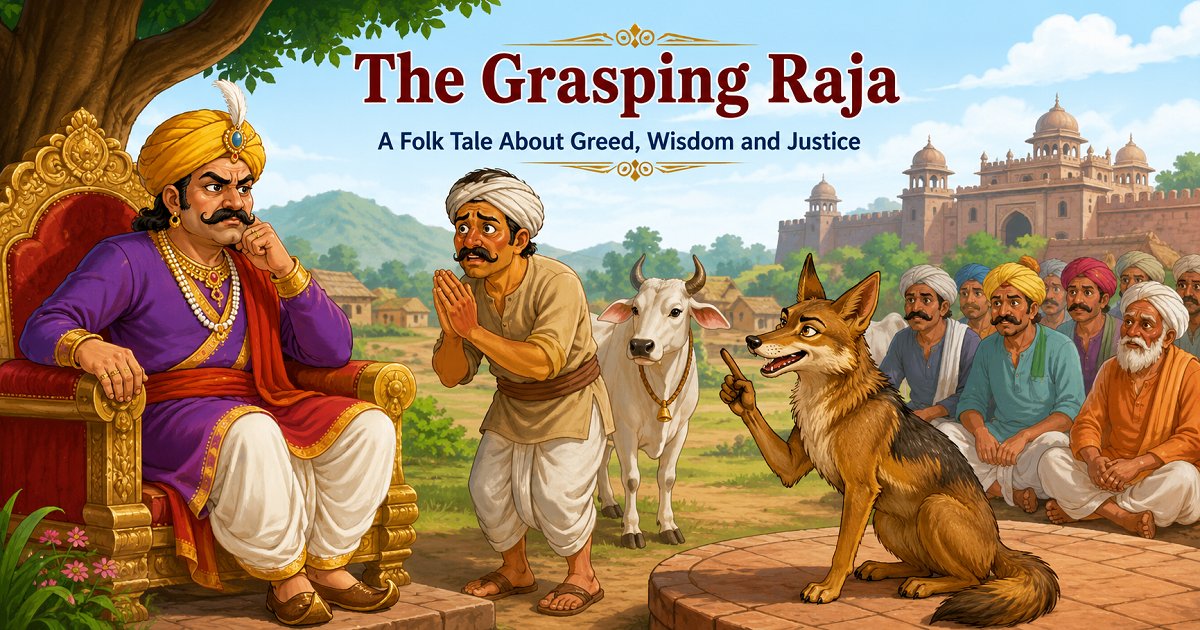
There was once a Raja who was very rich. He was a stern man and overbearing and would brook no contradiction. Not one of his servants or his subjects dared to question his orders; if they did so they got nothing but abuse and blows. He was a grasping man too; if a cow or a goat strayed into his herds he would return the animal if its owner claimed in the same day; but he would not listen to any claim made later. He was so proud that he thought that there was no one in the world wiser than himself.
It happened that a certain man living in the kingdom of this Raja lost a cow; one evening it did not come back to its stall from the grazing-ground; so the next day he set out to search for it and questioned every one he met. He soon got news that a cow like his had been seen in the Raja's herd. So he went to look, and there, among the Raja's cattle, he saw his own cow. He asked the cowherd to let him take it away; but the cowherd refused to do so without a written order from the Raja. So the owner went off to the Raja and claimed his cow; but the Raja would not listen and gave him only abuse and turned him out. Then he went to his friends and asked them to help him but they were afraid to do anything and advised him to regard the cow as lost for good.
So the unfortunate man took his way homeward very unhappily; on the way he sat down by the bank of a stream and began to bewail his loss. As he cried, Thakur took pity on him and sent a jackal to him. The jackal came and asked why he was crying, and when it had heard the story of the loss of the cow, it said "Cheer up! go back to the Raja and tell him that you want a panchayat to settle the matter about the cow; and that you intend to call one whether he agrees to abide by its decision or no. If he agrees, come back quickly to me and I will arrange to get back your cow for you." So off went the owner of the cow to the Raja and told him that he wanted to call a panchayat. The Raja made no objection and bade him call the neighbours together. The poor man did so and then hurried off to the jackal and told it how things had turned out. The jackal returned with him to the outskirts of the city and then sent him to the Raja to say that the panchayat must be held on the plain outside the city-for the jackal was afraid of the dogs in the city.
When the Raja received this message it made him very angry, however he went outside the city and met the panchayat and ordered them to get to business quickly. Then the owner of the cow stood up and told his story and the neighbours who had assembled called to him encouragingly, but the jackal sat in the background and pretended to be asleep. When the tale was finished, the Raja told the people who had assembled to give their decision, but they were all so afraid of the Raja that not one ventured to speak. As they kept silence the Raja turned to the owner of the cow. "Well, where are the people who are going to judge the case? No one here will say a word." "That is my judge," said the man pointing to the jackal. "Why it is fast asleep; what sort of a judge is that?" But just then the jackal shook itself and said. "I have had a most remarkable dream." "There, he has been dreaming, instead of listening to the case." exclaimed the Raja.
"O Raja don't be so scornful" said the jackal, "I am a cleverer judge than you." "You, who are you? I have grown old in judging cases and finding out the truth; and you dare to talk to me like that!" "Well," retorted the jackal, "if you are so clever guess the meaning of my dream; and if you cannot, give the man back his cow; if you can say what it means, I will acknowledge that you are fit to be a Raja. This is what I dreamt.-I saw three die in one place; one from sleepiness; one from anger and one from greed. Tell me what were the three and how did they come to be in one place."
This riddle puzzled every one, but the friends of the man who had lost his cow saw their opportunity and began to call out to the Raja to be quick and give the answer. The Raja made several guesses, but the jackal each time said that he was wrong, and asserted that the real answer would strike every one present as satisfactory. The Raja was completely puzzled and then suggested that there was no coherency in dreams: if the jackal had had some meaningless dream, no one could guess it. "No," said the jackal, "you just now laughed at the idea that any one should come to a panchayat and go to sleep; and what you said was true; I would not really go to sleep on an occasion like this; and I did not really dream. Now show that you are cleverer than I; if you can, you keep the cow."
The Raja thought and thought in vain, and at last asked to be told the answer to the puzzle. First the jackal made him write out a promise to restore the cow and to pay twenty-five rupees to the panchayat; and then it began:-"In a forest lived a wild elephant and every night it wandered about grazing and in the day it returned to its retreat in a certain hill. One dawn as it was on its way back after a night's feeding, it felt so sleepy that it lay down where it was; and it happened that its body blocked the entrance to a hole which was a poisonous snake. When the snake wanted to come out and found the way blocked, it got angry and in its rage bit the elephant and the elephant died then and there. Presently a jackal came prowling by and saw the elephant lying dead; it could not restrain itself from such a feast and choosing a place where the skin was soft began to tear at the flesh. Soon it made such a large hole that it got quite inside the elephant and still went on eating. But when the sun grew strong, the elephant's skin shrunk and closed the hole and the jackal could not get out again and died miserably inside the elephant. The snake too in its hole soon died from want of food and air. So the elephant met its death through sleepiness and the snake through anger and the jackal through greed. This is the answer to the puzzle, but Chando prevented your guessing it, because you unjustly took the poor man's cow and as a lesson to you that he is lord of all, of the poor and weak as well as of Rajas and Princes."
When the jackal concluded all present cried out that the answer was a perfect one; but the Raja said "I don't think much of that; I know a lot of stories like that myself." However he had to give back the cow and pay twenty-five rupees to the panchayat. In gratitude to the jackal the owner of the cow bought a goat and gave it to the jackal and then the jackal went away and was seen no more.
Key Characters
- The Grasping Raja: The Greedy King
- Chando (The Cow's Owner): The Common Man
- The Clever Jackal: Divine Trickster & Judge
- The Village Neighbours: The Silent Majority
Moral of the Story
Greed, anger, and complacency each carry the seeds of their own destruction. A wise and just approach to life - embodied here not in a king, but in a humble jackal - will always prevail. And no matter how powerful the oppressor, justice has a way of arriving when the innocent refuse to give up.
Why Kids Love This Story
- The puzzle of three deaths sits at the story's heart. Kids love trying to solve it before the answer is revealed.
- The jackal is charming, sneaky, and brilliant - a classic trickster figure that children adore across all cultures.
- There's universal joy in watching a bully king fail and a small man win. The underdog triumph is deeply satisfying.
- Making the king sign a promise before revealing the answer is a stroke of genius kids instantly recognise and admire.
- The panchayat, Thakur, village life - the setting is vivid, culturally rich, and opens a window into India's past.
- Greed, anger, and laziness as three paths to ruin is a lesson that sticks - without ever feeling preachy.
FAQs About the Story
What is a panchayat, and why is it important in this story?
A panchayat is a traditional village council in India - a gathering of community members who come together to resolve disputes. In the story, calling a panchayat is the legal mechanism that gives Chando legitimate standing to challenge the king publicly. The fact that even the Raja cannot simply refuse a panchayat shows that ancient Indian democratic traditions could check even royal power.
Why did the jackal make the Raja sign a promise before answering?
The jackal understood that a powerful king could simply ignore the answer and keep the cow without consequence. By securing a written promise first - while the king was desperate to hear the answer - the jackal made the agreement legally binding and publicly witnessed. It was a brilliant piece of tactical thinking: use the king's own pride and curiosity as leverage before he realised he was trapped.
Is this story similar to the Panchatantra or Jataka Tales?
Yes - "The Grasping Raja" shares several features with both traditions. Like Panchatantra tales, it uses an animal character to embody wisdom and teach moral lessons to humans. Like certain Jataka Tales, it involves a divine or providential figure (here the jackal sent by Thakur) who intervenes to ensure justice for the humble and honest. The riddle-within-a-story structure also echoes the Betal Pachisi tradition.