
Story Summary
A famously stingy merchant in the town of Bonga needs to transport goods through a dangerous, robber-filled forest. Too miserly to pay a competent helper, he hires Kaloo - the lovable town simpleton - for a pittance. When robbers strike, Kaloo's blundering innocence exposes the merchant and he loses everything. The twist: even after the robbers are caught and the goods recovered, the king keeps them as unpaid tax. The merchant's greed costs him twice over.
Full Story
There once was a rich merchant in the town of Bonga. He was so miserly that nobody liked him. He never paid his taxes, and he hoarded every paisa he earned. "Why spend a single coin more than I must?" he would mutter as he counted his money by lamplight each night.
One day, the merchant needed to transport a cartload of goods to a town beyond the forest. The forest was notorious - robbers lurked in its shadows, and wild animals prowled its paths after dark. The merchant knew he needed a helper. "What a nuisance! I suppose I will have to hire someone - but I shall pay no more than ten rupees," he decided firmly.
He went to the market and made his offer. The first man he approached shook his head. "I cannot take such a risk for only ten rupees!" he said flatly. The next man demanded a hundred. "This is no easy journey. You must pay accordingly," he insisted. The merchant was disgusted.
He went from one man to the next, but everyone turned him away. "This town is full of wastrels! So money-minded! No one wants to do an honest day's work!" he fumed - not seeing the rich irony in those words.
Then a cheerful voice spoke up from nearby. "I can take you, sir! I don't mind working for ten rupees!" It was Kaloo - the town simpleton, known and loved for his good heart and his complete lack of common sense.
The merchant looked him over doubtfully. "This man is a fool. How can I hire him?" But there was no alternative: it was either Kaloo and ten rupees, or a capable man and a hundred. The merchant gritted his teeth and agreed.
Kaloo cheerfully demanded his ten rupees in advance. The miser paid, wincing, and the two set off through the forest in a cart piled with goods.
They had not gone far when they heard the snap and shuffle of footsteps in the trees.
"It must be robbers!" whispered Kaloo.
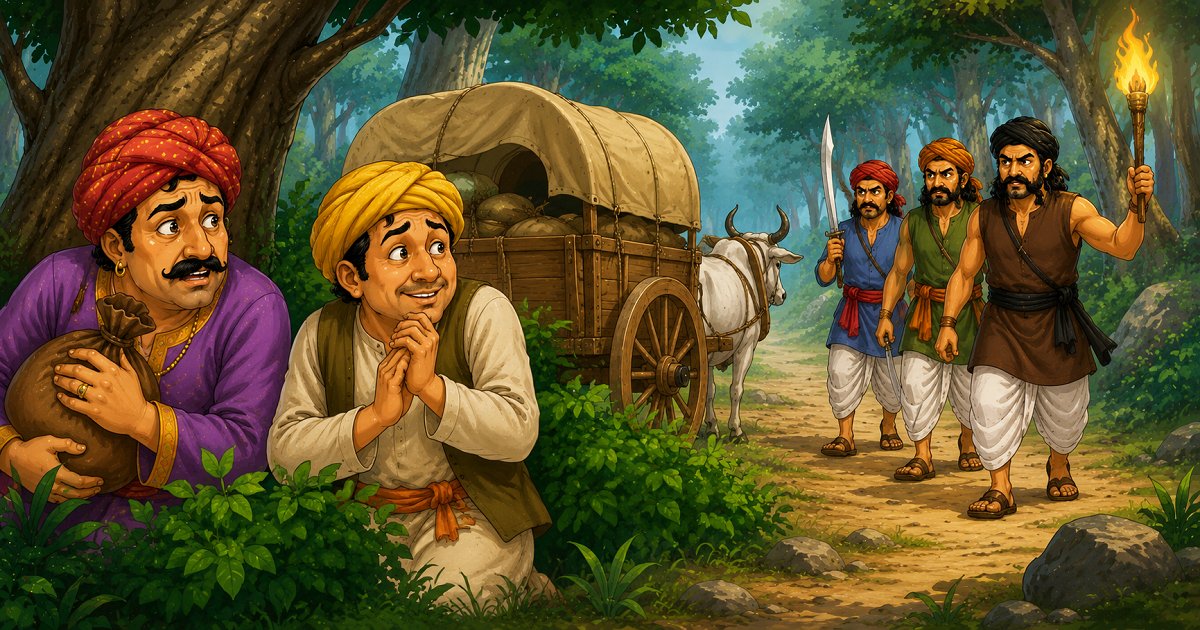
Hurriedly, the two men dragged the cart behind a cluster of trees. The merchant crouched behind one bush; Kaloo squeezed behind another. They held their breath as the voices grew closer.
Then - disaster. One of the robbers stumbled directly over Kaloo's outstretched leg. Dusting himself off, the robber muttered, "Must have been a tree root!"
Kaloo, deeply offended, forgot entirely where he was and what was at stake. "Does my leg look like a tree root to you?" he demanded loudly.
The robbers immediately dragged him out of the bush. "Hand over all your money!" they ordered.
Kaloo shrugged amiably. "I only have ten rupees. You can have it if you like." He handed over the note. Behind his bush, the merchant shook with silent fury.
One robber peered at the note suspiciously. "This looks like a fake note to me!"
Kaloo was immediately indignant. "Of course not! It's perfectly genuine!"
"And how are we supposed to believe you?"
"Ask my master!" Kaloo announced helpfully, pointing straight at the merchant's bush.
The merchant silently cursed every star that had ever shone on Kaloo's birth. Within moments the robbers had found him, dragged him from his hiding place, stripped him of all his money, and discovered the cart loaded with his goods. They took everything and melted back into the forest.
The merchant trudged home in the dark, empty-handed and hollow with regret. "What a fool I was - not Kaloo, but me! I tried to save ninety rupees and lost everything I owned. I should have hired a proper man from the start."
A few days later, good news arrived: the gang of robbers had been caught by the king's soldiers, and all stolen goods had been recovered. A royal messenger arrived at the merchant's door.
"Your goods have been found, sir!" announced the messenger.
The merchant's face lit up. "Wonderful! When can I collect them?"
The messenger's expression did not change. "Well, sir - since you have not paid your taxes for a very long time, the king has decided to retain the goods as payment of your outstanding debt to the kingdom."
The miserly merchant stood in silence for a long moment. Then, for the first time in his life, he understood: every paisa he had saved through dishonesty had cost him ten in return. The lesson had been paid in full - just not by him.
Moral of the Story
The cost of greed is always greater than the cost of fairness.
Key Characters
- The Merchant: Wealthy, miserly, and perpetually calculating - every decision he makes to save money ends up costing him far more.
- Kaloo the Simpleton: Good-natured but blissfully unaware of danger.
- The King: Never seen directly, but delivers the story's final moral
- The Robbers: The instrument of the merchant's first punishment
FAQs About the Story
Who is Kaloo and why is he important to the story?
Kaloo is the town simpleton - a well-meaning, good-natured man who is simply too innocent to function in dangerous situations. He is central to the story because his blundering innocence is the direct consequence of the merchant's greed: the merchant hired him to save money, and Kaloo's obliviousness caused the entire disaster. Kaloo is not a villain; he is the living embodiment of what happens when you prioritise cost over quality.
Why did the king keep the merchant's recovered goods?
The king retained the recovered goods because the merchant had not paid his taxes for a long time. Under the rules of the kingdom, the goods represented the outstanding debt he owed. This is the story's masterstroke: even when fortune tries to give him a second chance, the merchant's years of civic dishonesty close the door on him. He couldn't escape the consequences of his choices even after the robbers were caught.
Where is Bonga, and where does this story come from?
"The Miserly Merchant" is set in Bonga, a town in the folk tradition of Madhya Pradesh, central India. The state has one of India's richest oral storytelling traditions, with tales frequently using ordinary village and market settings to explore themes of greed, community, and natural justice.