
Story Summary
In a small village in Haryana, a habitual swindler spots an easy target: a land-hungry farmer. He concocts an elaborate scheme to sell a fake "silver well" that supposedly produces silver with every bucket drawn. But the farmer's sharp-witted wife smells a rat, a wise village elder devises a foolproof test, and the trickster - caught by his own refusal to put his claims in writing - gets a very different reward than the one he planned.
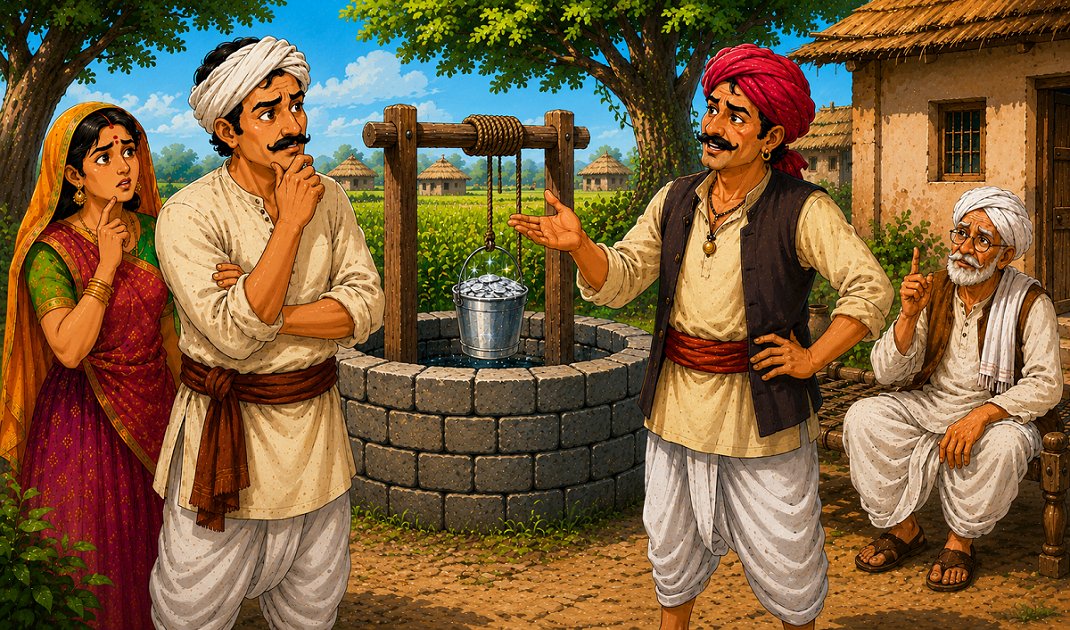
Full Story
There once lived a cunning and crafty man in a small village. He always made money through deceit. "Why should I work when I have the ability to deceive others!" he would think.
One day, the cunning man approached a farmer and said, "I have a huge property that I am not able to take care of. I want to sell some of my land. Would you like to buy it?"
The farmer was in need of land, so he said, "Yes - but first I would like to see it." "Sure!" said the cunning man, and led him to a wide field.
At one end of the field stood a hut and a well. "The hut and well are also for sale," said the cunning man smoothly. "But the well is the most expensive of all."
The farmer was surprised. "What is so special about this well?"
"It's called the 'Silver Well'," came the reply. "There is a great deal of silver down there."
Then the cunning man lowered the bucket - which he had secretly filled with silver beforehand - and pulled it back out gleaming. "See? Every time you draw the bucket, you will get silver! That is why this well commands the highest price."
The farmer's eyes went wide. "If I own this well, all my financial troubles will be over forever!" He asked the price. "The real price is 100 gold coins," said the cunning man, "but for you, dear friend, I shall reduce it to 75."
The farmer thought it sounded like a bargain, and went home to fetch the money - with the cunning man following close behind and waiting eagerly outside.
Inside, however, the farmer's wife was not so easily impressed. "I doubt this story of the 'silver well'," she said firmly. "Before we hand over our entire savings, we must seek the advice of the village wise man."
The farmer agreed. He went back to the cunning man and said politely, "Please give me one day to arrange the money. Come tomorrow morning - I shall have it ready."
Confident the farmer was trapped, the cunning man left in good spirits. That evening, the farmer visited the wise man of the village and explained everything.
"A silver well?" the wise man exclaimed, and then smiled."When the man arrives tomorrow, ask him to give you a written receipt stating that the well belongs to him, that it produces silver, and that he is selling it to you for 75 gold coins. If he is genuine, he will sign without hesitation. If he is a fraud, he will refuse - and then tell him you will only pay 10 gold coins. Watch what happens."
The next morning, the cunning man arrived. The farmer said calmly, "I am ready to buy the silver well. But you must first write on paper that the well is yours, that it produces silver, and that you are selling it to me for 75 gold coins."
The cunning man's smile froze. Written words meant legal proof - and legal proof meant certain punishment. "Err... I am giving you my word, dear friend! Surely that is enough?" he stammered.
"Very well. If you cannot give it to me in writing, I shall pay only 10 gold coins," said the farmer.
"Oh... ah... why yes - sure!" said the cunning man, still glad to get at least something for his trouble.
That was all the farmer needed. He now knew with certainty that the man was a fraud. He grabbed the cunning man and called the strong men of the village. The trickster received a thorough scolding and was firmly escorted out of the village.
Never again did that cunning man dare to deceive anyone.
Moral of the Story
Deceit never pays - and community wisdom always wins.
Key Characters
- The Cunning Man: A habitual swindler who lives by deception.
- The Farmer: Honest, hardworking.
- The Farmer's Wife: The real first line of defence.
- The Wise Elder: The village advisor whose simple, brilliant test dismantles the entire fraud.
Why Kids Love This Story
FAQs About the Story
Where does "The Silver Well" folk tale come from?
"The Silver Well" is a traditional folk tale from Haryana, a northern Indian state with a strong agricultural identity. Stories from the region often feature clever village communities outsmarting self-serving outsiders, and this tale is a perfect example of that tradition.
How did the cunning man fake the silver in the well?
Before visiting the farmer, the cunning man secretly filled the well's bucket with silver he had sourced elsewhere. When the bucket was raised in front of the farmer, it appeared as though the well itself had produced it - a clever but ultimately fragile deception that required no repeat performance.
Why was the written receipt such an effective trap?
A written receipt would serve as legal evidence of the cunning man's claims. If the well turned out not to produce silver, the farmer could use the document to demand justice or compensation. The cunning man knew this and refused - which immediately revealed his dishonesty to the farmer, exactly as the wise elder had predicted.