
Story Summary
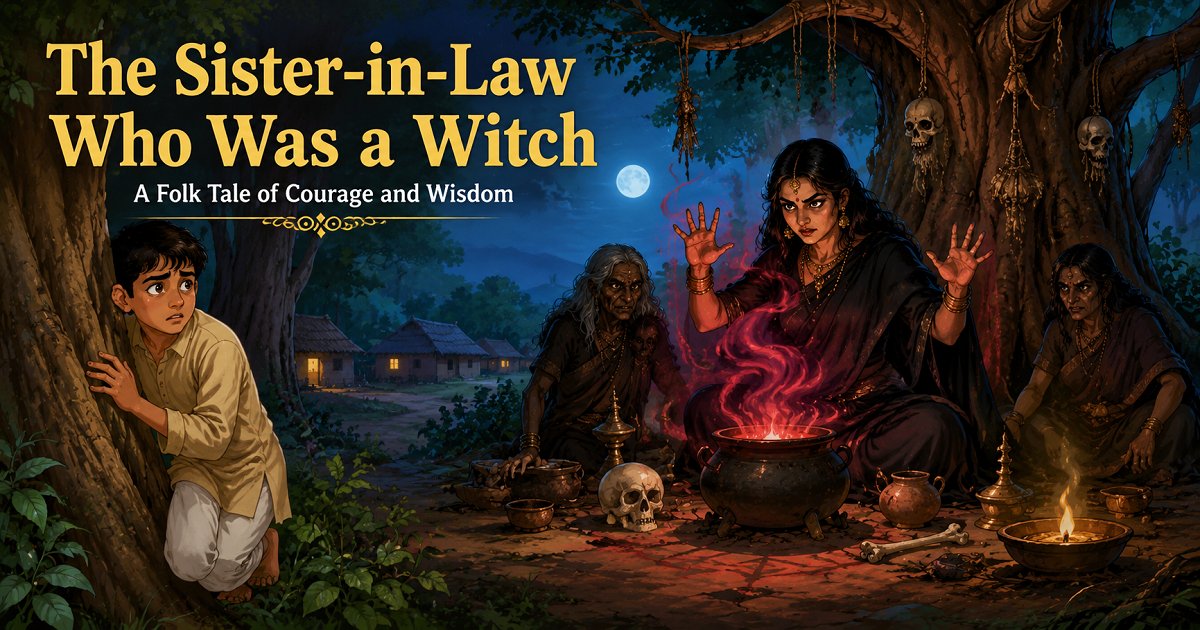
Two brothers live and work together. One day, as a harmless prank, the younger brother hides in a tree to avoid his sister-in-law. From his hiding place he witnesses something terrifying - she strips off her clothes, summons a fearsome forest spirit called Dharmal Chandi from a nearby pool, and demands that the younger brother be killed by a tiger. The younger brother must now warn his elder without being believed before the proof arrives, survive one day of the tiger's stalking, and trust that the brother he loves will choose wisely when the truth is finally told.
Full Story
There were once two brothers who lived together; the elder was married but the younger had no wife. The elder brother used to cultivate their lands and his wife used to draw water and fetch fuel and the younger brother used to take the cattle out to graze. One year when the elder brother was busy in the fields the younger one used to take his cattle to graze near where his brother was working and the wife used to bring out the breakfast for both of them. One day the younger brother thought he would play a trick on his sister-in-law by not answering when she called him to his breakfast; so when her husband had finished his meal and she called out for the younger brother to come he gave no answer; she concluded that the cattle were straying and would not let him come so she took up her basket and went to look for him; but when he saw her coming he climbed up a tree and hid himself and for all her calling gave no answer, but only sat and laughed at her although she came quite close to where he was.
At last the woman got into a passion and putting down the breakfast by the side of a pool which was close to the tree up which her brother-in-law had climbed she stripped off her clothes and began bowing down and calling. "Ho, Dharmal Chandi! come forth!" When he saw this the man was amazed and waited to see whom she was calling, meaning to let her know he was there directly she turned to go away home with the breakfast. But the woman kept on calling to Dharmal Chandi and at last out of the pool appeared an immense bearded bonga with long and matted hair. When the woman saw him her tongue flickered in and out like a snake's and she made a hissing noise, such as a crab makes. Then the woman began "Dharmal Chandi I have a request which you must promise to grant." And when the bonga had promised she proceeded. "You must have my brother-in-law killed by a tiger the day after to-morrow; he has put me to endless trouble making me go shouting after him all through the jungle; I wanted to go back quickly because I have a lot of work at home; he has wasted my time by not answering; so the day after to-morrow you must have him killed." The bonga promised to do what she asked and disappeared into the pool and the woman went home.
While the younger brother was up in the tree his cattle had got into a gundli field and eaten up the crop: and the owner found it out and got the brothers fined. So that evening the elder brother asked him where he had been that he had not looked after the cattle properly nor eaten any breakfast. In answer the younger brother only began to cry; at that his sister-in-law said. "Let him alone; he is crying for want of a wife; he is going silly because we have not married him;" and so nothing more was said. But the elder brother was not satisfied and the next day when they went together to work he asked the younger what was the real reason for his crying.
Then the younger answered. "Brother, I am in great trouble; it makes me cry all day; if you wish ever to look on my face again, you must not work in the fields to-morrow but keep me company while I tend the cattle; if we are separated for a moment a tiger will kill me; it will be quickly over for me but you I know will miss me much and so I am grieving for you; if you have any tenderness for me do not leave me to-morrow but save me from the tiger." His brother asked the reason for this foreboding but the younger man said that he would explain nothing and accuse no one until the events of the next day had shown whether he was speaking the truth; if a tiger really came to stalk him then that would be proof that he had had good reason for his apprehension; and he begged his brother not to speak a word about it to anyone and especially not to his wife.
The elder brother promised to keep the matter a secret and cheered his brother up and told him to be of good heart; they would take their bows and axes and he would like to see the tiger that would touch them. So the next morning the two brothers went off together well armed and tended the cattle in company; nothing happened and at midday they brought the cattle home; when the woman saw them with bows in their hands she asked where they had been. Her husband told her that he had been to look for a hare which he had seen on the previous day but he had not been able to find it. Then his brother said that he had seen a hare in its form that very morning but had not had time to shoot it. So they pretended to arrange to go and hunt this hare and after having eaten their rice they drove out the cattle again.
As they went along they kept close together with their arrows on the string, so that the tiger which came to stalk the younger brother got no opportunity to attack; at last it showed itself at the edge of the jungle; the cattle were thrown into a turmoil and the brothers saw that it was really following them; and the elder brother was convinced that there was some reason for his brother's fears. So they turned the cattle back and cautiously drove them home, keeping a good look out all the way; the tiger prowled round them hiding in the bushes, sometimes in front and sometimes behind, but found no opening to attack while they for their part did not dare to shoot at it. The tiger followed them right up to the house; but the elder brother did not leave the other for a moment nor let him go outside the door and at night he slept on the same bed with him.
The next morning he begged his brother to tell him all that had happened and explain how he knew that a tiger would seek his life on the previous day. "Come then" said the other, "to yonder open ground. I cannot tell you in the house;" so they went out together and then the younger told all that had happened and how his sister-in-law had ordered the Bonga to have him killed by a tiger; "I did not tell you before till my story had been put to the proof for fear that you would not believe me and would tell your wife; but now you know all. I cannot live with you any longer; from this very day I must go and find a home elsewhere." "Not so" said the other, "I will not keep such a woman with me any longer; she is dangerous; I will go home now and put her to death," and so saying he went home and killed his wife with an axe.
Key Characters
- The Younger Brother: A cattle herder
- The Elder Brother: The Loyal Protector
- The Sister-in-Law: The Witch
- Dharmal Chandi (The Bonga): Supernatural Entity
Moral of the Story
Small acts of pettiness - a minor irritation turned into murderous rage - can shatter a family completely. The story also teaches that trust between siblings, earned over a lifetime, is strong enough to survive even the most extraordinary and terrifying truths. And that those who harbour hidden evil do so at great cost: not only to their victims, but ultimately to themselves.
Why Kids Love This Story
- The Bonga rising from the pool is one of Indian folk literature's most vivid spirit encounters - spine-tingling in the best possible way.
- The tiger circling the brothers all day, hiding in bushes, following them home - creates sustained, nail-biting tension that older kids adore.
- Every child knows the feeling of a harmless joke that spirals. The younger brother's prank making him accidentally stumble into dark magic is deeply relatable.
- The elder brother staying by his sibling's side for a whole day with no explanation asked - pure loyalty - is genuinely moving.
- The revelation that a trusted family member is hiding a terrifying power taps into something primal - the uncanny within the domestic.
- Santal villages, cattle grazing, gundli fields, Bonga spirits - the story opens a window into one of India's richest tribal traditions.
FAQs About the Story
What is a Bonga, and is Dharmal Chandi a real figure in Indian mythology?
Bongas are spirits from Santal tribal cosmology - one of the indigenous peoples of eastern India. They are supernatural entities associated with nature, ancestors, and the spiritual world, ranging from household protectors to fearsome forest presences. "Dharmal Chandi" is a specific Bonga name from this oral tradition. Santal religious practice includes rituals to communicate with and appease Bongas, overseen by shamanic figures called ojhas.
Why didn't the younger brother warn his elder brother immediately?
He feared disbelief - and rightly so. Accusing a wife of witchcraft, without proof, risks being dismissed and potentially alerting her that she was seen. His strategy was methodical: secure the elder brother's company for the critical day without explaining why, let the tiger's actual appearance provide undeniable evidence, and only then reveal the full story. It's a subtle and psychologically astute approach that shows the younger brother is far wiser than the opening prank might suggest.
Is this story suitable for children - is it too violent or scary?
The story is best suited for children aged 9 and above. It contains supernatural elements (a spirit summoning, a tongue flickering like a snake's), genuine sustained tension (a tiger stalking the protagonists), and a violent conclusion. These elements are handled in the style of traditional oral folk tales - direct and matter-of-fact rather than gratuitously graphic. It is comparable in tone to darker Grimm fairy tales and can be a valuable discussion starter for older children about the consequences of petty revenge and the importance of trust.