
Story Summary
A proud Thakur borrows money from a Bania and refuses to repay it. When the Bania demands his dues publicly, the furious Thakur ambushes him on a lonely road, sword in hand. But the sharp-minded Bania turns the very document designed to cheat him - a blank receipt signed only by a banyan tree - into proof of the Thakur's crimes before the king. A timeless Rajasthani tale about truth, cunning, and justice catching up with the powerful.
Full Story
Once a Thakur borrowed money from a Bania. "I will pay you back as soon as possible," he promised. Several days passed and the money was not returned. The Bania reminded him often - but to no avail.
One day, the Bania went to the Thakur's house. The Thakur had many guests visiting him that day. "Thakur, please return my money," said the Bania. Embarrassed in front of his guests, the angry Thakur reluctantly agreed to repay the debt the next day.
The next day, when the Bania was walking down a deserted road, the Thakur was already waiting for him. He jumped out suddenly and drew his sword. "No one insults me and gets away with it!" he snarled.

Thinking fast, the Bania said, "I was expecting you to attack me. So I left a letter with my wife stating that you might harm me. If I don't return home, she will take it straight to the Rana!" Not willing to take the risk, the Thakur lowered the sword. "I'll spare your life! But I'll chop off your nose instead - that will teach you a lesson!"
"What if I write off your loan?" said the Bania calmly. "Will you let me go then?" The Thakur thought about this for a moment. "I don't trust you," he said. "You'll have to give me a signed receipt saying I've paid you in full - or else the deal is off!"
"Agreed!" said the Bania, opening his bundle of account books. "But we need a witness!"
"No!" said the Thakur. "Just give me the receipt - no witness needed!"
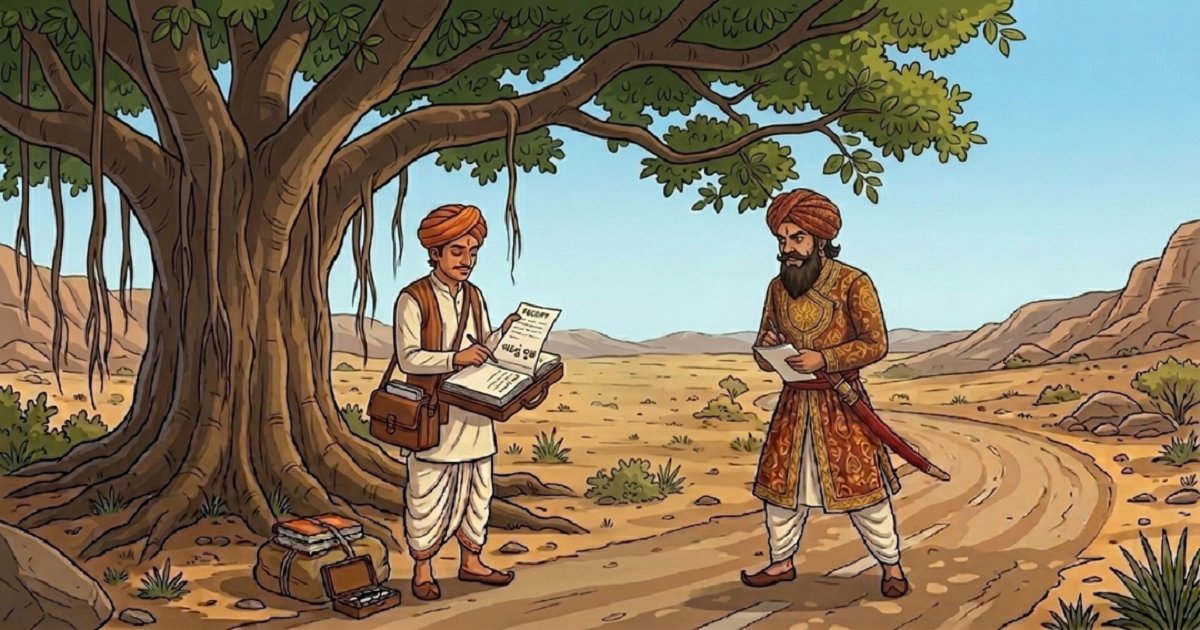
"The receipt is not valid without a witness," said the Bania firmly. He looked around carefully until he spotted something. "How about using the banyan tree as our witness?" he asked.
The Thakur thought this over. The tree can't possibly repeat my threats or complain to anyone. The Bania is trapped! So he agreed. The two men stood beneath the spreading branches. The Bania opened his ledger - and wrote out the receipt.
"Aha! I tricked the Bania so cleverly!" the Thakur rejoiced to himself, pocketing the paper. "Now I never have to pay him back!" He went home a happy man.
The next day, however, he was summoned to the Rana's court. When he arrived, he found the Bania was already there, waiting quietly.
"Do you owe this man some money?" asked the Rana.
"No!" said the Thakur triumphantly, producing the receipt. The Rana studied it carefully.
"So - your witness was a banyan tree?" the Rana said evenly.
"Yes, there was no one else there," said the Thakur, not seeing the trap closing around him.
"Then you admit that you waylaid this man on a deserted road?"
"No - I just happened to bump into him there," the Thakur said, beginning to panic.
"Anyway," said the Rana, his voice now cool and final, "this receipt is useless. It is not signed by the Bania."
The Thakur snatched the receipt back and read it with trembling hands. His face went pale.
The receipt bore only a single signature - that of the witness. Banyan Tree.
Moral of the Story
Greed and dishonesty always carry the seeds of their own destruction. A cool head and a sharp mind are worth more in a crisis than any sword - and those who set traps for others often find themselves inside them.
Key Characters
- The Bania: A merchant and moneylender - patient, soft-spoken, and lethally sharp.
- The Thakur: A proud landowner who considers debt repayment beneath his dignity.
- The Rana: The ruler and dispenser of justice.
- The Banyan Tree: The story's unforgettable silent character. The Thakur chose it as a witness because he thought it could not speak.
Why Kids Love This Story
- The twist is genius. The receipt is right there in the Thakur's hand - and it still destroys him. The realisation hits children and adults alike with equal force.
- The underdog wins without fighting. The Bania has no sword, no army, and no power - only brains. Children instinctively love this.
- Every step is a miniature puzzle. Kids can follow the Bania's reasoning and feel clever for spotting the trap before the ending arrives.
- The villain defeats himself. The Thakur's own greed - insisting on a receipt - is what seals his fate. There is deep satisfaction in watching arrogance fold.
- It teaches real-world reasoning. The Bania's brilliance is not magical - it is logical. This makes the story genuinely inspiring for young readers.
FAQs About the Story
Where does "The Witness" folk tale come from?
The story comes from Rajasthan, a state in northwest India. Rajasthan has an extraordinarily rich oral storytelling tradition, shaped by its warrior culture, feudal history, and the long evenings of desert life when stories were the evening's entertainment. Tales of honour, debt, clever merchants, and just rulers are a recurring thread in Rajasthani folk literature.
Why did the Bania use the banyan tree as a witness?
This was the Bania's masterstroke. He insisted a witness was legally required for the receipt to be valid, and then proposed the banyan tree. The Thakur agreed because he assumed a tree could not speak against him. But the Bania never actually signed the receipt himself - only the "witness" line, which he attributed to the tree. The document therefore proved the Thakur had met the Bania on a deserted road, but proved nothing about repayment, since the Bania - the creditor - had never signed it.
What role does the Rana play in the story?
The Rana is the ruler of the region - the highest authority to whom ordinary people could bring disputes for judgment. His brilliance in the story lies in asking precisely the right questions in the right sequence, letting the Thakur inadvertently confess to the ambush before the trap of the receipt is revealed. He represents the ideal of a just ruler who sees through deception without needing to be told the full truth in advance.