
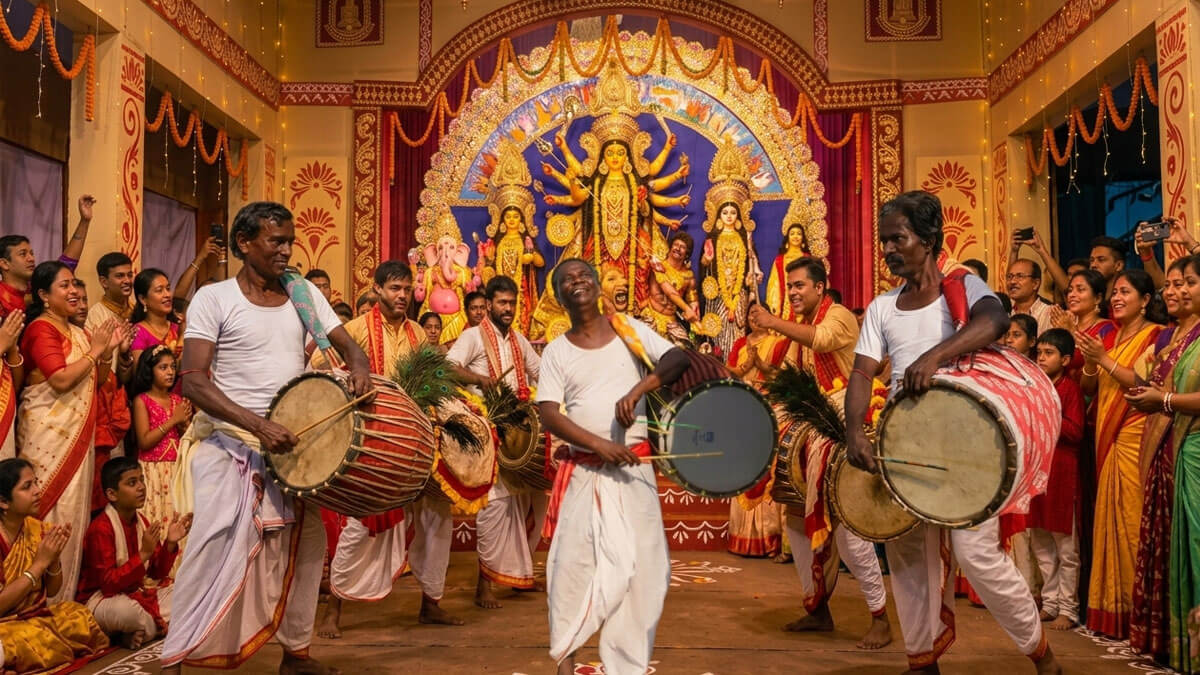
Who are the Dhakis?
A Dhaki is the drummer a puja committee hires for the festival. Many families have played the dhak for generations, with the rhythms handed down from grandfather to father to son, learned by ear and by recited syllables rather than from written notation.
The work is seasonal. For the rest of the year, many Dhakis earn their living from farming, weaving or fishing, and the festival weeks are among the most important earning days of their year.
Where do Dhakis come from?
Most Dhakis come from the rural districts of West Bengal — Murshidabad, Birbhum, Bankura, Bardhaman, Nadia and Malda among them. In the days before Pujo, groups of drummers gather outside Sealdah railway station in Kolkata with their dhaks, waiting for puja committees to come and hire them. That crowd of drummers on the station forecourt is one of the first signs that the festival has arrived in the city.
Many also travel well beyond Bengal, playing for Bengali communities that hold Durga Puja in Delhi, Maharashtra, Assam, Uttar Pradesh and elsewhere.
What is a dhak made of?
The dhak is a big barrel-shaped drum with a body of carved wood, hollowed out inside. Both ends are covered with animal skin — commonly goat skin on one face and calf skin on the other — and the heads are tightened with lacing that sets the pitch. It is played with thin, shaped sticks of cane or bamboo.
A dhak is heavy. The Dhaki usually hangs it from a strap across the shoulder and plays standing, walking and often dancing with it for hours. Many dhaks are decorated with plumes of white feathers on top, which make them easy to spot in a crowded pandal.
A different beat for every ritual
The dhak is not background music. Each stage of the worship has its own rhythm, and anyone who has grown up with Pujo can tell which ritual is under way just by listening.
The beat that accompanies the awakening and welcome of Ma Durga at the start of the festival.
The evening arati rhythm — fast, rising and devotional — is the beat most people associate with Pujo. The Sandhya Arati on Ashtami is considered incomplete without the dhak.
The dhak sets the pace as devotees dance with smoking clay incense burners (dhunuchi) in front of the Goddess.
On Bijoya Dashami the rhythm turns slow and heavy as the idol leaves the pandal for immersion. The same drum that welcomed Ma now says goodbye.
Dhaker Lorai: when drummers compete
Pujo has its own drumming contests, known as Dhaker Lorai. Dhakis face each other and trade rhythms, each one pushing the tempo higher and the footwork wilder, while the crowd cheers them on. Good pandals take pride in hiring a skilled Dhaki, and a strong performance can draw people in from the street.
The Pujo the Dhakis never see
There is a quiet cost to the music. While the rest of Bengal is pandal-hopping, Dhakis are at work, often far from home for the whole festival. Their own families celebrate in the village without them, and many only head home after the last immersion is done.
The craft itself is under pressure too. The income is uncertain, and when trains stopped running during the 2020 lockdown, many drummers could not reach Kolkata at all and some committees switched to recorded beats. Fewer young people now choose to carry the family dhak forward.
Why there is no Pujo without the dhak
A pandal can manage without a famous theme designer or a wall of LED lights, and the worship will still go on. But for most Bengalis, a Durga Puja without the dhak doesn't feel like Pujo at all. The Dhaki calls the Goddess in, keeps time for every ritual, and plays her out on Dashami.
So the next time you are at a pandal, don't just film the Dhaki from a distance. Walk up after the arati and tell him, "Bhalo bajachhen, dada" — "You play beautifully, brother." It costs nothing, and it will stay with you longer than any pandal selfie.
Frequently asked questions
- Who are the Dhakis of Durga Puja?
- Dhakis are the traditional drummers who play the dhak, the large barrel drum of Bengal, at every ritual of Durga Puja. Most come from villages in rural West Bengal and travel to the cities and towns for the festival season.
- Where do most Dhakis come from?
- Most Dhakis come from rural districts of West Bengal such as Murshidabad, Birbhum, Bankura, Bardhaman, Nadia and Malda. Before Pujo, many gather outside Sealdah railway station in Kolkata, where puja committees come to hire them.
- What is a dhak made of?
- A dhak has a hollowed-out wooden barrel for a body with animal-skin heads on both ends, commonly goat skin on one side and calf skin on the other. The heads are tightened with lacing to set the pitch, and the drum is played with thin cane or bamboo sticks.
- Do Dhakis play a different beat for each ritual?
- Yes. Each stage of Durga Puja has its own dhak rhythm, from the Bodhon that welcomes the Goddess, through the evening arati and Dhunuchi Nach, to the slow farewell beat played on Bijoya Dashami for the bisarjan.
- What do Dhakis do for the rest of the year?
- Drumming is seasonal and irregular work, so many Dhakis farm, weave or fish for the rest of the year. The skill is usually passed down within families from one generation to the next.
 CLAT Aspirants
 Durga Puja
 Craft Ideas for Kids
 Benefits of Yoga for Kids
 Fun and Jokes
 Stories for Kids
 School Projects & Homework Help
 Hobbies
