
Story Summary
Phaethon is one of Greek mythology's most dramatic cautionary tales - a story about a half-mortal boy who lets pride override wisdom, with consequences that nearly unmake the world. It has been told and retold for over two thousand years, inspiring poets from Ovid to Milton, and remains one of the most vivid parables about the danger of hubris ever conceived.
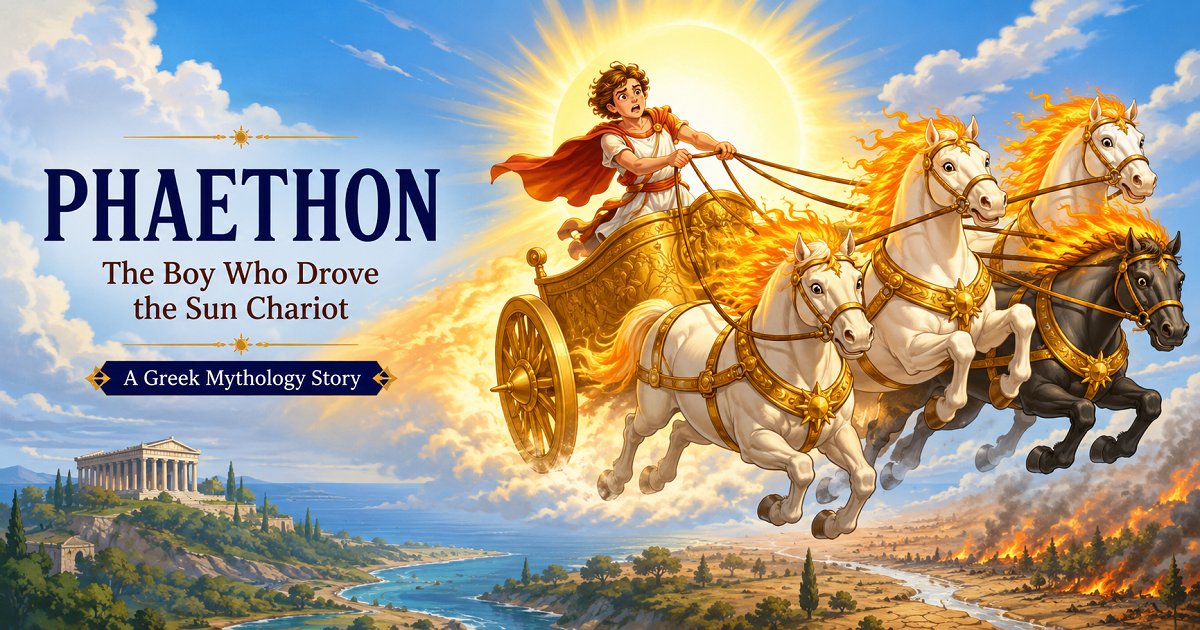
Full Story
Once upon a time, the reckless whim of a lad came near to destroying the Earth and robbing the spheres of their wits.
There were two playmates, said to be of heavenly parentage. One was Epaphus, who claimed Zeus as a father; and one was Phaethon, the earthly child of Phoebus Apollo (or Helios, as some name the sun-god). One day they were boasting together, each of his own father, and Epaphus, angry at the other's fine story, dared him to go prove his kinship with the Sun.
Full of rage and humiliation, Phaethon went to his mother, Clymene, where she sat with his young sisters, the Heliades.
"It is true, my child," she said, "I swear it in the light of yonder Sun. If you have any doubt, go to the land whence he rises at morning and ask of him any gift you will; he is your father, and he cannot refuse you."
As soon as might be, Phaethon set out for the country of sunrise. He journeyed by day and by night far into the east, till he came to the palace of the Sun. It towered high as the clouds, glorious with gold and all manner of gems that looked like frozen fire. The mighty walls were wrought with images of earth and sea and sky. Vulcan, the smith of the Gods, had made them in his workshop - for Mount Aetna is one of his forges, and he has the central fires of the earth to help him fashion gold and iron, as men do glass. On the doors blazed the twelve signs of the Zodiac, in silver that shone like snow in the sunlight. Phaethon was dazzled with the sight, but when he entered the palace hall he could hardly bear the radiance.
In one glimpse through his half-shut eyes, he beheld a glorious being, none other than Phoebus himself, seated upon a throne. He was clothed in purple raiment, and round his head there shone a blinding light, that enveloped even his courtiers upon the right and upon the left - the Seasons with their emblems, Day, Month, Year, and the beautiful young Hours in a row. In one glance of those all-seeing eyes, the sun-god knew his child; but in order to try him he asked the boy his errand.
"O my father," stammered Phaethon, "if you are my father indeed" - and then he took courage; for the god came down from his throne, put off the glorious halo that hurt mortal eyes, and embraced him tenderly.
"Indeed, thou art my son," said he. "Ask any gift of me, and it shall be thine; I call the Styx to witness."
"Ah!" cried Phaethon rapturously. "Let me drive thy chariot for one day!"
For an instant the Sun's looks clouded. "Choose again, my child," said he. "Thou art only a mortal, and this task is mine alone of all the Gods. Not Zeus himself dare drive the chariot of the Sun. The way is full of terrors, both for the horses and for all the stars along the roadside, and for the Earth, who has all blessings from me. Listen, and choose again." And therewith he warned Phaethon of all the dangers that beset the way - the great steep that the steeds must climb, the numbing dizziness of the height, the fierce constellations that breathe out fire, and that descent in the west where the Sun seems to go headlong.
But these counsels only made the reckless boy more eager to win honour of such a high enterprise.
"I will take care; only let me go," he begged.
Now Phoebus had sworn by the black river Styx, an oath that none of the Gods dare break, and he was forced to keep his promise.
Already Aurora, goddess of dawn, had thrown open the gates of the east, and the stars were beginning to wane. The Hours came forth to harness the four horses, and Phaethon looked with exultation at the splendid creatures, whose lord he was for a day. Wild, immortal steeds they were, fed with ambrosia, untamed as the winds; their very pet names signified flame, and all that flame can do - Pyrois, Eous, Aethon, Phlegon.
As the lad stood by watching, Phoebus anointed his face with a philter that should make him strong to endure the terrible heat and light, then set the halo upon his head, with a last word of counsel.
"Follow the road," said he, "and never turn aside. Go not too high or too low, for the sake of heavens and earth; else men and Gods will suffer. The Fates alone know whether evil is to come of this. Yet if your heart fails you, as I hope, abide here and I will make the journey, as I am wont to do."
But Phaethon held to his choice and bade his father farewell. He took his place in the chariot, gathered up the reins, and the horses sprang away, eager for the road.
As they went, they bent their splendid necks to see the meaning of the strange hand upon the reins - the slender weight in the chariot. They turned their wild eyes upon Phaethon, to his secret foreboding, and neighed one to another. This was no master charioteer, but a mere lad, a feather riding the wind. It was holiday for the horses of the Sun, and away they went.
Grasping the reins that dragged him after, like an enemy, Phaethon looked down from the fearful ascent and saw the Earth far beneath him, dim and fair. He was blind with dizziness and bewilderment. His hold slackened and the horses redoubled their speed, wild with new liberty. They left the old tracks. Before he knew where he was, they had startled the constellations and well-nigh grazed the Serpent, so that it woke from its torpor and hissed.
The steeds took fright. This way and that they went, terrified by the monsters they had never encountered before, shaking out of their silver quiet the cool stars towards the north, then fleeing as far to the south among new wonders. The heavens were full of terror.
Up, far above the clouds, they went, and down again, towards the defenceless Earth, that could not flee from the chariot of the Sun. Great rivers hid themselves in the ground, and mountains were consumed. Harvests perished like a moth that is singed in a candle-flame.
In vain did Phaethon call to the horses and pull upon the reins. As in a hideous dream, he saw his own Earth, his beautiful home and the home of all men, his kindred, parched by the fires of this mad chariot, and blackening beneath him. The ground cracked open and the sea shrank. Heedless water-nymphs, who had lingered in the shallows, were left gasping like bright fishes. The dryads shrank, and tried to cover themselves from the scorching heat. The poor Earth lifted her withered face in a last prayer to Zeus to save her if he might.
Then Zeus, calling all the Gods to witness that there was no other means of safety, hurled his thunderbolt; and Phaethon knew no more.
His body fell through the heavens, aflame like a shooting star; and the horses of the Sun dashed homeward with the empty chariot.
Poor Clymene grieved sore over the boy's death; but the young Heliades, daughters of the Sun, refused all comfort. Day and night they wept together about their brother's grave by the river, until the Gods took pity and changed them all into poplar-trees. And ever after that they wept sweet tears of amber, clear as sunlight.
Moral of the Story
The myth is one of antiquity's great parables about hubris - the dangerous overconfidence that leads mortals to overreach their limits. It teaches that ambition without skill is catastrophic, that pride can blind us to wise counsel, and that some gifts should be refused even when freely offered. Helios himself begged Phaethon to choose differently; the tragedy lies in the fact that he would not listen.
Key Characters
- Phaethon: The half-mortal son of Helios and the mortal Clymene.
- Helios (Phoebus Apollo): The sun-god and Phaethon's divine father.
- Clymene: Phaethon's mortal mother, who swears the truth of his parentage by the sun's own light.
- Epaphus: Phaethon's boastful companion, son of Zeus.
- Zeus: King of the gods and reluctant executioner.
- The Heliades: Phaethon's sisters, daughters of the sun.
- The Four Horses: Pyrois, Eous, Aethon, and Phlegon - immortal creatures of fire whose very names mean flame, dawn, blaze, and burning.
- Aurora: Goddess of the dawn, who opens the eastern gates each morning.
Why Kids Love This Story
- An unforgettable image. A boy driving the sun across the sky in a chariot of fire is one of the most spectacular pictures in all of world mythology. It stays in the imagination long after the story ends.
- Real stakes. This is not a small adventure - Phaethon nearly scorches the entire Earth. The cosmic scale of the consequences makes the story genuinely thrilling.
- A relatable hero. Phaethon just wants to be believed. His hurt pride, his need to prove himself, his excitement - children recognise every one of these feelings immediately.
- Mythology that explains the world. The Heliades weeping amber ties the story to a real, touchable substance - one of the ancient world's most magical materials. It makes the myth feel real.
- A father's impossible dilemma. Helios knows granting the wish will end in disaster, yet he cannot refuse his son. Older children in particular feel the depth of this parental tragedy.
- A lesson that doesn't preach. The moral - that ambition without skill is dangerous - arrives through pure drama, not lectures. Children absorb it naturally through the story's events.
FAQs About the Story
Who is Phaethon in Greek mythology?
Phaethon is the son of Helios (the Greek sun-god) and the mortal woman Clymene. His name means "the shining one" in Ancient Greek. He is best known for the myth in which he drives his father's sun chariot and nearly destroys the Earth - one of the most dramatic cautionary tales in all of classical mythology.
Why did Phaethon want to drive the sun's chariot?
His playmate Epaphus mocked him and doubted that Helios was truly his father. Stung by this humiliation, Phaethon journeyed to the palace of the Sun to prove his divine parentage. When Helios confirmed the truth and offered him any gift, Phaethon chose the sun chariot - driven not by wisdom, but by a burning desire for glory and vindication.
What happened when Phaethon drove the sun chariot?
The four immortal horses - Pyrois, Eous, Aethon, and Phlegon - sensed immediately that this was no master charioteer. They bolted off-course, first soaring too high and freezing the earth, then plunging too low and scorching mountains, boiling rivers, and burning entire lands to desert. Zeus was forced to strike Phaethon down with a thunderbolt before the whole Earth was consumed.