
Story Summary
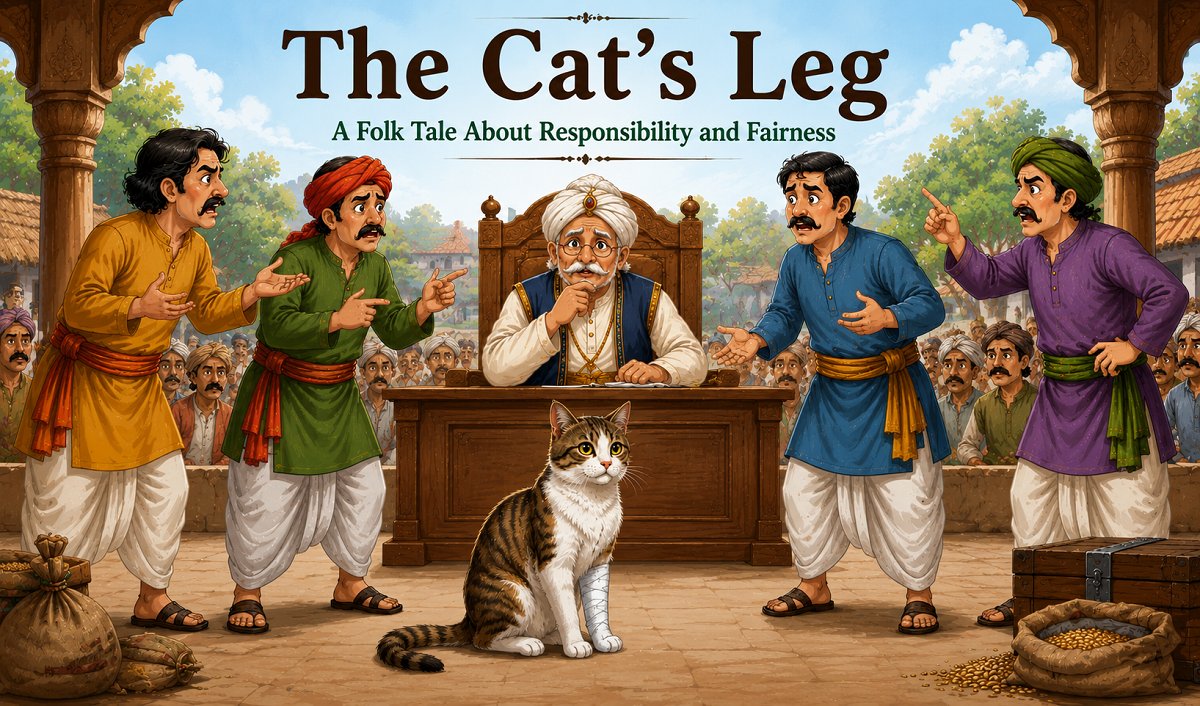
Four grain traders buy a cat to protect their shop from rats. They divide responsibility by assigning each partner one of the cat's four legs. When a bandaged leg catches fire and burns down the shop, they accuse the partner responsible for that leg - but a wise magistrate flips the argument entirely, exposing the true culprits: the three healthy legs that carried the cat through the flames.
Full Story
There once lived four traders who jointly owned a large grain shop. Year after year their business flourished, and each season brought a comfortable profit. Until one year, rats crept into the storeroom and rampaged through the sacks, destroying almost a quarter of the grain.
"This is a calamity!" cried one of the traders. "We must do something." Another suggested buying a cat to keep in the shop. The other three agreed instantly, and before long a fine cat had been purchased. They fed her milk and fish, gave her warmth and care, and she rewarded them by clearing the storeroom of every last rat in just a single night.
The next morning the four traders arrived to find the storeroom neat and tidy, every sack intact. They were delighted. They decided to keep the cat as a permanent guard. One of them said: "As the cat has four legs, let each of us take responsibility for one leg. That way we all care for the cat equally." The idea was agreed upon, and each partner claimed ownership of one leg.
Some weeks later, the cat injured one of her legs. The trader responsible for that leg promptly cleaned the wound and wrapped it in a careful bandage. "You'll be fine soon, dear," he told the cat, patting her gently. And indeed she recovered.
One night, as the cat prowled the storeroom, she brushed too close to an oil lamp and knocked it over. The glass cover shattered on the stone floor, and the flame leapt to the cat's bandaged leg. Crying out in panic, she ran wildly through the storeroom, rubbing her blazing bandage against one sack, then another, then another. One by one the sacks caught fire, and by morning the entire shop lay in ashes.
The four traders were devastated. When they pieced together what had happened, three of them turned on the fourth - the one who had bandaged the leg - and demanded he compensate them for the loss. "It was your bandage that caught fire and destroyed everything! You must pay for it all!"
The matter was brought before the local Magistrate, a thoughtful elderly man with a reputation for careful judgment. He listened to the whole story without interruption. Then he was quiet for a long moment.
"It is true," the Magistrate said at last, "that the bandaged leg caught fire. But the bandaged leg did not burn your shop down." He paused. "How did the fire spread? By the cat running from sack to sack. And what carried the cat? The three sound legs. It was those three legs - the ones belonging to the other three partners - that spread the fire and destroyed the shop. Therefore, the three of you must compensate your fourth partner, not the other way around."
The three partners fell silent. There was no arguing with the logic. They began to apologise and beg forgiveness. The fourth partner, being kind-hearted, asked the Magistrate to show mercy. The wise old man agreed but added: "Let this be a lesson to all four of you. If you entrust an animal to guard your livelihood without thinking through the consequences, such will be the result."
The four partners returned home humbled - and considerably wiser than when they had left.
Key Characters
- The Four Traders: Partners who jointly own a prosperous grain shop.
- The Cat: An efficient rat-catcher who becomes the unwitting centre of a legal dispute.
- The Magistrate: A wise elderly judge
- The Rats: The original problem that sets the whole chain of events in motion.
Moral of the Story
When responsibility is shared, so too are the consequences. Judge a situation by cause and effect - not by whoever is most convenient to blame.
Why Kids Love This Story
- The absurd premise - dividing ownership of a cat's legs - is immediately funny and memorable.
- The dramatic image of a flaming cat running through a storeroom is vividly cinematic and genuinely exciting.
- The magistrate's twist verdict surprises children every time - and makes them want to retell it.
- The story rewards careful listeners: children who pay attention realise the verdict is perfectly logical before it is explained.
- It opens great conversations about fairness, blame, and how we judge situations.
- The kind-heartedness of the fourth trader at the end adds an unexpected warmth to an otherwise sharp tale.
FAQs About the Story
Where does this folk tale come from?
The Cat's Legs is a traditional folk tale from Madhya Pradesh, a state in central India. It belongs to a rich oral storytelling tradition that uses everyday situations - traders, cats, grain shops - to convey moral wisdom to children and adults alike.
What age group is this story suitable for?
The story is suitable for children aged 6 to 12. The narrative is easy to follow and the drama holds young attention, while the underlying moral about fairness and blame makes it valuable for classroom discussion at primary and middle school level.
What lesson does the magistrate's judgment teach?
The judgment teaches that blame must be traced logically to its root cause, not assigned emotionally to the most obvious suspect. It also shows how quick accusations without careful reasoning can produce real injustice - and that wisdom lies in asking "how did things actually unfold?" before pointing fingers.