
Story Summary
Deep in the forests of Vrindavan lives a young lion who looks fearsome but is truly gentle at heart. When he falls in love and plans his wedding, he personally invites animals - hoping the celebration will finally show them his kinder side. Yet on his wedding day, every seat remains empty. Fear, not fact, kept every animal away. The story closes with the crow's wise reflection: we cannot share joy with those we are afraid of - a lesson that teaches children never to judge by appearances alone.
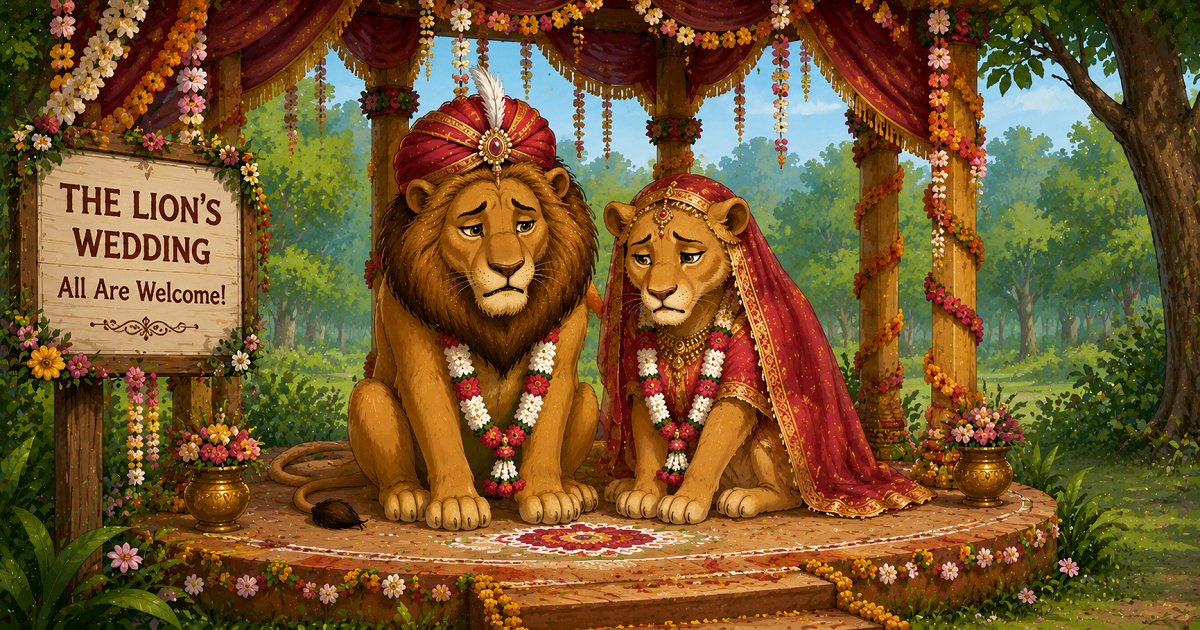
Full Story
Once upon a time, there was a young lion who lived in the forests of Vrindavan. All the animals of Vrindavan were afraid of him, for he was a fierce-looking beast.
Nobody dared go near the lion. "Never get in the way of that lion," the monkeys would instruct their young ones. "Get inside the cave, children - it is time for the lion to go for his evening stroll," the bears would warn their cubs.
In reality, however, the lion only looked fierce. He was very gentle and kind-hearted, and he longed for friendship the way most creatures long for sunlight.
When the lion reached a marriageable age, he decided to look for a suitable match. Within a few days, he arranged his marriage to a beautiful lioness. After consulting the priests, an auspicious date was set. The lion wanted to invite all the animals of Vrindavan. "Maybe this way I can show them that I am not all that bad," thought the lion.
So the lion went through the forest, inviting every animal he met. "You must come to my wedding, dear Elephant," said the lion warmly, "to blow the trumpet!" "Y... Ye... Yes, Sire! D... Definitely!" stammered the elephant nervously. Then the lion turned to the monkey: "You are such a wonderful dancer, dear friend! You must come to my wedding to entertain the gathering!" The monkey nodded and leapt away.
"Please collect some fresh honey for the rituals, dear Bear!" said the lion. "Sure..." said the bear, avoiding the lion's gaze. In this way, the lion invited the crow, the cat, the elephant, the fox, the jackal, the monkey, the bear, the camel, and the giraffe - every creature he met along the forest paths.
But on the day of the wedding, not one of the invited guests arrived at the venue. The lion and his bride waited and waited beneath the decorated bower. The flowers wilted. The music faded. The lion's heart grew very heavy.
Later, one day, the bear asked the elephant, "Why did you not go to the lion's wedding?" The elephant replied, "I am strong, but I still fear the lion." Then he asked the bear in turn. "I could not collect sufficient honey," replied the bear with a guilty shuffle. "The lion would have been upset - he may have even attacked me."
The monkey admitted, "I am so afraid of the lion that I may not have been able to dance a single step - my legs would have trembled!" Then the wise crow spoke up: "True it is, friends! We cannot share our happiness with someone we are afraid of."
And so, because of needless, unfounded fear, not one soul attended the gentle lion's wedding. If only they had known him - if only they had looked beyond his mane and his teeth and his heavy paws - they would have found the kindest heart in all of Vrindavan.
Moral of the Story
Don't judge a book by its cover. Appearances can deceive us and cause us to miss beautiful friendships and joyful moments. True character lies beneath the surface - and fear built on assumption is the loneliest cage of all.
Key Characters
- The Lion: Looks fierce; is gentle, warm, and longs to be accepted by his community.
- The Elephant: Invited to blow the trumpet. Strong yet paralysed by irrational fear.
- The Monkey: A gifted dancer, too afraid to perform. Represents self-doubt born from fear.
- The Bear: Tasked with gathering honey. Makes excuses rather than face his fear.
- The Crow: The story's wise voice. Delivers the story's central truth at the end.
Why Kids Love This Story
- Relatable animals with big personalities. Each animal has a distinct voice and reaction - the stammering elephant, the leaping monkey, the shifty bear - making the story vivid and fun to read aloud.
- A twist on the expected. Children expect the lion to be the villain. Discovering he is actually the kindest character is a genuine surprise that sparks important conversations.
- A clear, powerful moral. "Don't judge a book by its cover" is a concept children encounter early - in school, on the playground, in friendships. This story makes it unforgettable through empathy.
- Cultural richness. Set in the sacred forests of Vrindavan, the story introduces children to the landscape and storytelling traditions of Uttar Pradesh, broadening cultural awareness in a natural, engaging way.
- Emotional depth. The image of a beautifully decorated wedding venue with no guests is genuinely poignant. Children develop empathy by feeling the lion's sadness - an early step in emotional intelligence.
FAQs About the Story
Where does this folk tale come from?
The Lion's Wedding is a traditional folk tale from Uttar Pradesh, one of India's most culturally rich states. It is set in the forests of Vrindavan - a sacred town on the banks of the Yamuna River in Mathura district, famous in Hindu tradition as the childhood home of Lord Krishna.
Why did none of the animals attend?
Every animal was gripped by irrational fear. The elephant feared being attacked despite his own size and strength. The bear was afraid he had not collected enough honey and would be punished. The monkey worried his legs would tremble too much to dance. None of their fears were based on any actual experience of the lion being aggressive - they were all assumptions based on his appearance.
What does the crow represent in the story?
In many Indian folk tales, the crow serves as a symbol of wisdom, observation, and practical intelligence. In The Lion's Wedding, the crow acts as the story's moral compass - the animal who has watched events unfold clearly enough to articulate the core truth: fear blocks joy, and assumptions about appearances deny us real connection.