
Story Summary
A poor woodcutter is resting in the forest when a compassionate Lucky Bird - one of a magical family that brings fortune to humans - lays a golden egg beside him as a gift. A cunning shopkeeper tricks him into trading the priceless egg for a single gold coin and plants greed in his heart by offering five coins if he can capture the bird. The woodcutter catches the Lucky Bird, who reveals the shopkeeper's deception - but is now dying, for Lucky Birds perish if caught by human hands. Consumed by remorse, the woodcutter releases her and follows her final instructions to carry her feather to her family. Her family revives her through a remarkable ritual, and the story closes with the bird's promise: she will return to the woodcutter one day, because kindness is never forgotten.
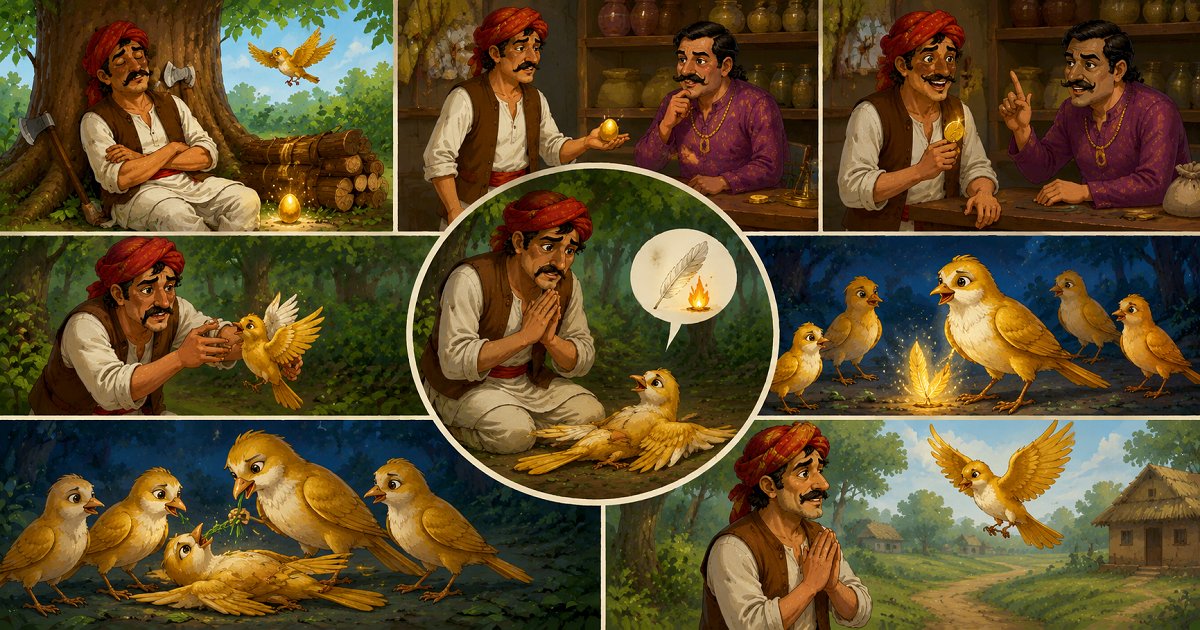
Full Story
There once was a poor woodcutter. One day while working in the forest, he felt tired and sat down under a tree to rest for a while. A little bird flying overhead happened to see the woodcutter and felt sad at his weary, miserable condition. "I must help him," thought the bird, and perched quietly beside him.
As the woodcutter dozed off, the little bird laid a golden egg near him and flew away. When the woodcutter woke up, he was surprised to find the gleaming egg. He quickly picked it up and slipped it safely into his pocket. Then he bundled the logs he had chopped and carried them to the shopkeeper to whom he usually sold his wood.
"Such a small bundle today?" said the shopkeeper. "You bring big bundles every day; it seems you did not work very hard today!" The woodcutter then told him how he had dozed off under the tree and found the golden egg when he woke up. The shopkeeper - a cunning man - immediately recognised the egg's immense value, but kept his face calm and unconcerned. He lured the innocent woodcutter into exchanging the egg for a single gold coin. The woodcutter, knowing nothing of the egg's true worth, accepted.
Then the shopkeeper leaned in and said casually: "If you can bring me the bird that laid the golden egg, I will give you five gold coins." Dazzled by the prospect, the woodcutter promised to try and went home.
The next day, he returned to the same tree and sat down, pretending to sleep. The little bird came again and perched trustingly beside him. Just then, the woodcutter sprang up and caught the bird.
"Now I shall sell you to the shopkeeper for five gold coins!" he said. "But one golden egg is a hundred times more valuable than five gold coins - don't you know that?" cried the bird. "The shopkeeper has made a complete fool of you!"
The woodcutter's heart sank with the weight of his realisation. "I am sorry I got greedy and harmed you," he said, and released the bird from his hands.
But the bird fell to the ground. "My end is near," she said quietly. "I come from the family of Lucky Birds. We bring luck to humans, but we are destined to die if ever caught by human hands." The woodcutter heard this and wept bitterly.
"Is there any way I can help you?" he asked. The bird looked up at him and said: "When I die, pluck a single feather from my wing and hold it to a flame. You will be transported to my home. Give my feather to my family and tell them the truth - every part of it." Saying this, the Lucky Bird breathed her last.
The woodcutter did exactly as he was told. In an instant, he found himself surrounded by the Lucky Bird's family. He showed them the feather and told them his story honestly, hiding nothing. "Oh, we must act fast!" said the Father Bird. He placed the feather carefully on the ground and began to hop around it in a circle. After ten complete rounds, he touched the feather gently. And then - as though the forest itself had exhaled - the Lucky Bird's lifeless body was transported there.
The Mother Bird and the Sister Birds rushed forward, bringing green leaves and a handful of rare grass that had the power to raise the dead. They stuffed them tenderly into the Lucky Bird's beak. In no time at all, the Lucky Bird's eyes fluttered open.
The woodcutter was overcome with relief and joy. The Lucky Bird looked at him steadily and spoke: "Luck appears and disappears - and so do we Lucky Birds. But we do not stay with those who are greedy." The woodcutter hung his head. "I have lost you because of my own foolishness," he said.
"Don't be disheartened, friend," said the Lucky Bird gently. "You helped me when it truly mattered. And so I shall return to you once again. But you will have to wait for that time."
The woodcutter returned home with a heavy heart, but carrying within him the warmth of a promise - and the quiet understanding that the best fortune we can cultivate is the kind that grows from our own honesty and care.
Moral of the Story
Greed drives away good fortune. True luck stays only with those who are grateful, kind, and honest. When we make a mistake, genuine remorse and swift action to make things right can earn us a second chance - but patience is required.
Key Characters
- The Woodcutter: Poor but hardworking. Honest at heart, though momentarily seduced by greed.
- The Lucky Bird: A mystical creature from a family that brings fortune to deserving humans.
- The Shopkeeper: Cunning and exploitative. Recognises the egg's true worth and manipulates the woodcutter for personal gain.
- The Golden Egg: Represents unexpected fortune freely given - and how greed can cause us to trade lasting blessings for small, immediate gains.
Why Kids Love This Story
- Pure magical enchantment. A bird that lays golden eggs, a feather that transports you to another world, and leaves that raise the dead - the story is packed with the kind of magic that fires a child's imagination and makes them want to know what happens next.
- A hero they can relate to. The woodcutter is not a prince or a warrior - he is an ordinary, struggling person who makes an understandable mistake. Children recognise the pull of temptation and find the woodcutter's journey toward redemption genuinely moving.
- A satisfying villain. The shopkeeper is cleverly drawn - not frightening, but recognisably unfair. Children love identifying and discussing his manipulation, which builds critical thinking skills around trust and exploitation.
- Hope in the ending. Unlike many moral tales that punish harshly, this story ends with a promise. The woodcutter is not destroyed by his mistake - he is forgiven and given hope. This balance between accountability and mercy is deeply reassuring for young readers.
- A window into Kashmiri culture. The story's magical elements - the ritual circling of the feather, the life-restoring plants, the concept of Lucky Birds as a family - introduce children to the unique mythological imagination of Kashmir, enriching their sense of India's extraordinary cultural diversity.
FAQs About the Story
Where does The Lucky Bird folk tale come from?
The Lucky Bird is a traditional folk tale from Kashmir, a region in northern India with one of the subcontinent's richest oral storytelling traditions. Kashmiri folk tales often feature magical birds, enchanted forests, and moral lessons delivered through supernatural encounters - elements that reflect the region's unique blend of Hindu, Buddhist, and Sufi cultural influences developed over centuries.
Why did the Lucky Bird die when caught?
The Lucky Bird explains that her entire family carries a fatal destiny: "We bring luck to humans, but we are destined to die if ever caught by human hands." This detail is a classic folk tale device that reinforces the moral - some gifts can only work if they are freely received. The moment greed causes someone to try to possess or control fortune, the gift itself is destroyed. It is a poetic way of expressing that good luck cannot be seized or hoarded; it can only be earned through integrity.
Will the Lucky Bird return to the woodcutter?
The story ends with the Lucky Bird promising: "You have helped me, and so I shall return to you once again. But you will have to wait for that time." The story does not show her return, leaving the ending open and hopeful. This is intentional - it teaches children that the consequences of kindness and integrity are real, even when they are not immediate. Good deeds plant seeds whose flowers we must sometimes be patient to see.