
Story Summary
Two brothers live very different lives: the elder is wealthy, arrogant, and cruel; the younger is poor, kind, and patient. When starvation forces the younger brother to beg his elder for food, the elder sends him - with secret murderous intent - to trade a goat's hoof with a demon in the forest in exchange for the demon's magical millstone. Instead of being killed, the younger brother succeeds through calm courage and earns the millstone, which grants any wish at the command "Grind, my millstone!" and stops at "Enough, the work is done!" The younger brother's family soon lives in abundance. But the elder brother secretly watches, then steals the millstone and rows out to sea to profit from its power. In his greed and excitement, he forgets the command to stop - and as salt fills the boat, it sinks, taking him and the millstone to the seafloor. There, the millstone grinds still, pouring salt endlessly into the ocean - and that, the story tells us, is why the sea is salty.
Full Story
Once, there lived two brothers. The elder was rich, while the younger was poor. The elder was also very selfish and arrogant - a man who had much and shared nothing. But the younger brother was kind-hearted and generous, and bore his hardship without complaint.
One day, the younger brother's wife said softly, "We do not have anything to eat, dear. We have been starving for the past two days. How long can we survive like this? Please go and ask your elder brother for some food." The younger brother knew well that his selfish elder brother would not freely offer him anything, but he had no other way out. So he walked to his elder brother's fine house and pleaded, "Please give me some food, dear brother."
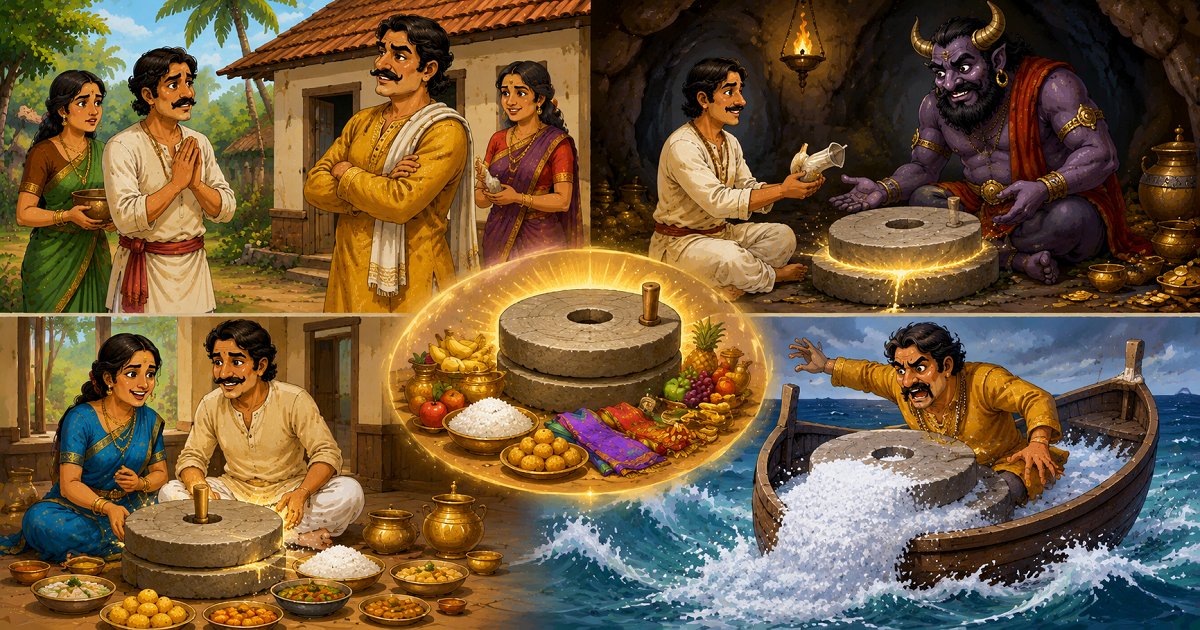
The elder brother whispered to his wife, "Give him the goat's hoof - the one the demon wants." His wife went to the kitchen and brought it out. Giving the hoof to the younger brother, the elder said with a thin smile, "Take this and go to the demon that has the magical millstone in the forest. He will give you food." When the younger brother turned to leave, the elder turned to his wife and murmured, "When he goes to ask for the millstone, the demon is sure to kill him." He smiled and said nothing more.
The younger brother thanked his elder, took the hoof, and began the long, tiring journey into the forest. After walking for many hours, he arrived at the demon's cave. The demon was sitting right at the mouth of the cave - enormous, fierce-looking, and watchful.
The poor brother bowed respectfully and said, "I come from far away, good demon, and I bring you this hoof." The demon was delighted. His eyes lit up. "In return," said the poor brother calmly, "I would like that millstone." "Oh no! I cannot part with that!" cried the demon. "Take silver, or gold, or diamonds! Ask for anything in the world - but not this millstone." "Well," said the poor brother with quiet resolve, "I do not want any of those things. Give me the millstone if you can, or else I shall take my leave." The demon hesitated. The hoof was magical, and he wanted it badly. Finally, he agreed.
"This is a magical millstone," the demon explained carefully. "Make a wish and say: 'Grind, my millstone!' When you have enough and want it to stop, say: 'Enough, the work is done!' Use it wisely." The poor brother thanked the demon with all his heart and carried the millstone home.
"Give me food! Grind, my millstone!" said the younger brother. In an instant, the magical millstone filled the table with many delicious dishes. The couple ate well and joyfully for the first time in days. "Enough, the work is done!" said the younger brother, and the millstone stopped. From that day on, the younger brother and his wife were poor no more. The magical millstone gave them good clothes, wonderful food, and eventually a fine house. Their lives were transformed by the gift that patience and courage had earned them.
One day, the elder brother secretly watched the younger brother command the millstone. His eyes narrowed. Overcome with greed, he waited for his moment and then snatched the millstone away from the younger brother and ran.
He carried it to the beach, put the millstone in a boat, and rowed out to sea, where fishermen were catching fish and preserving them in salt. "Salt will sell very well here," thought the greedy elder brother. He recalled how his younger brother had commanded the millstone and said, "Give me salt! Grind, my millstone!" The millstone immediately began to pour out heaps of fine white salt.
But in his excitement - and his haste - the elder brother had forgotten to ask the younger brother for the stopping command. "Stop, my millstone!" he shouted. But the millstone continued to pour. "Stop! Stop! I said, stop!" Salt piled up around his feet, around his ankles. The boat rode lower and lower in the water. Then, with a great heave, the weight of the salt tipped the boat upside down. The greedy elder brother drowned. The magical millstone sank to the bottom of the sea.
And as for the magical millstone? It is grinding there still, at the very bottom of the ocean - pouring out salt, endlessly, just as it was commanded. Nobody who knows the command to stop it has ever reached it. And that, they say, is why the sea is salty to this day.
Moral of the Story
Kindness, humility, and courage bring lasting prosperity. Greed - especially greed that is impatient, careless, and unkind - destroys those who give in to it. The gifts we earn through integrity tend to last; those we seize through selfishness tend to sink.
Key Characters
- The Younger Brother: Poor but steadfastly kind.
- The Elder Brother: Rich but ruthless.
- The Demon: Keeper of the magical millstone.
- The Magical Millstone: Grants any wish, but only obeys correctly spoken commands.
- The Sea: The final resting place of both the elder brother and the millstone
Why Kids Love This Story
- It answers a real question they've asked. "Why is the sea salty?" is one of the most common questions curious children ask. This story gives them a vivid, memorable - and entirely satisfying - narrative answer that connects wonder about the natural world to ancient storytelling.
- The magical millstone is genuinely exciting. A stone that produces anything you wish for at a simple spoken command is the kind of magic object that captures children's imaginations completely. Many children will spend time thinking about what they would wish for - an irresistible form of creative engagement.
- The contrast between the two brothers is crystal-clear. The younger brother is kind, brave, and responsible; the elder is selfish, scheming, and reckless. This clarity makes it easy for young readers to identify with the protagonist and understand the story's moral without needing adult guidance.
- The consequence is spectacular and unforgettable. The image of a boat sinking under an avalanche of unstoppable salt - and the millstone grinding away on the ocean floor forever - is one of those story endings that lodge in the memory for life. The drama of the elder brother's fate is visceral without being disturbing.
- A glimpse into Kerala's coastal culture. From the forest demon to the salt traders at sea, the story paints a vivid picture of a culture shaped by tropical forests and ocean trade. It naturally introduces children to the geography and way of life of Kerala, one of India's most distinctive regions.
FAQs About the Story
Where does The Magical Millstone folk tale come from?
This version is a traditional folk tale from Kerala, the state on India's southwestern Malabar Coast. Kerala has one of India's richest storytelling traditions, rooted in its ancient seafaring culture and spice trade connections. Remarkably, very similar magical millstone stories - with the same explanation for the salty sea - exist in Norwegian, Japanese, Korean, and other folk traditions, suggesting the story's core idea is one of the most ancient and widely shared in human storytelling.
How does the magical millstone work?
The magical millstone responds to precise spoken commands. To start it, the user states their wish and says: "Grind, my millstone!" The millstone will then produce whatever was wished for in unlimited quantities. To stop it, the user must say: "Enough, the work is done!" The elder brother's downfall is that he seized the millstone without ever learning the stopping command - so when he started it, he had no way to stop it, and the consequences were fatal.
Why is the sea salty according to this story?
When the greedy elder brother's boat capsized under the weight of the salt the magical millstone was producing, the millstone sank to the bottom of the sea. Because nobody ever knew - or could reach it to say - the command to stop it, the millstone is still grinding at the seafloor to this day, pouring salt endlessly into the ocean. This is the story's explanation for why seawater is salty. It is a classic example of an etiological folk tale - a story that explains a natural phenomenon through narrative.