
Christmas in Japan
Merī Kurisumasu: illuminations, Christmas cake, fried chicken and Christmas Eve for two


In Japan, Christmas is a secular season celebrated mainly on Christmas Eve, 24 December, with illuminations, presents, a strawberry-and-cream Christmas cake, fried chicken and, for couples, a romantic dinner, while 25 December remains an ordinary working day. Christians are only about 1 per cent of the population, so for most people Christmas is a cheerful seasonal custom rather than a religious festival. Shops and city streets begin decorating in November, and winter illuminations light up cities across the country. Once Christmas is over, the decorations come down quickly and Japan turns to its real family holiday, the New Year, Shōgatsu.
How Japan celebrates Christmas
Christmas, Kurisumasu, is one of the most visible seasons in Japan, even though very few Japanese are Christian. From early November, department stores, stations and shopping streets put up trees and lights, Christmas songs play in shops, and bakeries take orders for Christmas cakes. The celebration centres on Christmas Eve, Kurisumasu Ibu, rather than Christmas Day.
Christmas is not a public holiday in Japan. On 25 December offices, banks and most businesses work as usual. From 1989 to 2018, 23 December was a national holiday as the birthday of Emperor Akihito, which gave the season a long weekend in some years, but since Emperor Naruhito's accession in May 2019 the Emperor's Birthday has been 23 February. Families with young members often celebrate with a cake, a chicken dinner and presents left by Santa Kurōsu, usually called Santa-san, and as soon as Christmas is over, shops and homes switch to New Year decorations such as kadomatsu pine arrangements.
A short history of Christmas in Japan
The earliest surviving written record of Christmas in Japan comes from Yamaguchi in 1552. Jesuit missionaries led by Cosme de Torres, who had taken over the mission from Francis Xavier, celebrated Christmas in a former Buddhist temple, Daidō-ji, given to the Jesuits by the local lord Ōuchi Yoshitaka. A letter by the missionary Pedro de Alcáçova describes Masses, sermons and readings through the night and a meal shared with the poor. When Christianity was banned in the early 17th century, believers who kept their faith in secret, the kakure kirishitan ("hidden Christians"), had to hide any Christian observance.
Christmas returned after the Meiji Restoration, when freedom of religion was introduced and Japan opened to Western customs. Parties and gift exchanges, influenced by American practice, spread among non-Christians in the early 20th century, after the Russo-Japanese War, and after the Second World War, as cakes and decorations became affordable, Christmas grew into a nationwide season. Today Christians make up roughly 1 per cent of the population or less, and churches hold Christmas Eve services for their congregations and for visitors.
Christmas Eve: a night for couples
For young adults in Japan, Christmas Eve is the most romantic night of the year, closer to Valentine's Day elsewhere than to a family festival. Couples reserve a table at a luxury restaurant, often French, walk through the illuminations and exchange gifts, and many book a hotel room in advance. For those without a partner, singles' events and konkatsu (marriage-hunting) parties are organised for the evening, and their places fill quickly. The Christmas date is often described as the second most popular occasion of the year, after New Year.
Kentucky for Christmas
Japan's most famous Christmas custom is eating Kentucky Fried Chicken. It goes back to Takeshi Okawara, manager of Japan's first KFC, which opened in Nagoya in November 1970. The company says he came up with a Christmas party barrel after hearing a foreign customer say they missed turkey at Christmas, though the story has never been independently confirmed. In 1974 the Christmas party barrel went on sale nationwide, and advertising that linked fried chicken with Christmas turned it into a national habit.
Today Christmas buckets are pre-ordered from early November, and queues form outside branches on 24 and 25 December to collect them. A typical Christmas box contains chicken, a side dish and a small cake, and Christmas reportedly brings in about a third of KFC Japan's annual sales.
Kurisumasu kēki: Japanese Christmas cake
The Japanese Christmas cake is a light sponge layered with whipped cream and topped with bright red strawberries, in the red and white of the Japanese flag. The first Christmas cake in Japan is usually credited to Fujiya, a confectioner founded by Fujii Rinemon in the Motomachi district of Yokohama, which sold a fruit cake with a white glaze in 1910. In 1922 Fujii created a strawberry shortcake inspired by his time in the United States, and from the 1950s, as Japan recovered from the war, the strawberry Christmas cake became affordable and universal.
Bakeries, department stores and convenience stores all sell Christmas cakes, many of them ordered in advance, and they are collected and eaten on 24 or 25 December.
Winter illuminations
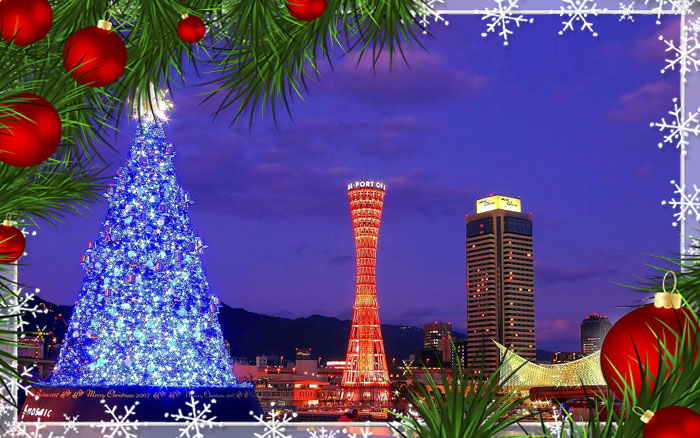
Japan's winter illuminations (iruminēshon) turn streets, parks and theme parks into displays of light; the largest use more than a million LEDs. Many open in November and run through Christmas, and some stay up until February or later. Displays near major stations are popular meeting places on Christmas Eve, and illumination walks are a classic date.
| Place | What to see | Usual season |
|---|---|---|
| Marunouchi, Tokyo | Street trees of the business district near Tokyo Station lit with LEDs | Usually mid-November to mid-February |
| Tokyo Midtown, Roppongi | Midtown Christmas light displays | November to December |
| Kobe Luminarie | Arches of light first held in 1995 in memory of the victims of the Great Hanshin Earthquake | Since 2024 held in late January rather than December |
| Nabana no Sato | Large garden illumination near Nagoya | Usually mid-October to late May |
| Sendai Pageant of Starlight | Avenue trees lit up in central Sendai | December |
| Huis Ten Bosch, Nagasaki | Dutch-style theme park lit up as the Kingdom of Light | Most of the year |
| Midosuji, Osaka | Illuminated street trees along Osaka's main boulevard | Usually early November to 31 December |
Exact dates for 2026–27 are announced by each organiser in the autumn. December also has its own soundtrack: Beethoven's Ninth Symphony, known as Daiku ("the Ninth"), is performed as many as 150 times across Japan at the end of the year, sometimes with choirs of thousands. The symphony was first performed in Japan in 1918 by German prisoners of war at the Bandō camp in Naruto, Tokushima.
Christmas and New Year food in Japan
| Food | What it is | When it is eaten |
|---|---|---|
| Kurisumasu kēki (Christmas cake) | Sponge cake with whipped cream and strawberries | 24 and 25 December; usually pre-ordered |
| Fried chicken | KFC party barrels or roast chicken legs | Christmas Eve and Christmas Day |
| Roast chicken and gratin | A Western-style family Christmas meal | Christmas Eve |
| Toshikoshi soba | Buckwheat noodles for a long life, eaten to "cross over" the year | New Year's Eve (ōmisoka) |
| Osechi ryōri | Boxed New Year dishes, many sweet, sour or dried so they keep for days | 1 to 3 January |
| Kagami mochi | Two round mochi topped with a daidai bitter orange, a New Year decoration | Displayed over New Year |
Shōgatsu: the New Year
If Christmas is for couples and friends, the New Year, Shōgatsu, is for family. Japan has celebrated New Year on 1 January since it adopted the Gregorian calendar in 1873. Government offices close from 29 December to 3 January, many companies take a similar break, and many people travel back to their home towns. Doors are decorated with kadomatsu of pine and bamboo, and a kagami mochi of two round rice cakes is displayed in the home.
On New Year's Eve, ōmisoka, families eat toshikoshi soba, "year-crossing noodles", and watch NHK's long-running song contest Kōhaku Uta Gassen. Around midnight, Buddhist temples ring their great bells 108 times in the ritual of joya no kane, one strike for each of the worldly desires of Buddhist teaching. On New Year's Day, Ganjitsu, a national holiday, families eat osechi ryōri, the young receive otoshidama, money gifts in small decorated envelopes, and people make hatsumōde, the first visit of the year to a shrine or temple, to pray for good fortune.
Nengajō: New Year cards
Japan's equivalent of the Christmas card is the nengajō, the New Year postcard. Japan Post usually starts accepting them on 15 December, and cards posted by about 25 December are delivered on 1 January. Many people now send greetings online as well, and free New Year 2027 e-cards, quote cards and ready-to-send wishes are a quick way to reach friends abroad who will not receive a postcard. The traditional greeting is Akemashite omedetō gozaimasu, "Happy New Year".
Japanese Christmas and New Year dates 2026
| Date | Occasion | What happens |
|---|---|---|
| Nengajō posting usually opens | Japan Post begins accepting New Year cards for 1 January delivery | |
| Christmas Eve (Kurisumasu Ibu) | Couples' dinners, illuminations, cake and fried chicken; church services | |
| Christmas Day | Ordinary working day; recommended last day to post nengajō | |
| Year-end holidays begin | Government offices close until 3 January | |
| Ōmisoka (New Year's Eve) | Toshikoshi soba, Kōhaku Uta Gassen, temple bells at midnight | |
| Ganjitsu (New Year's Day) | National holiday; hatsumōde, osechi and nengajō | |
| End of the New Year holidays | Government offices reopen on 4 January | |
| Emperor's Birthday | National holiday; until 2018 it fell on 23 December |
Video: Christmas in Japan
Christmas in Japan: frequently asked questions
How is Christmas celebrated in Japan?
In Japan, Christmas is a secular, commercial season rather than a religious or family holiday. Cities put up illuminations from November, couples go out for a special dinner on Christmas Eve, and many households eat fried chicken and a strawberry-and-cream Christmas cake on 24 or 25 December. Christmas Day is an ordinary working day, and the main family holiday is the New Year, Shōgatsu.
Is Christmas a public holiday in Japan?
No. Christmas Eve and Christmas Day are ordinary working days in Japan, and in 2026 Christmas Day falls on a Friday. From 1989 to 2018, 23 December was a national holiday because it was Emperor Akihito's birthday, but since Emperor Naruhito's accession in 2019 the Emperor's Birthday has been 23 February. Japan's long winter break comes at New Year, when government offices close from 29 December to 3 January.
Why do Japanese people eat KFC at Christmas?
The custom goes back to KFC Japan's marketing in the 1970s. Takeshi Okawara, manager of Japan's first KFC, which opened in Nagoya in November 1970, is credited with the idea of a Christmas party barrel, and the company's Christmas campaign went nationwide in 1974. Orders open in early November, and Christmas reportedly accounts for about a third of KFC Japan's yearly sales.
What is Japanese Christmas cake?
Japanese Christmas cake, kurisumasu kēki, is usually a light sponge layered and covered with whipped cream and topped with fresh strawberries. The Yokohama confectioner Fujiya sold a Christmas fruit cake in 1910, and its founder Fujii Rinemon created a strawberry shortcake in 1922. The strawberry version became widely available in the 1950s and is now the standard Christmas cake, bought or pre-ordered for 24 and 25 December.
Why is Christmas Eve romantic in Japan?
In Japan, Christmas Eve is a night for couples, more like Valentine's Day in other countries. Couples book dinner at a fine restaurant, walk among the winter illuminations and exchange presents, and hotels and restaurants are often booked well in advance. For families, Christmas is a lighter occasion with cake, fried chicken and presents from Santa.
How many Christians are there in Japan?
Christians are a small minority in Japan, roughly 1 per cent of the population or less, depending on the survey. Most Japanese people who celebrate Christmas do so as a secular, seasonal custom. Churches hold Christmas Eve services, and the earliest recorded Christmas in Japan was a Mass held by Jesuit missionaries in Yamaguchi in 1552.
What do Japanese people do at New Year?
New Year, Shōgatsu, is Japan's most important family holiday. On New Year's Eve, ōmisoka, families eat toshikoshi soba and watch NHK's Kōhaku Uta Gassen, and Buddhist temples ring their bells 108 times at midnight. In the first days of January people make hatsumōde, the first shrine visit of the year, eat osechi ryōri and read the nengajō New Year postcards delivered on 1 January.
How do you say Merry Christmas in Japanese?
Merry Christmas in Japanese is Merī Kurisumasu, written メリークリスマス, borrowed from English. Christmas is Kurisumasu, Christmas Eve is Kurisumasu Ibu, and Santa Claus is Santa Kurōsu, often called Santa-san. Happy New Year is Akemashite omedetō gozaimasu.
Christmas in nearby countries
 CLAT Aspirants
 Diwali
 Thanksgiving
 Christmas
 Craft Ideas for Kids
 Fun and Jokes
 School Projects & Homework Help
 Hobbies

CLAT Preparation for Students
Class 12 Accounts Mock Papers
Thanksgiving Greetings
Chritmas Greeting Cards
Christmas Around the World
New Year 2027
Hanukkah Cards
7 Continents of the World
Moral Stories
Fairy Tales and Fables
Classic Stories
Betal Pachisi
Singhasan Battisi
Indian Mythology stories
School Projects
Quiz on Famous Footballers
Unsolved Mysteries
Pets & Pet Care
Wishes and Greetings in Many Languages