The Geographic Location of North America
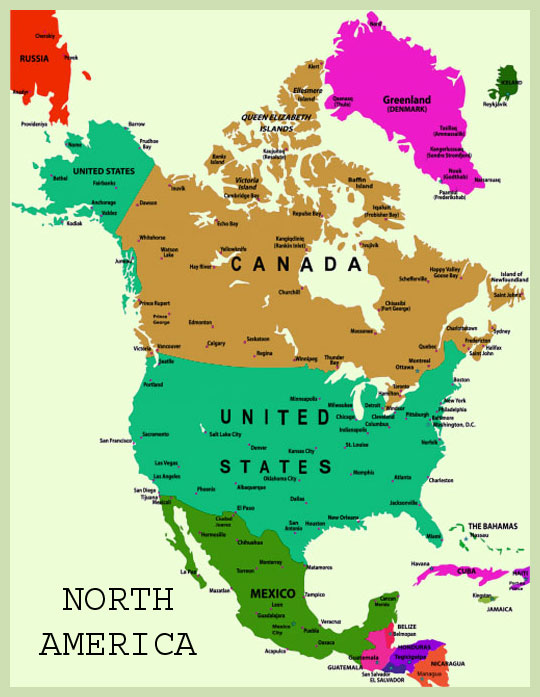
North America is located primarily in the Northern Hemisphere, extending from the Arctic Circle in the north to the Tropic of Cancer in the south. The continent spans more than 5,000 miles (8,000 km) north to south and nearly the same distance east to west.
- Total land area: ~9.36 million sq mi (24.2 million km²)
- Global rank: Third-largest continent after Asia and Africa
On the map, North America resembles a broad triangle, widest along the Arctic Ocean and narrowing toward the Caribbean Sea and the Gulf of Mexico.
Borders and Neighboring Regions
| Direction | Natural Boundary |
|---|---|
| North | Arctic Ocean |
| East | North Atlantic Ocean |
| West | North Pacific Ocean |
| South | Caribbean Sea |
| Northeast | Denmark Strait (between Greenland and Iceland) |
| Northwest | Bering Strait (between Alaska and Siberia) |
| Southwest | Isthmus of Panama (land link to South America) |
The Origin of the Name North America
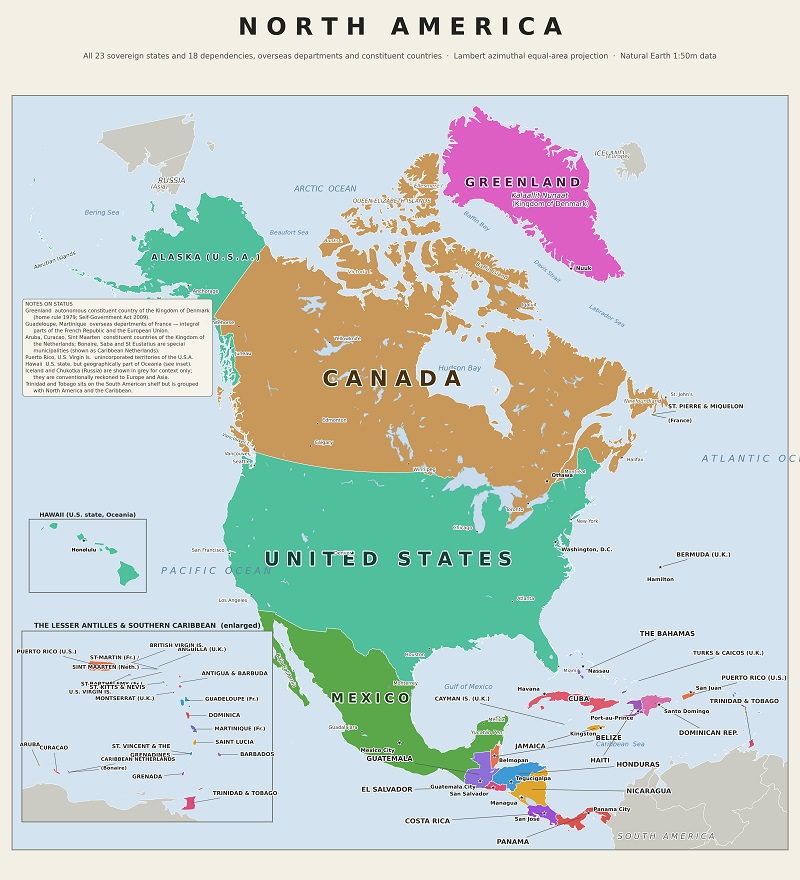
The name America comes from Amerigo Vespucci, the Italian explorer who argued in the early 1500s that the newly encountered lands were not part of Asia, but an entirely new world. Cartographers later adopted the Latinized version of his name.
Over time, the continent was divided into North America and South America, with the Isthmus of Panama serving as the conventional boundary.
The Geological Backbone: The Canadian (Laurentian) Shield
Much of North America rests on the Canadian Shield, also known as the Laurentian Shield. This Precambrian bedrock formation is more than one billion years old and represents one of the most stable geological foundations on Earth.
The shield influences mineral wealth, river patterns, and landforms across Canada and the northern United States.
Natural Resources: North America's Strategic Advantage
| Resource | Why It Matters |
|---|---|
| Minerals | Copper, gold, nickel, uranium, and rare earths power global industries |
| Forests | Vast boreal and temperate forests support biodiversity and carbon storage |
| Freshwater | The Great Lakes hold about 21% of the world's surface freshwater |
| Fertile Soils | Prairies and river deltas rank among the world's most productive farmland |
Population and Peoples
Indigenous Peoples
Humans arrived in North America more than 15,000 years ago, crossing the Bering Land Bridge from Siberia. Indigenous peoples developed rich cultures, languages, and traditions that continue to shape the continent today.
Major Waves of Migration
- European settlers from Britain, France, Spain, and other nations
- African diaspora through the trans-Atlantic slave trade
- Asian immigrants from China, India, Japan, and Southeast Asia
Latin America: Cultural Blending
Latin American populations reflect a blend of Indigenous, European, African, and Asian heritage, especially in Mexico, Central America, and the Caribbean.
The Global Importance
- Geographic diversity: tundra, deserts, mountains, forests, and coastlines
- Economic power: leadership in finance, technology, and manufacturing
- Cultural influence: film, music, science, and innovation
- Environmental impact: climate challenges with global consequences
Quick Facts and Highlights
| Fact | Detail |
|---|---|
| Longest coastline | Approximately 41,000 miles (66,000 km) |
| Highest point | Denali – 20,310 ft (6,190 m) |
| Largest lake | Lake Superior |
| Most spoken languages | English, Spanish, French |
| Population | About 580 million (2024 estimate) |
Conclusion: A Continent of Lasting Influence
North America is more than a geographic region—it is a living intersection of ancient geology, natural abundance, migration, and innovation. Its influence on global culture, economics, and environmental policy continues to shape the modern world.