
Christmas in Albania
Gëzuar Krishtlindjen: a holiday restored after 1990, shared across faiths


In Albania, Christmas, Krishtlindjet, is celebrated on 25 December by Catholic and Orthodox Christians, and it is a public holiday for the whole country, but for many families New Year is the bigger celebration. Religion was banned under communism from 1967 until 1990, and in those years the tree, the presents and the family feast moved to New Year, where many of them have stayed. Today about half of Albanians identify as Muslim, yet Christmas lights, trees and greetings are shared widely, and many families of mixed heritage mark both Christmas and New Year.
How Albania celebrates Christmas
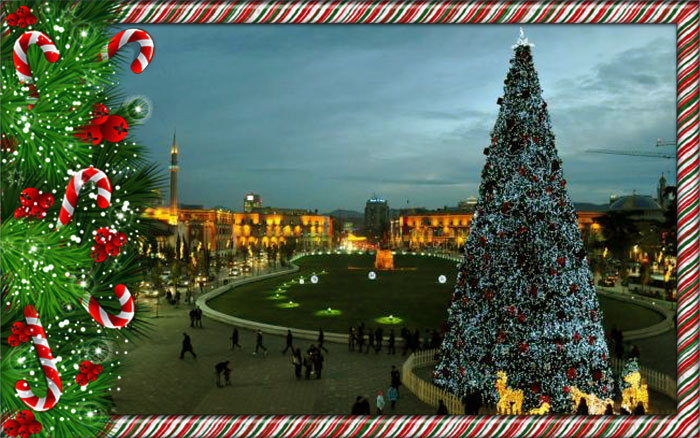
Christmas in Albania is shaped by two facts: the country is religiously mixed, and for more than two decades religion was forbidden altogether. Krishtlindjet, Christmas, is a public holiday on 25 December, when Catholic and Orthodox Christians go to church and families share a festive meal. Towns and cities put up lights and trees in December, shop windows are decorated, and greetings of Gëzuar Krishtlindjen are exchanged well beyond the Christian communities.
For many Albanians, though, the main family celebration of winter is New Year, Viti i Ri, a two-day public holiday on 1 and 2 January. The tree is often called the New Year tree, the big family dinner takes place on New Year's Eve, and the presents come at New Year. The result is a long festive season from late November, when Albania marks its Independence Day and Liberation Day, to the first days of January.
The ban on religion and its legacy
Under the communist leader Enver Hoxha, the communist state set out to eliminate religious life. In 1967 a campaign closed or repurposed every church, mosque and other religious institution in the country, and religious practice was outlawed. The 1976 constitution stated that "the State recognises no religion", making Albania the world's first constitutionally atheist state. Christmas could not be celebrated in public.
The ban on religious observance was lifted in December 1990, as the communist system collapsed, and religious life resumed in earnest from 1991. Churches were reopened or rebuilt: the Albanian Orthodox Church alone has restored or rebuilt more than 250 churches since its revival. Today 25 December is an official public holiday. Yet a generation that grew up without Christmas had transferred its winter festivities to New Year, and for many families New Year has remained the main event.
Catholic and Orthodox Christmas
Catholic Christmas
Albania's Catholics, about 8 per cent of the population in the 2023 census, live mainly in the north, around Shkodër. Catholic parishes celebrate Advent, set up nativity scenes and hold Masses on Christmas Eve and Christmas Day. Shkodër's St Stephen's Cathedral, begun in 1858, was closed in 1967 and turned into a Palace of Sports; it reopened in 1990, with a Mass celebrated there on 11 November 1990, and Pope John Paul II visited it in 1993.
Orthodox Christmas
Orthodox Christians, about 7 per cent of the population, are concentrated in the south and south-east, in cities such as Korçë, as well as in Tirana. Unlike the Serbian or Russian churches, the Orthodox Autocephalous Church of Albania adopted the Revised Julian calendar in 1937, so Albanian Orthodox believers celebrate Christmas on 25 December, the same day as Catholics, not on 7 January. Observant believers keep the traditional Orthodox fast in the weeks before Christmas, eating no meat or dairy, and attend the Nativity liturgy. The church's headquarters, the Resurrection of Christ Cathedral in central Tirana, was opened on 24 June 2012, the 20th anniversary of the church's revival. Since March 2025 the church has been led by Archbishop Joani, successor to Archbishop Anastasios, who guided its rebuilding from 1992.
A holiday shared across faiths
Albania is a Muslim-majority country: in the 2023 census, 50.7 per cent of the population identified as Muslim (45.9 per cent Sunni and 4.8 per cent Bektashi), 8.4 per cent as Catholic and 7.2 per cent as Orthodox, while 13.8 per cent described themselves as believers without a denomination and 15.8 per cent gave no answer. The public holiday calendar reflects this mix, with Catholic Easter, Orthodox Easter, Eid al-Fitr, Eid al-Adha, the spring festival of Nevruz and Christmas all official holidays.
Religious tolerance is regarded as one of the core values of Albanian tradition. Marriages between Muslims and Christians are common and considered unremarkable, and the offspring of mixed marriages often identify with both parents' faiths and sometimes practise both. In practice this means that Christmas visits, greetings and meals can cross religious lines, and the same trays of bakllava appear on the tables of Muslim, Catholic and Orthodox families at their respective festivals.
Christmas around Albania
| Place | What to know |
|---|---|
| Shkodër | The main centre of Albanian Catholicism; St Stephen's Cathedral, built from 1858, used as a sports hall under communism and reopened in 1990 |
| Tirana | The Orthodox Resurrection of Christ Cathedral, opened in 2012; lights, trees and New Year celebrations in the city centre |
| Korçë | An important religious centre for both Orthodox Christians and Muslims in the south-east, where January temperatures average below freezing |
| Mixed communities nationwide | Families of Muslim and Christian heritage sharing Christmas and New Year visits and meals |
New Year: Albania's big family feast
Preparations for Viti i Ri begin with the tree, which many Albanians call the New Year tree rather than the Christmas tree. The Santa Claus figure is usually called Babagjyshi i Vitit të Ri, "Grandfather of the New Year", a name that ties him to the turn of the year. On New Year's Eve families gather for the most elaborate meal of the season, and at midnight Albanians toast and greet each other and fireworks are lit.
The centrepiece of the meal in many families is gjel deti me përshesh, turkey with përshesh, followed by bakllava. Greetings of Gëzuar Vitin e Ri, Happy New Year, are sent to relatives in Albania and to Albanians abroad, and free Happy New Year cards and quote images, including New Year 2027 wishes and WhatsApp and Instagram status images, are a simple way to send them. 1 and 2 January are both public holidays, a time for visiting family and friends.
Festive food in Albania
| Food | What it is | When it is eaten |
|---|---|---|
| Gjel deti me përshesh | Turkey boiled and then roasted, served with përshesh: bread baked in the turkey broth with mint and spices | New Year's Eve, and other celebrations |
| Bakllava | Layers of thin pastry with walnuts or hazelnuts in syrup, baked on large trays | Religious holidays of Muslims, Catholics and Orthodox, and New Year |
| Kadaif | Shredded pastry filled with walnuts or pistachios and soaked in syrup | Often served alongside bakllava |
| Byrek and lakror | Savoury layered pies of thin pastry | Family gatherings |
| Fasting dishes | Meals without meat or dairy for those keeping the Orthodox Nativity fast | The weeks before Christmas |
To make gjel deti me përshesh, the turkey is first boiled and then roasted, and the broth is poured over pieces of kulaç bread, which are baked with mint and other spices until they absorb it. Bakllava is made on large round trays, cut into shapes and soaked in syrup.
Public holidays over Christmas and New Year
Albania's official public holidays in the season are Independence Day (28 November), Liberation Day (29 November), Christmas Day (25 December) and New Year (1 and 2 January). Christmas Eve and New Year's Eve are listed as optional bank holidays. When a public holiday falls on a weekend, the first working day afterwards is a day off; in the 2026–27 season, 28 and 29 November fall on a weekend and 2 January 2027 is a Saturday.
Albanian festive season dates 2026
| Date | Occasion | What happens |
|---|---|---|
| Independence Day | Public holiday; flags and celebrations | |
| Liberation Day; First Sunday of Advent | Public holiday; Catholic Advent begins | |
| Christmas Eve | Optional bank holiday; Christmas Eve services | |
| Krishtlindjet (Christmas Day) | Public holiday; Catholic and Orthodox services; family lunch | |
| New Year's Eve | Optional bank holiday; family dinner, toasts and fireworks at midnight | |
| Viti i Ri (New Year's Day) | Public holiday | |
| Second day of New Year | Public holiday; falls on a Saturday | |
| First working day after 2 January | Under the weekend rule, normally the day off in lieu |
Video: Christmas in Albania
Christmas in Albania: frequently asked questions
How is Christmas celebrated in Albania?
In Albania, Christmas, Krishtlindjet, is celebrated on 25 December by both Catholics and Orthodox Christians, with church services, family meals and decorated streets, and it is a public holiday for everyone. Because religion was banned from 1967 to 1990, many Albanian families still put up their tree, give presents and hold their biggest family dinner at New Year, which is a two-day public holiday on 1 and 2 January.
Is Christmas a public holiday in Albania?
Yes. 25 December is an official public holiday in Albania, alongside New Year's Day on 1 and 2 January. Christmas Eve and New Year's Eve are listed as optional bank holidays. If a public holiday falls on a weekend, the next working day is a day off.
Do Orthodox Albanians celebrate Christmas on 7 January?
No. The Orthodox Autocephalous Church of Albania adopted the Revised Julian calendar in 1937, so its fixed feasts follow the same dates as the Gregorian calendar. Orthodox and Catholic Albanians therefore both celebrate Christmas on 25 December.
Was Christmas banned in Albania?
Yes. In 1967 Enver Hoxha's communist regime closed every church and mosque and outlawed religious practice, and the 1976 constitution declared that the state recognised no religion. Christmas could not be celebrated openly until the ban on religious observance was lifted in December 1990. During those years the tree, presents and family feast became attached to New Year.
Do Muslims in Albania celebrate Christmas?
Many do in a social sense. About half of Albanians identified as Muslim in the 2023 census, but Christmas is a public holiday for all, marriages between Muslims and Christians are common, and the offspring of mixed marriages often grow up marking the festivals of both faiths. Baklava, for example, is baked for the religious holidays of Muslims, Catholics and Orthodox alike.
What do Albanians eat at New Year?
A common New Year's dish in many Albanian families is gjel deti me përshesh, turkey that is boiled, then roasted, and served with përshesh, pieces of bread baked in the turkey broth with mint and spices. Dessert is often bakllava, layers of thin pastry with walnuts or hazelnuts in syrup, sometimes alongside kadaif.
Who brings presents in Albania?
Albanians usually call the Santa Claus figure Babagjyshi i Vitit të Ri, which means Grandfather of the New Year. As his name suggests, he is linked to New Year rather than to Christmas, the season when many Albanian families exchange presents.
How do you say Merry Christmas in Albanian?
Merry Christmas in Albanian is Gëzuar Krishtlindjen, and Happy New Year is Gëzuar Vitin e Ri. Krishtlindje literally means the birth of Christ, and Viti i Ri means the New Year.
Christmas in nearby countries
 CLAT Aspirants
 Diwali
 Thanksgiving
 Christmas
 Craft Ideas for Kids
 Fun and Jokes
 School Projects & Homework Help
 Hobbies

CLAT Preparation for Students
Class 12 Accounts Mock Papers
Thanksgiving Greetings
Chritmas Greeting Cards
Christmas Around the World
New Year 2027
Hanukkah Cards
7 Continents of the World
Moral Stories
Fairy Tales and Fables
Classic Stories
Betal Pachisi
Singhasan Battisi
Indian Mythology stories
School Projects
Quiz on Famous Footballers
Unsolved Mysteries
Pets & Pet Care
Wishes and Greetings in Many Languages