
Story Summary
Daedalus, the greatest craftsman of ancient Greece, was imprisoned on the island of Crete by the vengeful King Minos. With no ship able to escape the king's watch, Daedalus turned to the sky - crafting two pairs of wings from feathers and wax. His warning to young Icarus was clear: fly neither too low nor too high. Icarus, drunk on the joy of flight, forgot everything his father had told him. He soared toward the sun. The wax melted. He fell into the sea. And his name was given to that water forever.
Full Story
Among all those mortals who grew so wise that they learned the secrets of the gods, none was more cunning than Daedalus.
He once built, for King Minos of Crete, a wonderful Labyrinth of winding ways so cunningly tangled up and twisted around that, once inside, you could never find your way out again without a magic clue. But the king's favor veered with the wind, and one day he had his master architect imprisoned in a tower. Daedalus managed to escape from his cell; but it seemed impossible to leave the island, since every ship that came or went was well guarded by order of the king.
At length, watching the sea-gulls in the air - the only creatures that were sure of liberty - he thought of a plan for himself and his young son Icarus, who was captive with him.
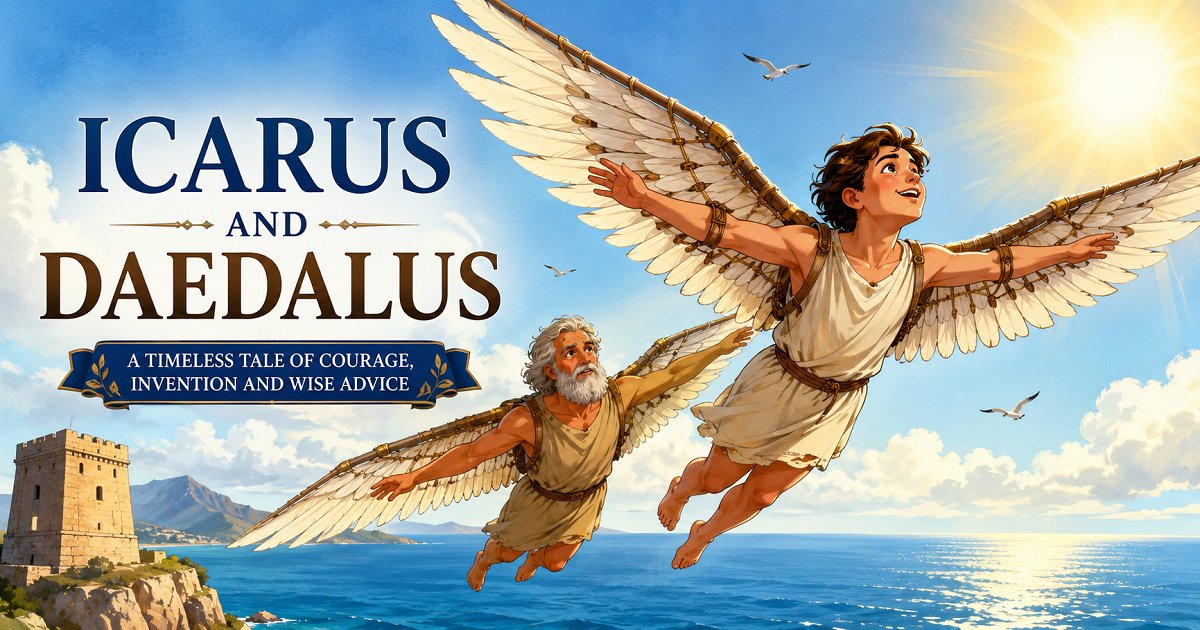
Little by little, he gathered a store of feathers great and small. He fastened these together with thread, moulded them in with wax, and so fashioned two great wings like those of a bird. When they were done, Daedalus fitted them to his own shoulders, and after one or two efforts, he found that by waving his arms he could winnow the air and cleave it, as a swimmer does the sea. He held himself aloft, wavered this way and that, with the wind, and at last, like a great fledgling, he learned to fly.
Without delay, he fell to work on a pair of wings for the boy Icarus, and taught him carefully how to use them, bidding him beware of rash adventures among the stars. "Remember," said the father, "never to fly very low or very high, for the fogs about the earth would weigh you down, but the blaze of the sun will surely melt your feathers apart if you go too near."
For Icarus, these cautions went in at one ear and out by the other. Who could remember to be careful when he was to fly for the first time? Are birds careful? Not they! And not an idea remained in the boy's head but the one joy of escape.
The day came, and the fair wind that was to set them free. The father bird put on his wings, and, while the light urged them to be gone, he waited to see that all was well with Icarus, for the two could not fly hand in hand. Up they rose, the boy after his father. The hateful ground of Crete sank beneath them; and the country folk, who caught a glimpse of them when they were high above the tree-tops, took it for a vision of the gods - Apollo, perhaps, with Cupid after him.
At first there was a terror in the joy. The wide vacancy of the air dazed them - a glance downward made their brains reel. But when a great wind filled their wings, and Icarus felt himself sustained, like a halcyon-bird in the hollow of a wave, like a child uplifted by his mother, he forgot everything in the world but joy. He forgot Crete and the other islands that he had passed over: he saw but vaguely that winged thing in the distance before him that was his father Daedalus. He longed for one draught of flight to quench the thirst of his captivity: he stretched out his arms to the sky and made towards the highest heavens.
Alas for him! Warmer and warmer grew the air. Those arms, that had seemed to uphold him, relaxed. His wings wavered, drooped. He fluttered his young hands vainly - he was falling - and in that terror he remembered. The heat of the sun had melted the wax from his wings; the feathers were falling, one by one, like snowflakes; and there was none to help.
He fell like a leaf tossed down the wind, down, down, with one cry that overtook Daedalus far away. When he returned, and sought high and low for the poor boy, he saw nothing but the bird-like feathers afloat on the water, and he knew that Icarus was drowned.
The nearest island he named Icaria, in memory of the child; but he, in heavy grief, went to the temple of Apollo in Sicily, and there hung up his wings as an offering. Never again did he attempt to fly.
Moral of the Story
The story's central moral is the importance of balance, moderation, and listening to those who know better. Daedalus gave Icarus two specific warnings - fly neither too low nor too high. Icarus ignored both, overwhelmed by the exhilaration of flight. The myth teaches that overconfidence and the failure to heed wise counsel can have fatal consequences - one of the most universal lessons in all of mythology.
Key Characters
- Daedalus: The greatest inventor and craftsman of ancient Greece.
- Icarus: Daedalus's young son, brave and full of wonder.
- King Minos: The powerful and capricious ruler of Crete.
- The Sun: Not a character but a force - both the source of life and the agent of death in this story.
- The Sea Gulls: A small but pivotal detail.
- The Labyrinth: Though it does not speak, the Labyrinth is the story's original sin.
Why Kids Love This Story
- The ultimate flying dream. Human flight is one of the oldest fantasies in history, and Icarus lives it. Children who have ever stretched their arms out running down a hill understand exactly what Icarus felt in the moment before he soared.
- A lesson that doesn't feel like a lesson. Every child is told "listen to your parents." Icarus shows what happens when you don't - but through adventure and spectacle, not a finger-wagging lecture. The message lands because the story is genuinely exciting.
- A genius at work. Daedalus is essentially the world's first engineer-hero. Kids who love building things, Lego, or problem-solving are instantly drawn to a character who builds his way out of an impossible situation using nothing but feathers, thread, and wax.
- The myth is on the map. Icaria is a real island in the real Aegean Sea, and the Icarian Sea is a real named body of water. This mythological geography makes the story feel grounded and verifiable - a huge draw for curious young readers.
- A phrase they'll use forever. "Flying too close to the sun" is a living idiom. Once kids learn where it comes from, they see it everywhere - in sports commentary, in news articles, in movies. The myth becomes a key that unlocks language they already know.
- A father's heartbreak. Older readers pick up the emotional undercurrent: Daedalus survives, grieves, and never flies again. The story isn't just about Icarus's recklessness - it's about parental love that cannot save what it has set free.
FAQs About the Story
Who were Icarus and Daedalus?
Daedalus was the legendary master craftsman of ancient Greece - most famous for designing the Cretan Labyrinth for King Minos. Icarus was his young son. When King Minos imprisoned them both on Crete, Daedalus crafted two pairs of wings from feathers and wax, giving them a means of escape through the sky.
Why did Icarus fly too close to the sun?
The myth suggests that Icarus was simply overwhelmed by the joy of flight - something no human had ever experienced before him. He forgot every warning in the sheer thrill of freedom after years of captivity. In mythological terms, this is called hubris - excessive pride or ambition that blinds a person to their limits. The sun did not choose to punish him; Icarus chose to reach for it.
What happened to Daedalus after Icarus fell?
Daedalus survived the flight and reached Sicily. Grief-stricken, he named the nearest island "Icaria" in memory of his son - a real island in the Aegean Sea that still bears that name today. He then travelled to the temple of Apollo in Sicily and hung up his wings as an offering to the god, vowing never to fly again. The greatest inventor of the ancient world was so broken by loss that he gave up the one thing that had set him free.