
Story Summary
Orpheus was the greatest musician who ever lived - so gifted that trees moved to hear him and wild beasts lay down at his feet. When his beloved wife Eurydice died from a snakebite, he did what no mortal had ever done: he descended living into the Underworld and played his lyre so beautifully that even Pluto and Persephone wept and agreed to release her. There was just one condition. He must lead her back to the light without once looking behind him. It is one of the most heartbreaking moments in all of mythology when, in the instant before reaching the sunlit world above, he turns.
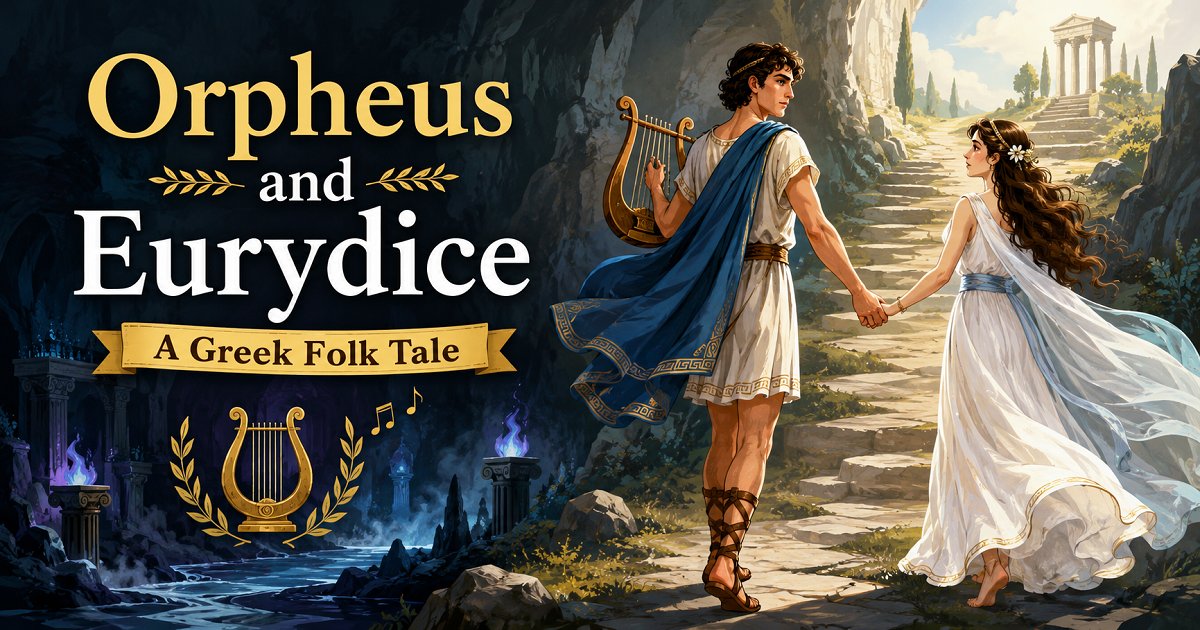
Full Story
When gods and shepherds piped and the stars sang, that was the day of musicians! But the triumph of Phoebus Apollo himself was not so wonderful as the triumph of a mortal man who lived on earth, though some say that he came of divine lineage. This was Orpheus, that best of harpers, who went with the Grecian heroes of the great ship Argo in search of the Golden Fleece.
After his return from the quest, he won Eurydice for his wife, and they were as happy as people can be who love each other and every one else. The very wild beasts loved them, and the trees clustered about their home as if they were watered with music. But even the gods themselves were not always free from sorrow, and one day misfortune came upon that harper Orpheus whom all men loved to honor.
Eurydice, his lovely wife, as she was wandering with the nymphs, unwittingly trod upon a serpent in the grass. Surely, if Orpheus had been with her, playing upon his lyre, no creature could have harmed her. But Orpheus came too late. She died of the sting, and was lost to him in the Underworld.
For days he wandered from his home, singing the story of his loss and his despair to the helpless passers-by. His grief moved the very stones in the wilderness, and roused a dumb distress in the hearts of savage beasts. Even the gods on Mount Olympus gave ear, but they held no power over the darkness of Hades.
Wherever Orpheus wandered with his lyre, no one had the will to forbid him entrance; and at length he found unguarded that very cave that leads to the Underworld, where Pluto rules the spirits of the dead. He went down without fear. The fire in his living heart found him a way through the gloom of that place. He crossed the Styx, the black river that the Gods name as their most sacred oath. Charon, the harsh old ferryman who takes the shades across, forgot to ask of him the coin that every soul must pay. For Orpheus sang.
Now the dead, when they go to the Underworld, drink of the pool of Lethe; and forgetfulness of all that has passed comes upon them like a sleep, and they lose their longing for the world, they lose their memory of pain, and live content with that cool twilight. But not the pool of Lethe itself could withstand the song of Orpheus; and in the hearts of the shades all the old dreams awoke wondering. They remembered once more the life of men on earth, the glory of the sun and moon, the sweetness of new grass, the warmth of their homes, all the old joy and grief that they had known. And they wept.
Even the Furies were moved to pity. Those, too, who were suffering punishment for evil deeds ceased to be tormented for themselves, and grieved only for the innocent Orpheus who had lost Eurydice. Sisyphus, that fraudulent king (who is doomed to roll a monstrous boulder uphill forever), stopped to listen. The daughters of Danaus left off their task of drawing water in a sieve. Tantalus forgot hunger and thirst, though before his eyes hung magical fruits that were wont to vanish out of his grasp, and just beyond reach bubbled the water that was a torment to his ears; he did not hear it while Orpheus sang.
So, among a crowd of eager ghosts, Orpheus came, singing with all his heart, before the king and queen of Hades. And the queen Proserpina wept as she listened and grew homesick, remembering the fields of Enna and the growing of the wheat, and her own beautiful mother, Demeter. Then Pluto gave way.
They called Eurydice and she came, like a young guest unused to the darkness of the Underworld. She was to return with Orpheus, but on one condition. If he turned to look at her once before they reached the upper air, he must lose her again and go back to the world alone.
Rapt with joy, the happy Orpheus hastened on the way, thinking only of Eurydice, who was following him. Past Lethe, across the Styx they went, he and his lovely wife, still silent as a shade. But the place was full of gloom, the silence weighed upon him, he had not seen her for so long; her footsteps made no sound; and he could hardly believe the miracle, for Pluto seldom relents. When the first gleam of upper daylight broke through the cleft to the dismal world, he forgot all, save that he must know if she still followed. He turned to see her face, and the promise was broken!
She smiled at him forgivingly, but it was too late. He stretched out his arms to take her, but she faded from them, as the bright snow, that none may keep, melts in our very hands. A murmur of farewell came to his ears - no more. She was gone.
He would have followed, but Charon, now on guard, drove him back. Seven days he lingered there between the worlds of life and death, but after the broken promise Hades would not listen to his song. Back to the earth he wandered, though it was sweet to him no longer. He died young, singing to the last, and round about the place where his body rested, nightingales nested in the trees. His lyre was set among the stars; and he himself went down to join Eurydice, unforbidden.
Those two had no need of Lethe, for their life on earth had been wholly fair, and now that they are together they no longer own a sorrow.
Moral of the Story
The myth weaves together several themes: the extraordinary power of art to move even the hardest hearts; the nature of love as both a source of strength and of doubt; the impossibility of fully conquering death; and the cruelty of conditions that cannot be met by imperfect humans. It also asks whether we can ever truly trust in something we cannot see - a question that has no easy answer.
Key Characters
- Orpheus: The greatest harper who ever lived, said to be the son of the Muse Calliope and either Apollo or a Thracian king.
- Eurydice: A wood nymph and the beloved wife of Orpheus.
- Pluto (Hades): The stern, rarely merciful ruler of the dead.
- Persephone (Proserpina): Originally the daughter of Demeter, goddess of the harvest, she was taken by Pluto to be his queen.
Why Kids Love This Story
- The power of music. The idea that a song could stop time, move gods, and silence the punishments of the dead is one of the most electrifying concepts in all storytelling.
- A real adventure into the Underworld. Charon, the Furies, Sisyphus, Tantalus - the Underworld is vivid and atmospheric, full of unforgettable figures that young readers immediately want to know more about.
- The unbearable suspense. The walk back through the darkness - will he turn, won't he turn - is as tense as any thriller. Children feel it keenly every single time.
- A beautiful, sad ending. Eurydice's forgiving smile, Orpheus singing to the last, his lyre becoming a constellation - the ending is deeply moving without being frightening.
- Big ideas in a short story. Love, death, doubt, the limits of human will - this short myth raises questions that children find themselves thinking about long afterwards.
- A perfect school text. Pairs naturally with topics on ancient Greece, the solar system (Lyra constellation), music history, and classical art.
FAQs About the Story
What is the story of Orpheus and Eurydice about?
It is a Greek myth about the greatest musician who ever lived. When his wife Eurydice dies from a snakebite, Orpheus descends into the Underworld and uses the power of his music to move even Pluto and Persephone to release her - on condition that he does not look back as he leads her to the upper world. In the last moment before reaching the sunlight, he turns, and loses her forever. It is one of the most powerful myths of love, loss, and the limits of human will.
Who was Orpheus in Greek mythology?
Orpheus was the greatest musician and poet in all of Greek mythology, said to be the son of the Muse Calliope and either Apollo or the Thracian king Oeagrus. His skill on the lyre was so extraordinary that wild animals became tame, trees uprooted themselves to follow him, and even rivers stopped to listen. He also sailed with Jason on the Argo, where his music drowned out the deadly Sirens and saved the crew.
How did Orpheus charm the Underworld?
Orpheus sang of youth, love, death, the sweetness of earth, and the bitterness of loss - things that live in every human heart. His music was so moving that Charon forgot to collect his fare, the Furies wept for the first time, Sisyphus stopped rolling his boulder to listen, Tantalus forgot his hunger and thirst, and the daughters of Danaus put down their endless water-sieves. Even Persephone wept with homesickness, and Pluto himself relented - something he had never done before.
What happened to Orpheus after he lost Eurydice the second time?
Charon turned him away from the Underworld and he wandered the earth in grief, finding no joy in the world. He died young, still singing, and nightingales nested where his body rested. His lyre was placed among the stars as the constellation Lyra. His spirit then went down to join Eurydice in the Underworld - unforbidden this time - where, finally together, they had no need of Lethe's forgetfulness.