
Story Summary
A kind-hearted old priest in Hitachi, Japan, shelters a badger from the winter cold every night for a decade. The badger, overwhelmed with gratitude yet unable to requite it, secretly travels to the gold-mining island of Sado, refines discarded mine-waste for three years, and returns with three honest gold coins - exactly the amount the priest had modestly wished for to fund prayers for his afterlife.
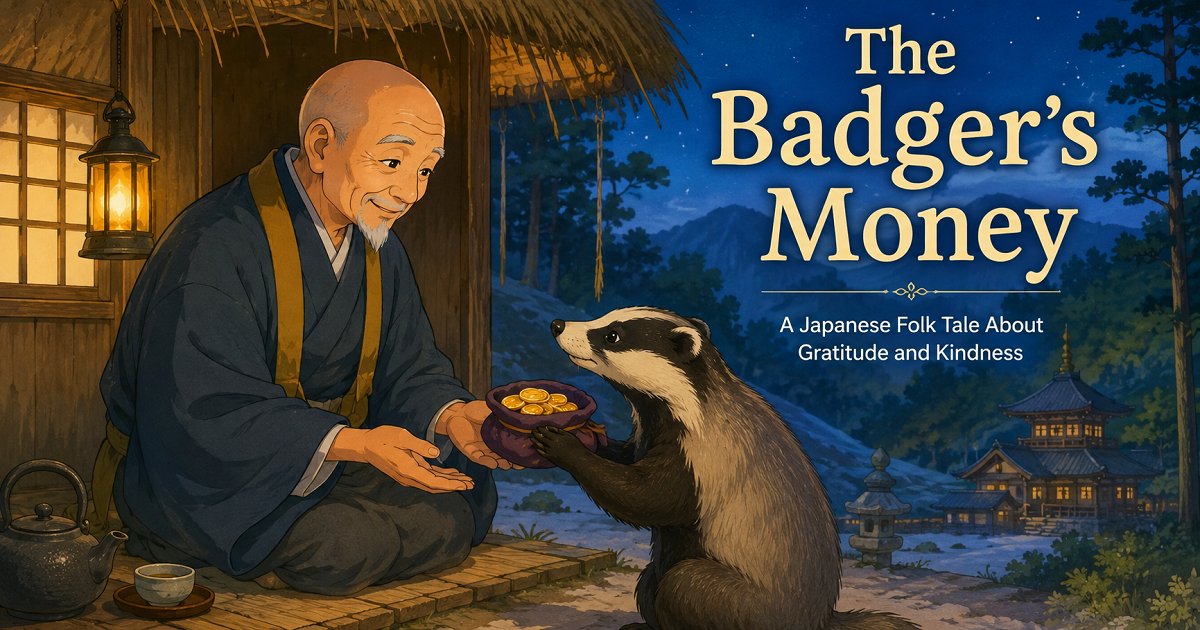
Full Story
It is a common saying among men that to forget favours received is the part of a bird or a beast: an ungrateful man will be ill spoken of by all the world. And yet even birds and beasts will show gratitude; so that a man who does not requite a favour is worse even than dumb brutes. Is not this a disgrace?
Once upon a time, in a hut at a place called Namékata, in Hitachi, there lived an old priest famous neither for learning nor wisdom, but bent only on passing his days in prayer and meditation. He had not even a child to wait upon him, but prepared his food with his own hands. Night and morning he recited the prayer Namu Amida Butsu, intent upon that alone. Although the fame of his virtue did not reach far, yet his neighbours respected and revered him, and often brought him food and raiment; and when his roof or his walls fell out of repair, they would mend them for him; so for the things of this world he took no thought.
One very cold night, when he little thought any one was outside, he heard a voice calling, "Your reverence! your reverence!" So he rose and went out to see who it was, and there he beheld an old badger standing. Any ordinary man would have been greatly alarmed at the apparition; but the priest, being such as he has been described above, showed no sign of fear, but asked the creature its business. Upon this the badger respectfully bent its knees and said:
"Hitherto, sir, my lair has been in the mountains, and of snow or frost I have taken no heed; but now I am growing old, and this severe cold is more than I can bear. I pray you to let me enter and warm myself at the fire of your cottage, that I may live through this bitter night." - The Badger, to the Old Priest
When the priest heard what a helpless state the beast was reduced to, he was filled with pity and said: "That's a very slight matter: make haste and come in and warm yourself."
The badger, delighted with so good a reception, went into the hut, and squatting down by the fire began to warm itself; and the priest, with renewed fervour, recited his prayers and struck his bell before the image of Buddha, looking straight before him.
After two hours the badger took its leave, with profuse expressions of thanks, and went out; and from that time forth it came every night to the hut. As the badger would collect and bring with it dried branches and dead leaves from the hills for firewood, the priest at last became very friendly with it, and got used to its company; so that if ever, as the night wore on, the badger did not arrive, he used to miss it, and wonder why it did not come. When the winter was over, and the springtime came at the end of the second month, the badger gave up its visits, and was no more seen; but, on the return of the winter, the beast resumed its old habit of coming to the hut.
When this practice had gone on for ten years, one day the badger said to the priest, "Through your reverence's kindness for all these years, I have been able to pass the winter nights in comfort. Your favours are such that during all my life, and even after my death, I must remember them. What can I do to requite them? If there is anything that you wish for, pray tell me."
The priest, smiling at this speech, answered: "Being such as I am, I have no desire and no wishes. Glad as I am to hear your kind intentions, there is nothing that I can ask you to do for me. You need feel no anxiety on my account. As long as I live, when the winter comes, you shall be welcome here." The badger, on hearing this, could not conceal its admiration of the depth of the old man's benevolence; but having so much to be grateful for, it felt hurt at not being able to requite it.
As this subject was often renewed between them, the priest at last, touched by the goodness of the badger's heart, said: "Since I have shaven my head, renounced the world, and forsaken the pleasures of this life, I have no desire to gratify, yet I own I should like to possess three riyos in gold. Food and raiment I receive by the favour of the villagers, so I take no heed for those things. Were I to die to-morrow, and attain my wish of being born again into the next world, the same kind folk have promised to meet and bury my body. Thus, although I have no other reason to wish for money, still if I had three riyos I would offer them up at some holy shrine, that masses and prayers might be said for me, whereby I might enter into salvation. Yet I would not get this money by violent or unlawful means; I only think of what might be if I had it."
When the priest had done speaking, the badger leant its head on one side with a puzzled and anxious look, so much so that the old man was sorry he had expressed a wish which seemed to give the beast trouble, and tried to retract what he had said. "Posthumous honours, after all, are the wish of ordinary men. I, who am a priest, ought not to entertain such thoughts, or to want money; so pray pay no attention to what I have said;" and the badger, feigning assent to what the priest had impressed upon it, returned to the hills as usual.
From that time forth the badger came no more to the hut. The priest thought this very strange, but imagined either that the badger stayed away because it did not like to come without the money, or that it had been killed in an attempt to steal it; and he blamed himself for having added to his sins for no purpose, repenting when it was too late: persuaded, however, that the badger must have been killed, he passed his time in putting up prayers upon prayers for it.
After three years had gone by, one night the old man heard a voice near his door calling out, "Your reverence! your reverence!"
As the voice was like that of the badger, he jumped up as soon as he heard it, and ran to open the door; and there, sure enough, was the badger. The priest, in great delight, cried out: "And so you are safe and sound, after all! Why have you been so long without coming here? I have been expecting you anxiously this long while."
So the badger came into the hut and said:
"If the money which you required had been for unlawful purposes, I could easily have procured as much as ever you might have wanted; but when I heard that it was to be offered to a temple for masses for your soul, I thought that, if I were to steal the hidden treasure of some other man, you could not apply to a sacred purpose money which had been obtained at the expense of his sorrow. So I went to the island of Sado, and gathering the sand and earth which had been cast away as worthless by the miners, fused it afresh in the fire; and at this work I spent months and days." - The Badger explains its three-year absence
As the badger finished speaking, the priest looked at the money which it had produced, and sure enough he saw that it was bright and new and clean; so he took the money, and received it respectfully, raising it to his head.
"And so you have had all this toil and labour on account of a foolish speech of mine? I have obtained my heart's desire, and am truly thankful."
As he was thanking the badger with great politeness and ceremony, the beast said: "In doing this I have but fulfilled my own wish; still I hope that you will tell this thing to no man."
"Indeed," replied the priest, "I cannot choose but tell this story. For if I keep this money in my poor hut, it will be stolen by thieves: I must either give it to some one to keep for me, or else at once offer it up at the temple. And when I do this, when people see a poor old priest with a sum of money quite unsuited to his station, they will think it very suspicious, and I shall have to tell the tale as it occurred; but I shall say that the badger that gave me the money has ceased coming to my hut, you need not fear being waylaid, but can come, as of old, and shelter yourself from the cold."
To this the badger nodded assent; and as long as the old priest lived, it came and spent the winter nights with him.
From this story, it is plain that even beasts have a sense of gratitude: in this quality dogs excel all other beasts. Is not the story of the dog of Totoribé Yorodzu written in the Annals of Japan? I have heard that many anecdotes of this nature have been collected and printed in a book, which I have not yet seen; but as the facts which I have recorded relate to a badger, they appear to me to be passing strange.
Moral of the Story
The story teaches that gratitude is not exclusive to humans - even animals recognise and repay kindness. It also emphasises honesty: the badger refuses to use stolen money for a sacred purpose and instead earns it honestly over three years of hard work.
Key Characters
- The Old Priest: A humble Buddhist hermit at Namékata who lives by prayer and the charity of neighbours.
- The Badger: An ageing mountain badger who seeks warmth and returns kindness ten-fold.
- The Villagers: A quiet supporting presence - the community who feed the priest and promise to bury him.
Why Kids Love This Story
- The badger is a talking animal with real feelings - instantly loveable to young readers.
- A mystery unfolds: the badger vanishes for three whole years. Where did it go?
- The twist rewards patience - the badger's absence turns out to be an act of extraordinary love.
- The priest is gentle and never greedy, modelling a kindness children instinctively respect.
- Cosy winter imagery - firelight, snowfall, dried branches - makes the story feel like a warm hug.
- The badger proves you don't have to be powerful to do something truly great.
FAQs About the Story
Where does The Badger's Money take place?
The story is set in Namékata, in the historical Hitachi province of Japan - present-day Ibaraki Prefecture, north-east of Tokyo. The badger also travels to the island of Sado (off the coast of Niigata), historically famous for its gold mines.
How did the badger earn the money?
The badger travelled to Sado Island and collected sand and earth discarded as worthless by gold miners. It then smelted this waste material in a fire over many months to extract three clean gold coins - the precise sum the priest had mentioned.
What did the priest want the three gold coins for?
The priest wished to offer three riyos (a traditional Japanese unit of gold currency) to a holy shrine so that masses and prayers could be said for him after death, helping his soul enter salvation. He was not motivated by greed but by spiritual devotion.