
Story Summary
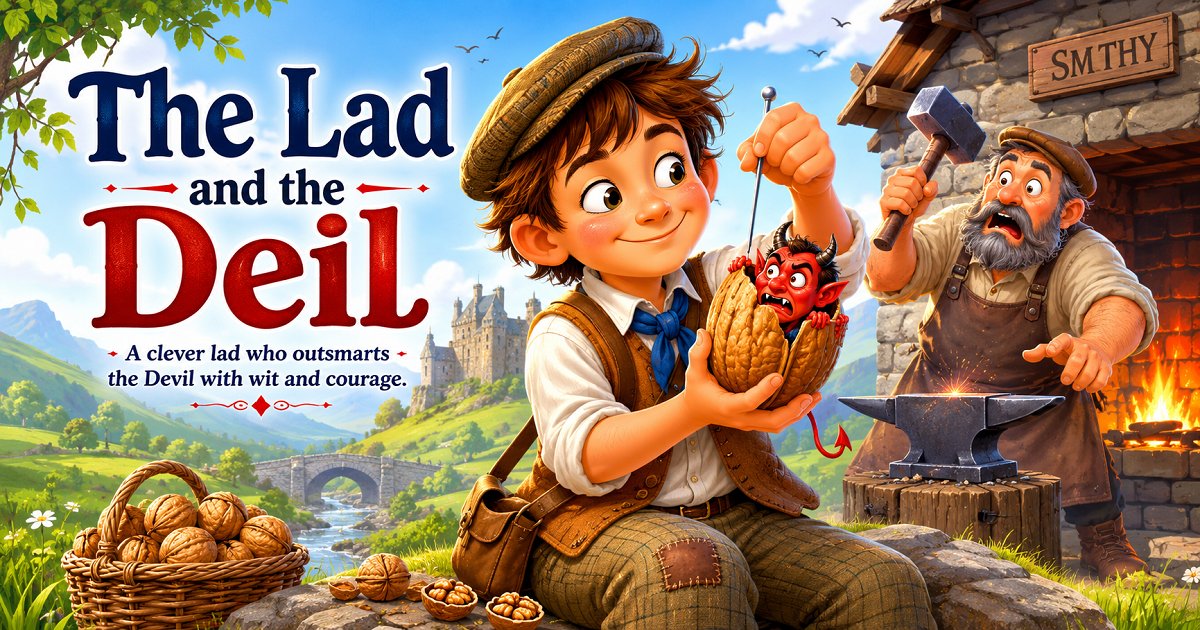
A sharp-witted lad, cracking nuts on a country road, meets the Devil himself. With one cunning question, he tricks the Deil into squeezing inside a hollow walnut shell - then stoppers the hole with a pin. He walks to the village smithy and asks the blacksmith to crack the nut. No hammer is big enough, until the smith brings down his great sledgehammer. The nut explodes with a bang so powerful it blows half the roof off - and the lad walks away laughing.
Full Story
Once on a time there was a lad who was walking along a road cracking nuts, so he found one that was worm-eaten, and just at that very moment he met the Deil.
"Is it true, now," said the lad, "what they say, that the Deil can make himself as small as he chooses, and thrust himself on through a pinhole?"
"Yes, it is," said the Deil.
"Oh! it is, is it? then let me see you do it, and just creep into this nut," said the lad.
So the Deil did it.
Now, when he had crept well into it through the worm's hole, the lad stopped it up with a pin.
"Now, I've got you safe," he said, and put the nut into his pocket.
So when he had walked on a bit, he came to a smithy, and he turned in and asked the smith if he'd be good enough to crack that nut for him.
"Ay, that'll be an easy job," said the smith, and took his smallest hammer, laid the nut on the anvil, and gave it a blow, but it wouldn't break.
So he took another hammer a little bigger, but that wasn't heavy enough either.
Then he took one bigger still, but it was still the same story; and so the smith got wroth, and grasped his great sledge-hammer.
"Now, I'll crack you to bits," he said, and let drive at the nut with all his might and main. And so the nut flew to pieces with a bang that blew off half the roof of the smithy, and the whole house creaked and groaned as though it were ready to fall.
"Why! if I don't think the Deil must have been in that nut," said the smith.
"So he was; you're quite right," said the lad, as he went away laughing.
Moral of the Story
Even the most powerful adversary can be defeated by a cool head and a clever question. Pride is the greatest weakness - and curiosity is the greatest strength. You do not need magic, weapons, or luck when you have the wit to ask the right question at the right moment.
Key Characters
- The Lad: Quick-witted and fearless, the unnamed boy turns a simple walk into an extraordinary adventure.
- The Deil (Devil): In Scottish folklore, the Deil is powerful but fatally vain.
- The Blacksmith: An honest working man whose professional stubbornness is used brilliantly by the lad.
Why Kids Love This Story
- The underdog wins - Children instinctively root for the small, resourceful person against a supposedly all-powerful opponent. The lad's effortless victory is enormously satisfying.
- A brilliant comic climax - The image of a sledgehammer, an anvil, a worm-eaten nut, and an entire roof flying off is perfectly slapstick - funny, vivid, and unforgettable.
- The secret the reader shares - Children love knowing something that a character (the smith) doesn't. Keeping the lad's secret while watching the blacksmith escalate his hammers is delicious dramatic irony.
- Instant, effortless storytelling - At just a few hundred words, the story never outstays its welcome. It begins with action, ends with a punchline, and leaves children grinning rather than fidgeting.
- A model for clever thinking - The lad uses information (knowing the Deil can shrink himself) and curiosity (asking him to prove it) as his only weapons. Children see intelligence, not luck, as the hero's real superpower.
FAQs About the Story
What is "The Lad and the Deil" about?
It is a short Scottish folk tale about a clever boy who tricks the Devil (Deil) into squeezing inside a worm-eaten walnut shell, then seals him in with a pin. He takes the nut to a blacksmith, who cracks it open with a giant sledgehammer - releasing the Devil with a bang that blows half the smithy's roof off.
What does "Deil" mean in Scottish?
"Deil" is the Scottish dialect word for the Devil. It appears frequently across Scottish folklore and poetry, most famously in the works of Robert Burns, where the Deil is often portrayed as a powerful but foolable figure.
Where does this folk tale come from?
The story is a traditional Scottish folk tale, part of the rich oral storytelling tradition of Scotland. It belongs to a widespread category of trickster tales found across Europe, in which an ordinary person outwits the Devil through wit rather than strength or magic.