

World Legend: Wayland the Smith
In the court of King Nidung, a smith of extraordinary skill served the royal household. Wayland — sometimes spelled Volund in older Norse tellings of the legend — was renowned throughout the kingdom as the finest craftsman of his age, able to forge blades, jewellery, and tools of a quality that no other smith in the land could match.
King Nidung had one daughter and three sons. The eldest, Otvin, spent much of his time away from court guarding the kingdom's borders, while his two younger brothers, still boys, often visited Wayland's forge, fascinated by the sparks and the ringing hammer that shaped raw metal into gleaming treasures.
One day, the two young princes came to Wayland's forge asking him to craft arrows for their bows. Ever mindful of his position, Wayland explained that he could not simply agree to make anything for the king's sons without their father's knowledge and consent, however eager the boys were and however capable he was of the task. It was a small moment, but one that reflected the careful, principled nature for which Wayland was known even beyond his legendary craftsmanship.
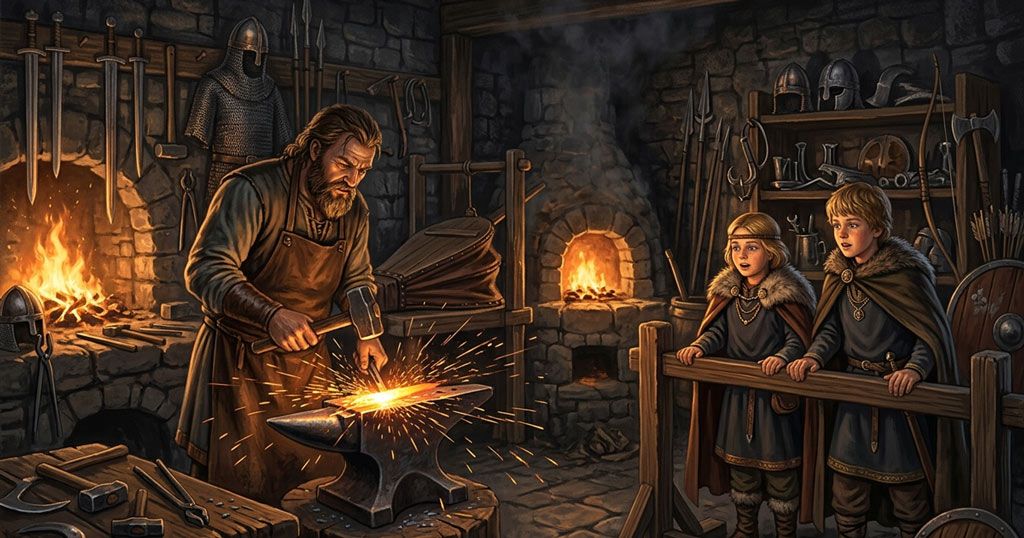
Wayland's fame as a smith spread across the Germanic and Norse world for a simple reason: in an age when a well-made sword or piece of armour could mean the difference between life and death, a craftsman whose work was said to be without equal became a legend in his own right, every bit as celebrated as the warriors who carried what he made.
Tales of Wayland's forge, his cleverness, and the treasures that came from his hands were told and retold across many lands and many centuries, carried by storytellers from the Norse sagas all the way to early English folklore, where his name and legend continued to be remembered long after the age of kings and forges had passed.
Who's Who in This Story
- Wayland the Smith — the legendary master craftsman, famed for skill unmatched by any smith in the world
- King Nidung — the ruler whom Wayland served
- Otvin — King Nidung's eldest son, away guarding the kingdom's borders
Did You Know?
- Wayland the Smith is known by several names across different traditions, including Volund in Norse legend and Weyland in Old English sources.
- A famous Neolithic burial site in England is still called "Wayland's Smithy" today, named after the legendary smith long after the tomb itself was built.
- Wayland's legend is thought to be over a thousand years old, appearing in Norse poetry, Germanic epic, and early English literature alike.
Wayland's legend reminds us that true mastery of a craft, paired with integrity in how it is used, is its own kind of heroism — one remembered as long as any sword or shield.