

Mythological Story: The Gorgon's Head
Long before he became one of the most famous heroes of Greek mythology, Perseus was simply a boy washed ashore in a wooden chest. His mother, Danae, had been set adrift on the sea by enemies who wished her harm, and the waves carried them both to the small island of Seriphus, where a kind fisherman pulled them from the water and raised Perseus as his own.
The fisherman's brother, however, was the island's king, Polydectes, and he was nowhere near as good-hearted. As Perseus grew into a strong and clever young man, Polydectes grew jealous of him and hatched a plan to be rid of him for good. He announced that he wished to marry a foreign princess, and that every young man on the island must bring him a wedding gift. When it came to Perseus's turn, the king smiled slyly and said, "Bring me the head of Medusa the Gorgon."
It was, everyone knew, an impossible request. Medusa was one of three monstrous sisters called the Gorgons, and she alone among them could be killed. She had brass claws, golden wings, and hair made of living, hissing snakes — and one glance into her eyes turned any living creature instantly to stone. Polydectes fully expected Perseus to fail, or never return at all.
But Perseus was not without friends among the gods. The messenger god Hermes and the wise goddess Athena took pity on the brave young man and came to his aid. Hermes lent him a curved sword sharp enough to cut through Medusa's scales, while Athena gave him her own polished bronze shield, telling him never to look at Medusa directly — only at her reflection.
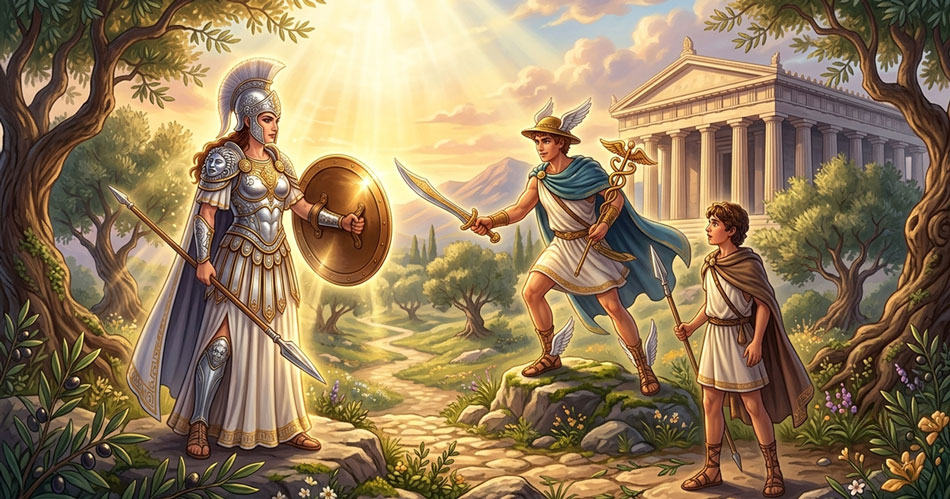
To finish his equipment, Perseus first had to visit the Three Gray Women, strange sisters who shared a single eye between them, passing it from hand to hand. By cleverly snatching the eye while it changed hands, Perseus forced the sisters to reveal the location of the nymphs who guarded three magical treasures: winged sandals that let him fly, a cap that made him invisible, and a magic pouch strong enough to carry Medusa's dreadful head without harming him.
Armed and ready, Perseus flew across the sea to the Gorgons' island and found the three sisters asleep among the rocks. Careful never to look at them directly, he watched Medusa's reflection shimmer in his polished shield as he crept closer. When he was near enough, he struck with one swift stroke of his sword, and Medusa's head fell free. Perseus caught it in the magic pouch before her sisters even stirred, then pulled on the cap of invisibility and flew for home before they could take revenge.
On his way back to Seriphus, Perseus had further adventures — he rescued a princess named Andromeda from a sea monster and later married her — but his greatest triumph came when he finally returned to face King Polydectes. Certain that Perseus was dead, the wicked king had continued to trouble Danae in his absence. When Perseus arrived at the palace and the king demanded proof of his quest, Perseus lifted Medusa's head from the pouch. In an instant, Polydectes and his flattering courtiers were turned to stone, frozen forever exactly as they stood.
Perseus later gave Medusa's head to Athena, who set it upon her own shield, where it remained a symbol of protection against evil for the rest of Greek mythology.
Who's Who in This Story
- Perseus — the hero of the story, son of Danae, who defeats the Gorgon Medusa
- Medusa — one of the three Gorgon sisters, the only one who could be killed, whose stare turned onlookers to stone
- Athena — the goddess of wisdom who lent Perseus her polished shield
- Hermes — the messenger god who lent Perseus his sword and guided him on the journey
- Polydectes — the scheming king of Seriphus who sent Perseus on the quest hoping he would never return
Did You Know?
- Medusa was not always a monster — in most versions of the myth she was once a beautiful woman before being transformed.
- The winged horse Pegasus is said to have sprung from Medusa's blood the moment her head was cut off.
- Ancient Greeks carved Medusa's face, called a Gorgoneion, onto shields, armor and buildings as a symbol meant to ward off danger.
Perseus's quest is a reminder that courage paired with cleverness — not just brute strength — is what carries a hero through the impossible.