

Mythological Story: The Cyclops
After the long Trojan War finally ended, the Greek hero Odysseus set sail for home with his crew, hoping for a swift and easy voyage. The gods, however, had other plans, and it would be ten more years before Odysseus saw his kingdom of Ithaca again. Among the strangest and most dangerous stops on his journey was a rocky island inhabited by the Cyclopes — a race of enormous one-eyed giants.
Odysseus and a dozen of his bravest men rowed ashore to explore, and finding a great cave stocked with cheeses and pens full of sheep, they went inside to wait for its owner, hoping for hospitality. Instead, the cave's owner turned out to be Polyphemus, a Cyclops the size of a small mountain and the son of the sea god Poseidon himself. When Polyphemus returned and found strangers inside his home, he rolled an enormous boulder across the entrance, trapping them all inside, and to the crew's horror, devoured two of the sailors on the spot.
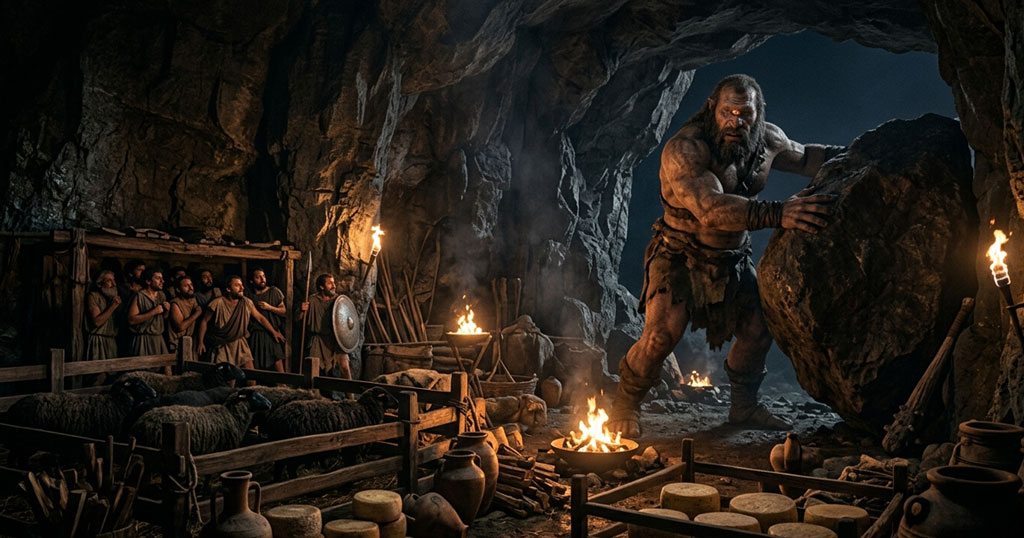
Knowing that brute force would never defeat a giant of such size, Odysseus relied instead on his wits — the very quality for which he was famous throughout Greek mythology. He offered Polyphemus a skin of extremely strong wine, and when the giant asked his name, Odysseus cleverly answered, "My name is Nobody." Delighted with the wine, Polyphemus drank until he fell into a deep, heavy sleep.
While the giant slept, Odysseus and his remaining men heated the sharpened end of a wooden stake in the fire and drove it into Polyphemus's single eye, blinding him instantly. Polyphemus woke roaring in agony and called out to the other Cyclopes on the island for help. When they asked who had hurt him, he shouted, "Nobody is hurting me!" — and hearing this, his neighbours simply shrugged and went back to sleep, assuming nothing was wrong at all.
The next morning, the blinded Polyphemus rolled the boulder aside just enough to let his sheep out to graze, running his hands along each animal's back to make sure no men were riding out on top of them. But Odysseus had planned for this too: he and his men tied themselves to the undersides of the sheep, clinging on as the animals walked right beneath the giant's searching fingers and out into the daylight.
Safely back at his ship, Odysseus could not resist calling out his true name to taunt the giant one last time — a moment of pride that would haunt him. Furious, Polyphemus prayed to his father Poseidon for revenge, and the sea god heard him. It was this curse that caused Poseidon to hound Odysseus with storms and misfortune for years afterward, turning what might have been a short voyage home into one of the longest journeys in all of Greek mythology.
Who's Who in This Story
- Odysseus — the clever Greek hero and king of Ithaca, famous for his cunning mind
- Polyphemus — a Cyclops, son of Poseidon, who traps Odysseus and his crew in his cave
- Poseidon — the god of the sea, Polyphemus's father, who curses Odysseus's journey home
Did You Know?
- The word "cyclops" comes from Greek words meaning "round eye."
- Odysseus's trick with the name "Nobody" is one of the most famous wordplay jokes in all of ancient literature.
- This adventure is one episode within a much longer poem called The Odyssey, written by the ancient poet Homer.
Odysseus's escape shows that a clear head and a clever plan can overcome even an enemy many times your size — though even clever heroes must be careful not to let pride undo their victories.