|
Beneath the ground, the soil teems with life. Worms, slugs, millipedes,
and beetles live there, feeding on decaying matter. Tiny living creatures,
called decomposers, break down everything that remains. Decomposers include
microscopic bacteria, fungi, woodlice, mites, and small insects. They
digest organic material such as dead animals, leaves, and plants, and
break it down into nutrients. This process, called decomposition, creates
arich fertilizer for plants growing in the soil. As organic material rots,
its nutrients or goodness are returned to the soil. The nutrients or goodness
are returned to the soil. The nutrients dissolve in rainwater, and trickle
down to tree and other plant roots below.
WATCHING DECAY IN THE SOIL
This experiment demonstrates the best conditions for decomposing plants.
It shows that plant material decays quickest in warm, moist areas. You
can take a closer look at the decomposers themselves in the second project,
which shows how to separate creepy- crawlies from the rotting leaves they
live in. You could repeat the experiment with leaves from a different
areas, and see if the insects you find are the same.
You will need :
1> Gardening gloves
2> Trowel (optional)
3> Two clean plastic containers
4> Soil
5> Dead leaves
6> Water in a watering can
7> One container lid
Step 1
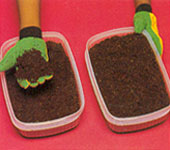
Be sure to wear a pair of gardening gloves for this project. Use your
hand or a trowel if you prefer, to fill two plastic containers with plenty
of dry soil.
Step 2
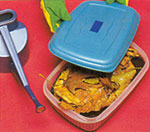
Put a layer of dead leaves on top of the soil in one of the containers.
Water the leaves and soil thoroughly, then press the lid onto the container
to cover it.
Step 3
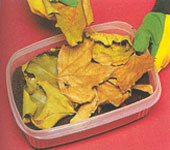
Place a layer of leaves on the dry soil in the other container. Do not
water it and do not cover the container. Store both containers in a dry
place.
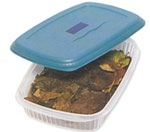 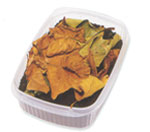
After a few weeks, the leaves in the wet soil (left) will have begun to
rot, and those in the dry soil (right) will have shrivelled.
STUDYING DECOMPOSERS
You will need :
1> Plastic funnel
2> Large clear jar
3> Gloves
4> Rotting leaves from a compost heap
5> Black paper
6> Sticky tape
7> Desk lamp
8> Magnifying glass
9> Field guide
Step 1
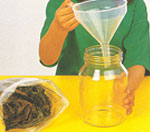
Rotting leaves are covered in insects and other creepy-crawlies. You can
separate them by using a lamp, a funnel, and a large jar. Put the funnel
inside the jar, as shown.
Step 2
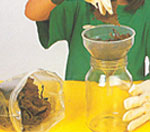
Wearing a pair of gardening gloves, loosely fill the funnel with rotting
leaves. Tape a sheet of black paper around the sides of the jar to block
out the light.
Step 3
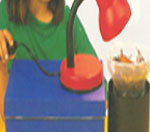
Place the lamp so that it shines on the leaves. The creatures will move away from the heat and the light of the lamp, and fall down the slippery funnel into the jar below.
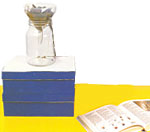
After an hour, there will be several creatures in the jar. Look at them
with a magnifying glass and use a field guide to identify them. Then return
the creatures to where you found them.
Feast for woodlice
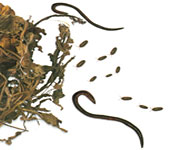
Rotting, in nature, does not happen by itself. Dead leaves are food for decomposers, such as woodlice. They eat the fallen leaves and pass many of the nutrients back into the soil, to be taken up again by the trees' roots.
|


 Mother's Day
 Craft Ideas for Kids
 Rhymes & Poems
 Benefits of Yoga for Kids
 Stories for Kids
 School Projects & Homework Help