
Christmas in Slovakia
Veselé Vianoce: Mikuláš, Štedrý večer, oblátky, kapustnica and Ježiško


In Slovakia, Christmas, Vianoce, is celebrated mainly on Christmas Eve, Štedrý večer ("generous evening"), 24 December, with a family supper, presents from Ježiško and midnight Mass, followed by two more days off on 25 and 26 December. The supper begins with prayer and thin oblátky wafers eaten with honey and sometimes garlic, followed by kapustnica, a sauerkraut soup, and fried carp with potato salad. Before that come four weeks of Advent, with Mikuláš filling boots on 6 December and Christmas markets in Bratislava and other towns. The season ends with Epiphany, Traja králi, on 6 January.
How Slovakia celebrates Christmas
Slovakia is a largely Christian country, and its Christmas mixes Roman Catholic, Lutheran and, in the east, Greek Catholic church tradition with a rich layer of folk belief from its villages. The word Vianoce covers the whole season, but the emotional centre is Štedrý deň, Christmas Eve day, and above all its evening, Štedrý večer. The name comes from štedrý, "generous", and the evening was traditionally meant to be the most plentiful of the year, a wish for plenty in the months ahead.
Many customs of the Christmas Eve table are small acts of magic for health, love and money in the new year: honey for sweetness, garlic for health, money or a carp scale under the tablecloth for wealth, and an apple cut in half to read the family's luck. Recipes and rituals change from region to region, and families hold on to their own versions.
Advent and Mikuláš
Advent opens the season with wreaths, baking and markets. Homes bake medovníky, spiced honey biscuits that are iced and decorated, and the Advent wreath gains a lit candle each Sunday.
On the evening of 5 December, cleaned boots are set on the windowsill or by the door for Mikuláš, St Nicholas, who fills them overnight with sweets and fruit. In towns and many families he also appears in person, as a bishop accompanied by an angel (anjel) and a devil (čert). The youngest must sing a song or recite a poem; the angel hands out sweets from a basket, and the devil threatens the badly behaved with coal and a wooden spoon, threats that are rarely carried out.
Since 1990, Slovak scouts have brought the Light of Peace from Bethlehem (Betlehemské svetlo) to Slovakia. The flame, lit in the Church of the Nativity in Bethlehem, is handed over at an ecumenical service in Linz, Austria, and scouts then carry it by train and on foot to more than 300 towns and villages, as well as to hospitals, care homes and churches. Many families light a candle from it for the Christmas Eve table.
St Lucy's Day: 13 December
In the Slovak folk calendar, Lucia, 13 December, was one of the so-called witch days, when evil powers were thought to be at their strongest. In the past, men and women dressed in white, with flour on their faces, went from house to house in the village holding a goose wing and silently swept the corners of each house to drive evil out. Garlic wreaths were hung on stable doors, stables were kept locked, and noise was made with pans and tools to scare witches away. Spinning and sewing were avoided that day.
Lucia also opened a twelve-day season of love divination. Twelve names were written on slips of paper and one was destroyed each day; the name left on Christmas Eve was believed to be that of a future partner.
Christmas markets in Bratislava and beyond
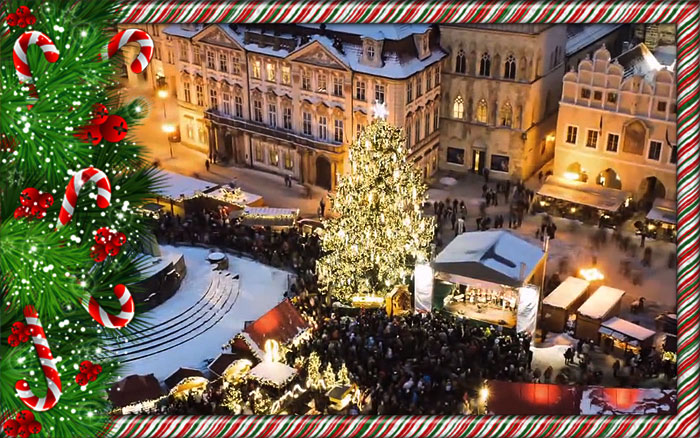
From late November, Slovak towns hold Christmas markets (vianočné trhy). In Bratislava, the main market fills Hlavné námestie (Main Square), Františkánske námestie (Franciscan Square) and Primaciálne námestie in the old town, with further stalls on Hviezdoslavovo námestie. The 2025–26 season ran from 27 November to 6 January, and the markets usually stay partly open between Christmas and New Year, closing late on New Year's Eve. Visitors come for mulled drinks, handicrafts and Slovak specialities such as lokše (potato pancakes), kapustnica served in cups and decorated medovníky.
Štedrý večer: the Slovak Christmas Eve supper
Christmas Eve is the most important day of the Slovak Christmas. Traditionally it was a day of fasting, and anyone who held out without food until supper was promised a glimpse of a golden piglet or a golden star. The tree is decorated and a candle is lit before the family sits down to supper.
Customs at the table
The supper begins with a shared prayer. In many families the head of the household marks a small cross of honey on each person's forehead, and everyone eats oblátky, thin wafers, spread with honey for sweetness and plenty. Some families also eat a clove of garlic for health. Money or a carp scale is tucked under the tablecloth so that wealth will multiply, a chain is sometimes placed around the table legs to keep the family together, and walnuts may be thrown into the corners of the room for abundance. An extra place is laid for an unexpected guest or for family members who cannot be there, including those who have died.
An apple is cut across the middle and shared: if the seeds form a star, the family can expect health and happiness, while a cross shape was read as a bad sign.
The courses
Next comes soup, most often kapustnica, a sauerkraut soup with dried mushrooms and smoked sausage or meat, often finished with cream. The main course in almost every family is fried carp with potato salad, the salad made with mayonnaise, pickles and carrots. In most of Slovakia the meal also includes opekance, also called bobaľky or pupáky, small baked dough balls topped with poppy seeds, which were once believed to have magical power. Medovníky, nuts and fruit complete the table.
Ježiško, carols and midnight Mass
During or after the supper, Ježiško, the Infant Jesus, leaves presents under the tree. He is never seen. Presents are opened on Christmas Eve, not on Christmas morning.
Many families then go to midnight Mass, polnočná omša, often shortened to polnočná. Through the Christmas season, groups of carol singers (koledníci) visit homes. The best known today are the carollers of Dobrá novina ("Good News"), a Catholic charity campaign run with the youth movement eRko since the mid-1990s, who sing in Slovak homes and collect money for development projects in Africa. Over 30 years it has supported more than 420 projects.
Christmas Day, Prvý sviatok vianočný, is a quiet day for church and family, and 26 December, Druhý sviatok vianočný, St Stephen's Day, is for visiting relatives and friends.
Christmas holidays and shop opening in Slovakia
24, 25 and 26 December are all days off work (dni pracovného pokoja) in Slovakia, and so are 1 and 6 January. From 2024 the government began turning other public holidays into working days as part of a budget consolidation: Constitution Day (1 September) from 2024, and 8 May and 15 September from 2026, with 17 November also dropped as a day off. The Christmas days were not touched, and in 2026 Slovakia has 11 days off in all.
The same package relaxed Sunday-style closing rules on holidays. Since the 2025–26 season, shops may open on most public holidays, including Epiphany, but they must still close on Christmas Eve from 12 noon, on 25 and 26 December, on 1 January, Good Friday and Easter Sunday. Pharmacies, petrol stations and shops at airports and railway stations are exempt.
Traditional Slovak Christmas food
The Slovak Christmas table varies from region to region, but a few dishes appear almost everywhere.
| Food | What it is | When it is eaten |
|---|---|---|
| Oblátky (oplátky) | Thin round wafers spread with honey, sometimes eaten with a clove of garlic | Start of the Christmas Eve supper |
| Kapustnica | Sauerkraut soup with dried mushrooms, smoked sausage or meat, often finished with cream | Christmas Eve supper; also sold at markets |
| Kapor so zemiakovým šalátom | Fried carp with potato salad dressed with mayonnaise, pickles and carrots | Christmas Eve main course |
| Opekance / bobaľky | Small baked dough balls topped with poppy seeds | Christmas Eve, in most of Slovakia |
| Medovníky | Spiced honey biscuits, often iced and decorated | Baked in Advent; sold everywhere at Christmas |
| Lokše | Thin potato pancakes with sweet or savoury fillings | Christmas markets |
| Apples, walnuts and honey | Shared at the table; an apple is cut across to read the year's luck | Christmas Eve |
| Šošovica | Lentil soup or lentils, for wealth in the coming year | New Year's Day |
Slovak and Czech Christmas: what is the difference?
Slovakia and the Czech Republic formed Czechoslovakia from 1918 to 1992 and still share most Christmas customs, but the Christmas Eve table differs.
| Custom | Slovakia | Czech Republic |
|---|---|---|
| Word for Christmas | Vianoce | Vánoce |
| Christmas Eve | Štedrý deň / Štedrý večer | Štědrý den / Štědrý večer |
| Gift-bringer | Ježiško | Ježíšek |
| Start of the supper | Oblátky wafers with honey | Usually fish soup |
| Typical soup | Kapustnica (sauerkraut) | Rybí polévka (fish) |
| Main course | Fried carp and potato salad | Fried carp and potato salad |
For the Czech side, including Mikuláš's angel and devil and the Christmas Eve superstitions, see Christmas in the Czech Republic.
Silvester, New Year and Epiphany
New Year's Eve in Slovakia is Silvester, named after the feast of Pope St Sylvester on 31 December. It is a night of parties, dancing and fireworks at midnight, and in recent years the Bratislava markets have stayed open into the early hours. 1 January is both New Year's Day and the Day of the Establishment of the Slovak Republic, created on 1 January 1993. Folk custom says that how you meet the new year is how you will spend it: lentils are eaten for wealth, pork is preferred because a contented pig stays near the home, and poultry and fish are avoided so that luck does not fly or swim away. A traditional wish runs "Rok nový, spokojný, šťastivý a hojný", a new year that is content, lucky and plentiful. If you are writing to Slovak friends, you can find free New Year greetings for Silvester, along with Happy New Year 2027 cards and status images to share.
The season closes on 6 January, Traja králi, the feast of the Three Kings, which remains a day off.
Slovak Christmas season dates 2026
| Date | Occasion | What happens |
|---|---|---|
| First Sunday of Advent | First candle on the Advent wreath; markets in full swing | |
| Mikuláš Eve | Boots cleaned and set on the windowsill | |
| Mikuláš (St Nicholas) | Sweets and fruit; St Nicholas visits with an angel and a devil | |
| Lucia (St Lucy's Day) | Old witch-day customs; the twelve-day love divination begins | |
| Štedrý deň (Christmas Eve) | Day off; shops close at noon; supper, Ježiško and midnight Mass | |
| Prvý sviatok vianočný (Christmas Day) | Day off; shops closed; church and family | |
| Druhý sviatok vianočný (St Stephen's Day) | Day off; shops closed; visiting relatives | |
| Silvester (New Year's Eve) | Parties and fireworks at midnight | |
| New Year's Day; Day of the Establishment of the Slovak Republic | Day off; shops closed; lentils for wealth | |
| Traja králi (Epiphany) | Day off; end of the Christmas season |
Bratislava's 2026 market dates had not been announced at the time of writing; the markets usually open in the last week of November.
Christmas in Slovakia: frequently asked questions
How is Christmas celebrated in Slovakia?
In Slovakia, Christmas, Vianoce, reaches its peak on Christmas Eve, Štedrý večer, 24 December. The family supper begins with prayer and oblátky wafers with honey, followed by kapustnica sauerkraut soup and fried carp with potato salad, and Ježiško, the Infant Jesus, leaves presents under the tree. Many families then go to midnight Mass, and 25 and 26 December are quieter days of family visits.
Who brings Christmas presents in Slovakia?
Presents are brought by Ježiško, the Infant Jesus, on Christmas Eve. He leaves them under the Christmas tree during or after the family supper and is never seen. Earlier in the season, on the night of 5 to 6 December, Mikuláš, St Nicholas, brings sweets and fruit, often visiting in person with an angel and a devil.
What is kapustnica?
Kapustnica is a Slovak sauerkraut soup and the best-known dish of the Christmas Eve supper. It is usually made with dried mushrooms and smoked sausage or other meat, and is often finished with cream. Every region and family has its own recipe, and it is also sold at Slovak Christmas markets.
What are oblátky?
Oblátky, also called oplátky, are thin round Christmas wafers baked in a wafer iron. They are eaten at the start of the Christmas Eve supper, spread with honey and sometimes eaten with a clove of garlic, as a wish for a sweet, healthy and prosperous year. In many homes the head of the family also marks a small cross of honey on each person's forehead.
Is Christmas Eve a public holiday in Slovakia?
Yes. 24, 25 and 26 December are all days off work in Slovakia, and they were kept when the government turned several other public holidays into working days from 2024 onwards to save money. Shops must close at 12 noon on Christmas Eve and stay closed on 25 and 26 December, although pharmacies, petrol stations and shops at airports and railway stations may open.
What happens on St Lucy's Day in Slovakia?
St Lucy's Day, 13 December, was one of the so-called witch days of the Slovak folk calendar. In the past, people dressed in white with flour on their faces went from house to house carrying a goose wing and silently swept the corners of rooms to drive out evil, and garlic was hung on stable doors. A love-divination custom also began that day: twelve names were written on slips of paper and one was destroyed each day, the last one on Christmas Eve revealing a future partner.
What is the Light of Peace from Bethlehem in Slovakia?
The Light of Peace from Bethlehem is a flame lit in the Church of the Nativity in Bethlehem and brought to Linz in Austria. Slovak scouts have collected it there every year since 1990 and carry it across Slovakia before Christmas, to churches, hospitals, care homes and private houses. Many families light a candle from it for the Christmas Eve table.
How is Slovak Christmas different from Czech Christmas?
Both countries celebrate mainly on Christmas Eve, eat fried carp with potato salad and receive presents from the Infant Jesus, Ježiško in Slovak and Ježíšek in Czech. The Slovak supper usually opens with oblátky wafers and honey and features kapustnica sauerkraut soup, while the Czech supper typically opens with fish soup.
How do you say Merry Christmas in Slovak?
Merry Christmas in Slovak is Veselé Vianoce. The fuller greeting Šťastné a veselé Vianoce means a happy and merry Christmas, and it is often followed by a wish for the new year, such as a šťastný nový rok, a happy new year.
Christmas in nearby countries
 CLAT Aspirants
 Diwali
 Thanksgiving
 Christmas
 Craft Ideas for Kids
 Fun and Jokes
 School Projects & Homework Help
 Hobbies

CLAT Preparation for Students
Class 12 Accounts Mock Papers
Thanksgiving Greetings
Chritmas Greeting Cards
Christmas Around the World
New Year 2027
Hanukkah Cards
7 Continents of the World
Moral Stories
Fairy Tales and Fables
Classic Stories
Betal Pachisi
Singhasan Battisi
Indian Mythology stories
School Projects
Quiz on Famous Footballers
Unsolved Mysteries
Pets & Pet Care
Wishes and Greetings in Many Languages