

The Curse and Grace of the Moon
Have you ever wondered why the moon grows full and then fades away, over and over, every month? The Shiva Purana has a beautiful answer — one that begins with a father's disappointment and ends with Shiva's quiet kindness.
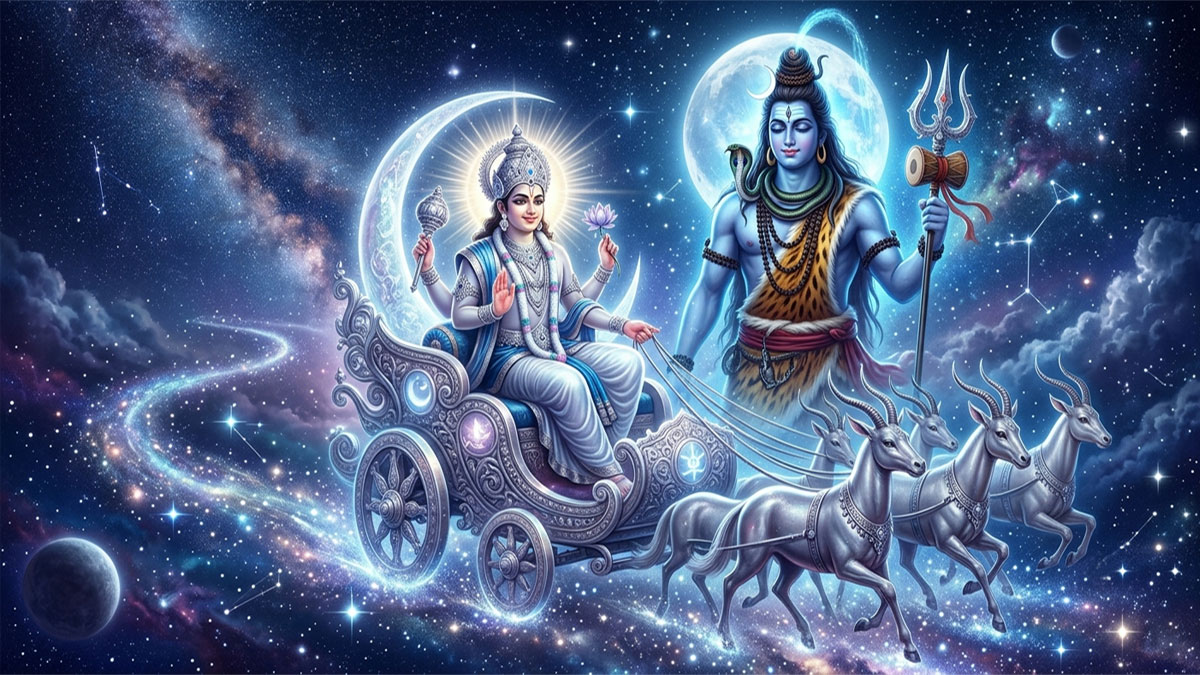
A Favourite Among Many
The Moon God, Chandra, was married to all twenty-seven daughters of King Daksha, each of whom represented one of the twenty-seven constellations that circle through the night sky. Rather than treating each of his wives with equal care and attention, however, Chandra devoted almost the whole of his love to just one of them, a gentle wife named Rohini, and largely ignored the other twenty-six entirely.
Hurt and increasingly resentful of this ongoing neglect, the overlooked daughters eventually went together to their father and pleaded with him to intervene on their behalf. Daksha, deeply troubled by what he heard, approached Chandra directly and warned him more than once to treat all of his wives fairly, without favouritism.
Chandra, however, remained unmoved by these repeated warnings, continuing to favour Rohini exactly as before, seemingly unwilling or unable to change his behaviour despite his father-in-law's growing frustration.
A Fading Light
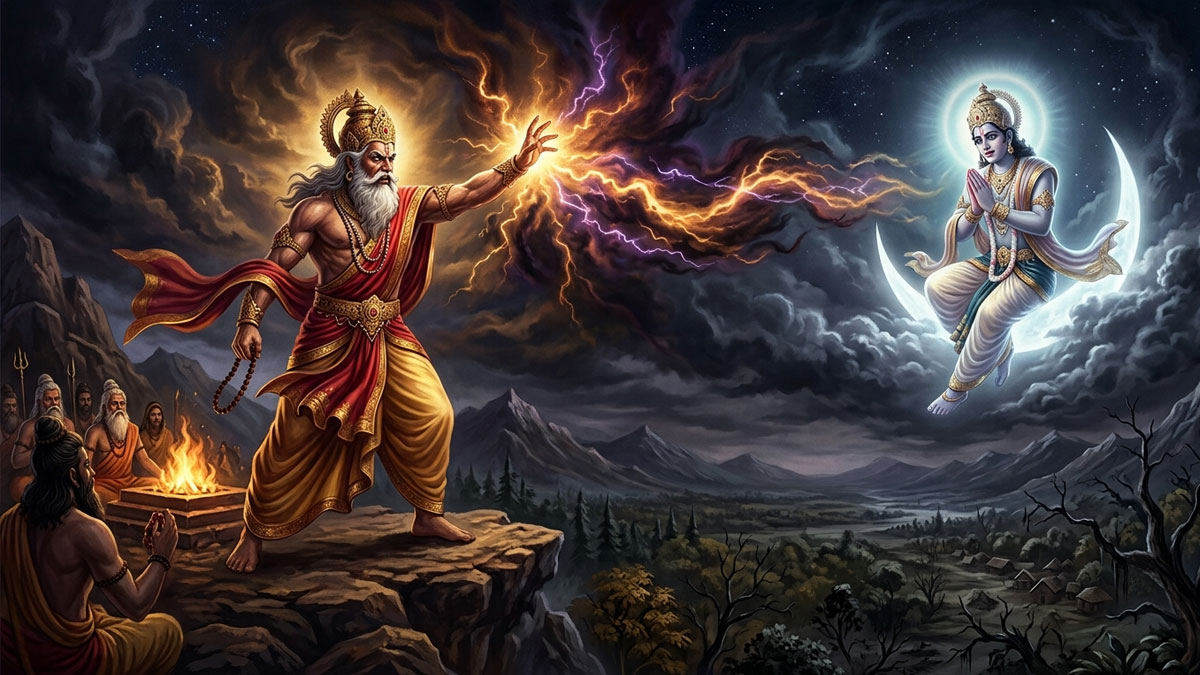
Finally, his patience exhausted, an enraged Daksha pronounced a powerful curse upon Chandra: he would suffer from Kshay Roga, a wasting affliction that would cause his vital life force and his once-brilliant light to grow dimmer and weaker with every single passing day.
As the curse began to take hold, the moon's light in the night sky started fading visibly, night after night, growing thinner and dimmer until it seemed close to vanishing altogether. This decline did not affect Chandra alone — as his light weakened, plants across the earth that depended on his gentle glow for their nourishment began to wither, and all of creation slowly began to suffer under the growing darkness.
Shiva's Gentle Compromise
Desperate and fading fast, Chandra sought guidance and was advised to seek out Lord Shiva directly. He travelled to the coastal region now known as Prabhas Patan, in present-day Gujarat, and prayed there with complete sincerity and devotion for six unbroken months, hoping against hope that Shiva might find a way to help him.
Moved by the depth of his devotion, Shiva finally appeared before him. He explained gently, but honestly, that a curse spoken by a father like Daksha could not simply be erased or undone entirely, no matter how much compassion he wished to offer. What he could do, however, was find a way to soften its effects into something more bearable.
Shiva placed Chandra safely upon his own head, cradling him gently among his matted locks alongside the sacred river Ganga. From that day forward, he decreed a new pattern for the moon's existence: for fifteen days, Chandra's light would slowly fade, exactly as Daksha's curse required, but for the following fifteen days, he would just as steadily grow back toward his full brilliance once again. This became the eternal cycle of waxing and waning, the Krishna Paksha and Shukla Paksha, that the moon still follows in the sky above us every single month.
Why This Story Matters
This story turns something children see every night — the changing moon — into a story about fairness and fresh starts. It gently teaches that consequences for our actions are real, but that even after a mistake, there's usually a path back toward balance and light.
Quick Questions
Why does the moon wax and wane, according to this story?
According to the Shiva Purana, Shiva could not remove Daksha's curse entirely, so he arranged for the moon to fade for fifteen days and then grow full again for the next fifteen, creating the lunar cycle.
Why is a crescent moon shown on Shiva's head?
The crescent moon represents Chandra, the Moon God, whom Shiva protected by placing him safely on his own crown after Daksha's curse.