

The Tandava of Grief and the Origin of the Shakti Peethas
After Sati left her body, Lord Shiva's sorrow was too large for the universe to hold safely. What happened next explains why, even today, certain places across India are considered among the holiest on Earth.
A Dance That Shook the Skies
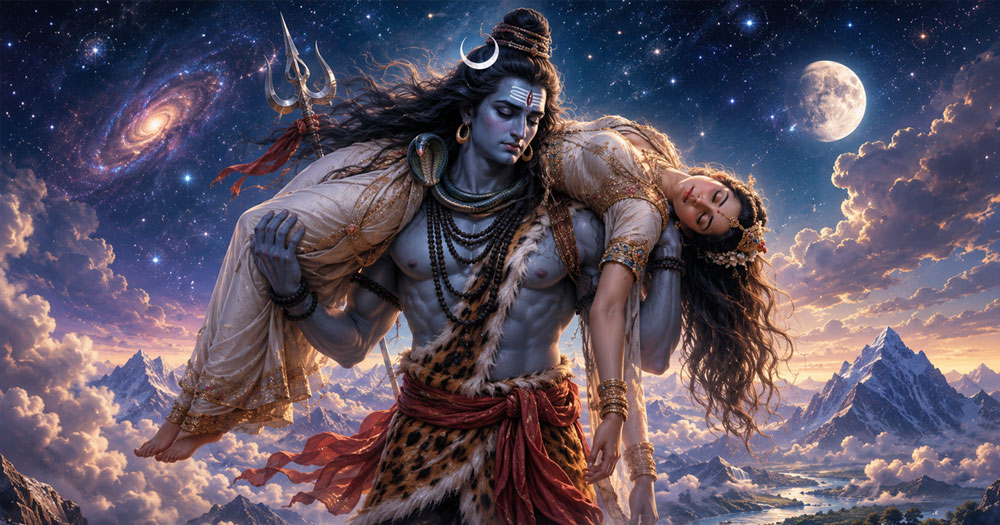
Once Virabhadra's fury had passed and the terrible ceremony lay in ruins, Shiva walked slowly into the wreckage and gathered up the unburned body of his beloved wife, lifting her gently onto his shoulders. He did not return to Kailash. Instead, lost entirely in his grief, he began to wander across the heavens, carrying Sati with him wherever he went.
As he walked, his sorrow began to take a shape of its own. It turned into a wild, unstable version of his great cosmic dance, the Tandava — a dance usually performed with perfect, deliberate control, now unleashed as pure, uncontained grief. Wherever his feet came down, mountains trembled to their roots, rivers changed their courses, and stars themselves seemed to dim and flicker in the sky.
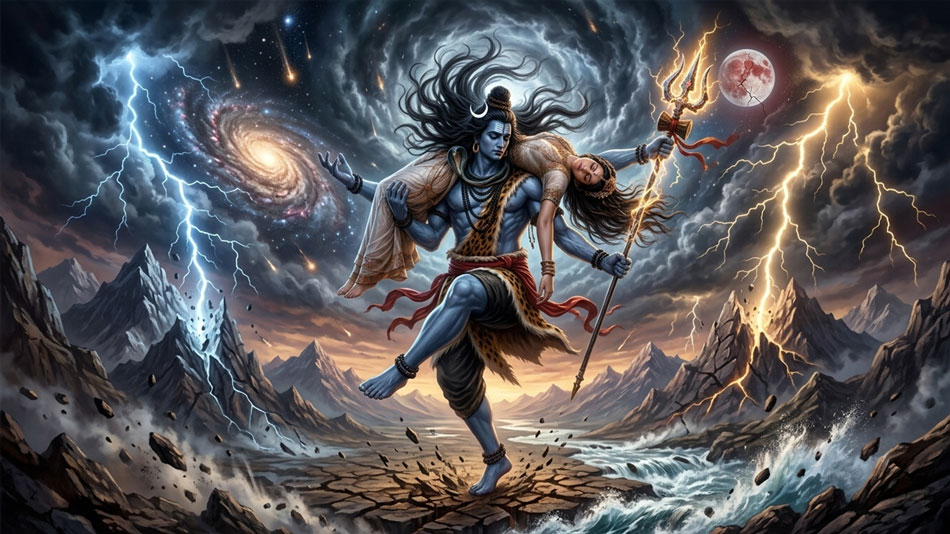
The other gods, watching from their own realms, grew more alarmed with every passing hour. What had begun as a private sorrow was quickly becoming something far more dangerous. If Shiva's grief-dance continued unchecked, the delicate structure holding the entire universe together might come completely undone.
Vishnu Steps In
Understanding that Shiva, consumed entirely by his loss, would never willingly choose to let Sati go on his own, the gathered gods turned to the one being they believed might be able to help without confronting Shiva directly: Lord Vishnu, the great protector and preserver of the universe.
Vishnu did not attempt to stop Shiva or reason with him. Instead, he quietly followed him through the sky, keeping his distance, watching for the right moment. When it finally came, he released his spinning discus, the Sudarshana Chakra, sending it out silently to do what needed to be done without forcing Shiva to make the choice himself.
The discus moved with careful precision, gently separating Sati's body, piece by piece, so that the terrible weight of Shiva's grief could slowly ease without ever requiring him to consciously decide to release her.
Sacred Ground Across the Land
Wherever a single piece touched the earth below, that exact spot transformed instantly into a place of extraordinary, sacred energy — a Shakti Peetha. Piece by piece, as Shiva continued his dance across the sky, these sacred sites began appearing across the length and breadth of the Indian subcontinent, from the icy peaks of the Himalayas all the way down to the warm southern coasts.
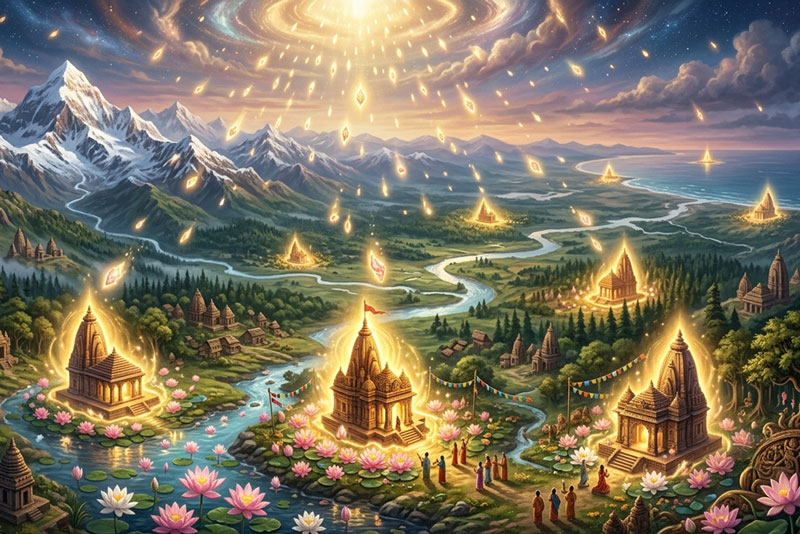
In time, fifty-one such locations came to be recognised, each one honoured as a place where the divine feminine had touched the earth directly. Pilgrims still travel to these very sites today, generation after generation, to offer their prayers at the places where this ancient story is said to have unfolded.
As the very last piece fell away, Shiva's wild, destructive dance finally began to grow calmer. Slowly, he came to understand that the weight had lifted for a reason far larger than his own personal sorrow — that something sacred and lasting had grown out of his loss. He settled at last into deep, quiet meditation on Mount Kailash, waiting, though he did not yet know it, for Sati to return to him once again.
Why This Story Matters
This story helps children understand grief in a gentle way — that even the deepest sorrow eventually needs to be set down, and that something meaningful can grow from loss. The Shakti Peethas, still visited by millions of pilgrims today, are living proof of how this ancient story continues to shape real places on the map.
Quick Questions
What are the Shakti Peethas?
The Shakti Peethas are sacred sites across the Indian subcontinent believed to mark the spots where pieces of Goddess Sati's body fell to earth during Shiva's grieving dance.
Why did Vishnu use his discus on Sati's body?
Vishnu acted to gently ease Shiva's unbearable grief and stop his destructive dance from shaking apart the universe, since Shiva could not bring himself to let go on his own.