

Daksha's Sacrifice and the Devotion of Sati
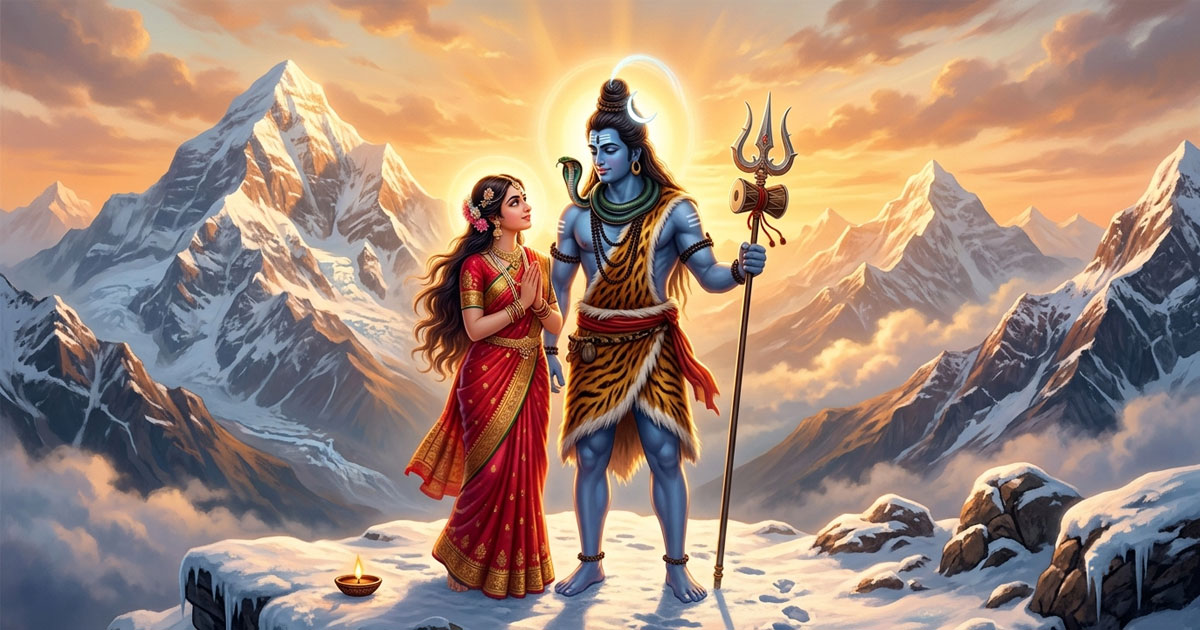
Goddess Sati loved her husband, Lord Shiva, with all her heart. But her own father, King Daksha, never approved of Shiva's simple, unusual way of life. Their disagreement would grow into one of the most sorrowful stories in the Shiva Purana.
A Father's Disapproval
King Daksha was a proud and immensely powerful ruler, one of Brahma's own mind-born sons, respected across the heavens as a great patriarch and organiser of sacred rituals. When his daughter Sati first performed intense penance in the hope of marrying Shiva, Daksha was troubled. He could not understand why any daughter of his — raised amid wealth, order, and royal dignity — would set her heart on a god who wandered cremation grounds, wore ash upon his skin, kept serpents as ornaments, and surrounded himself with spirits rather than kings.
Sati's devotion, however, proved unshakeable, and Daksha eventually agreed to the marriage rather than stand in his daughter's way entirely. Yet agreeing was not the same as approving, and deep in his heart, his disapproval of Shiva's unconventional life never really faded. It simply waited, quietly, for an opportunity to resurface.
Sati, for her part, saw past every outward appearance that troubled her father. She knew her husband not as the wild ascetic others whispered about, but as the deepest, gentlest, and wisest soul in the entire universe, and she carried that certainty with her wherever she went.
An Invitation Left Unsent
As years passed, Daksha's old resentment found its moment. He decided to hold an enormous, magnificent sacrificial ceremony — a Yajna grand enough to draw every god, sage, and celestial being across the three worlds. Invitations were sent far and wide, to every corner of creation, with one deliberate exception: neither Shiva nor Sati received an invitation at all.
From her home on Mount Kailash, Sati began to notice something strange in the sky — chariot after glittering chariot streaking past, all heading in the same direction, toward her father's grand ceremony. Confused and hopeful, she asked Shiva if they might attend as well, certain there had simply been some oversight.
Shiva, who understood far better than Sati what her father's silence truly meant, gently tried to warn her. He explained that no good could come of arriving somewhere one had not been welcomed, even if that place was a parent's own home. But Sati's heart ached with longing to see her family again, and against his quiet caution, she set out for her father's kingdom alone.
Words That Could Not Be Taken Back
When Sati arrived at the ceremony, dressed simply and without the grandeur of the other guests, she moved through the crowd searching for some sign that her husband had been remembered — an offering set aside in his name, a seat left open for him. She found nothing. Every other god had received full honour and respect; Shiva's place remained completely empty, as though he did not exist at all.
Confronting her father directly, Sati asked why Shiva had been excluded. Rather than offering any kind of apology, Daksha responded in front of the entire gathered assembly with open scorn, mocking Shiva's appearance, his choice of company, and his simple, ash-covered way of life, calling him unworthy of the honour shown to every other god present.
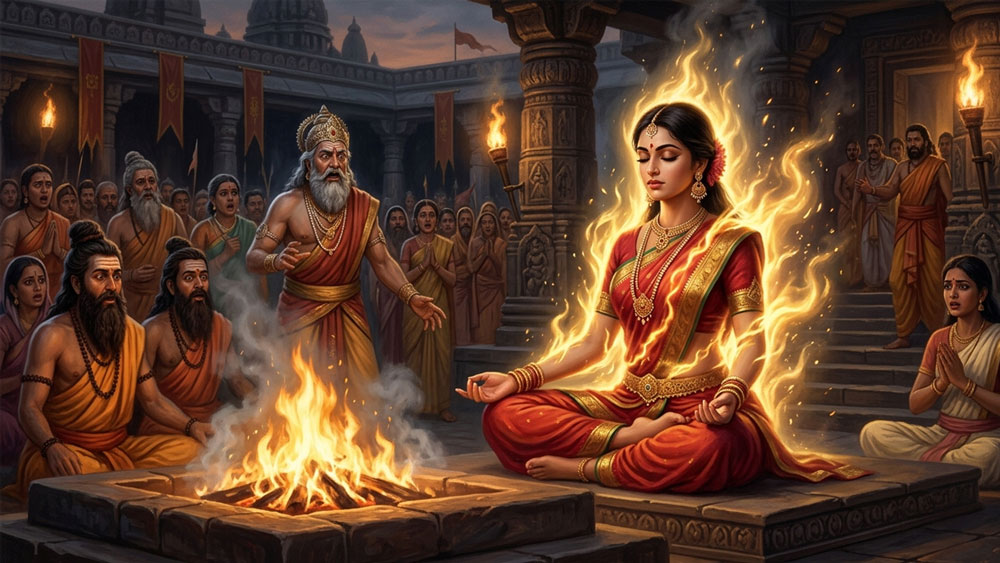
Sati could have borne almost any insult directed at herself. But hearing her husband spoken of this way, in front of gods and sages who said nothing to defend him, filled her with a grief and anger she could not contain. She felt, in that moment, the full weight of having been born from a body connected to a father capable of such cruelty. Without another word, she sat down calmly upon the ground, closed her eyes, and drew upon her own deep yogic power. A pure inner fire rose within her, and before the shocked and silent crowd, she released her own life, her body consumed entirely by flames she herself had called forth.
Shiva's Grief and Virabhadra's Fury
When the news reached Mount Kailash, it struck Shiva like nothing before it. His sorrow was so immense that it did not stay sorrow for long — it transformed, almost instantly, into a fury the universe had rarely witnessed. In his grief, he tore a single lock of his own matted hair and struck it against the ground with tremendous force.
From that strand of hair rose a towering, terrifying warrior named Virabhadra, along with the fierce goddess Bhadrakali, both born entirely from Shiva's anguish and rage. Without hesitation, Shiva sent them both to Daksha's ceremony, and they arrived like a storm breaking over a still lake.
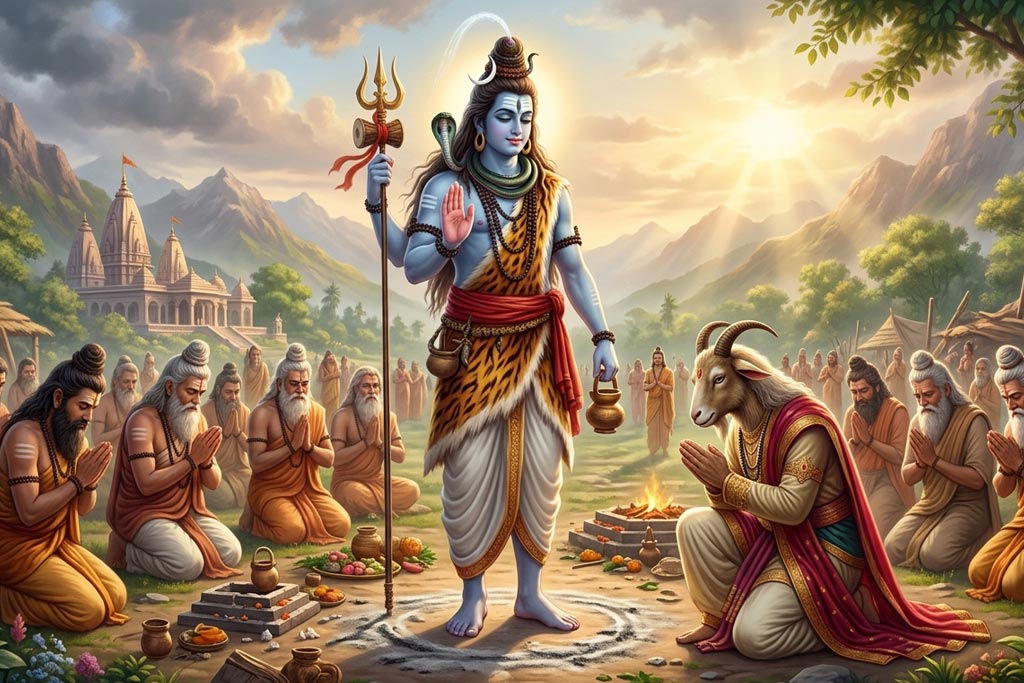
Virabhadra tore through the grand assembly, scattering the celestial guests who tried in vain to defend it, and brought the entire elaborate ceremony to a complete and violent end. Daksha himself did not escape the consequences of the cruelty he had spoken. Yet even in the depths of his fury, Shiva's underlying nature remained one of compassion rather than pure destruction — and in time, once his rage had passed, he restored what could still be restored, showing that even his most terrible anger had grown out of love, not hatred.
Why This Story Matters
This story is often told to children not for its sorrow, but for what it says about standing beside people we love, even when others look down on them. It also gently reminds us that pride and mockery — even from someone as powerful as a king — can cause pain that ripples far beyond what was intended.
Quick Questions
Why was Sati not invited to her father's ceremony?
King Daksha excluded Sati and Shiva because he never approved of Shiva's simple, unconventional way of life, even though Sati had chosen to marry him out of deep devotion.
Who was Virabhadra?
Virabhadra was a mighty warrior that Lord Shiva created from a lock of his own hair, born out of grief and anger after Sati's passing.