

The Manifestation of Rudra
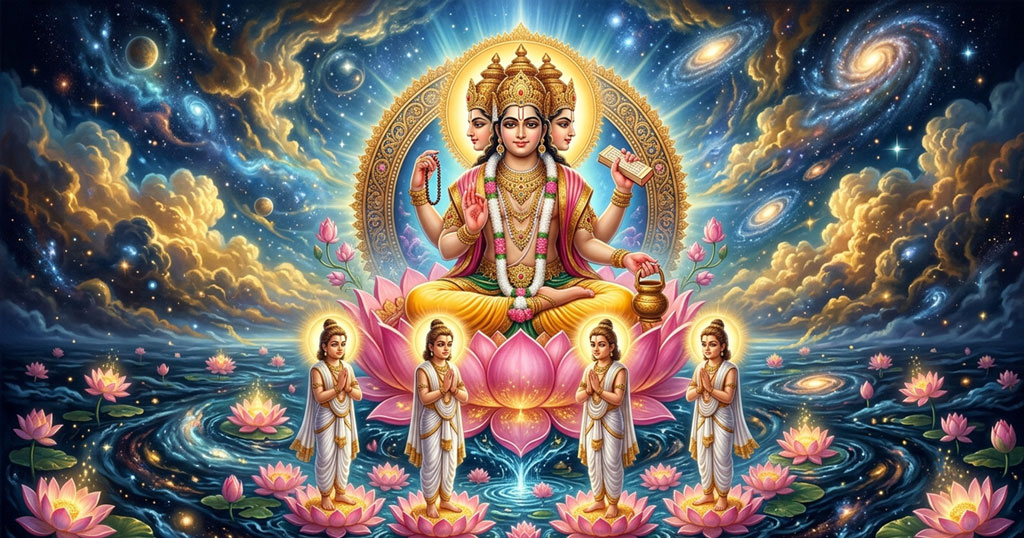
In the earliest days of the universe, Lord Brahma faced a problem no god had faced before: the beings he created refused to help him fill the world with life. His frustration would soon give rise to one of the most powerful forms of Lord Shiva.
Brahma's Silent Sons
When creation was still very young, and the world was little more than empty land, still water, and open sky, Brahma set about the enormous task he had been given: filling this new universe with living beings. Using nothing but the power of his own mind, he brought forth four remarkable sons – Sanaka, Sanandana, Sanatana, and Sanatkumara – hoping they would go on to have families of their own and help fill the world with new life, generation after generation.
But these four sons were born already carrying an unusual gift: deep, complete wisdom, far beyond their years. From the very moment of their birth, they understood the nature of the universe so clearly that worldly life held no appeal to them at all. Where Brahma had hoped for busy households and growing families, his sons instead chose to wander the universe in quiet meditation, forever unmarried, forever detached from ordinary concerns.
Brahma watched, at first with pride, and then with growing unease, as his sons walked away from the world he had built for them. Days turned into years, and years into ages, and still the world remained mostly empty, its vast lands and oceans waiting for a population that never seemed to arrive.
The Birth of a Weeping Child
Brahma's disappointment slowly hardened into frustration, and that frustration grew heavier with every passing age, until it gathered like a storm cloud at the very center of his forehead, in the space between his eyebrows. He tried to hold it in, but the pressure only continued to build, unlike anything he had felt before.
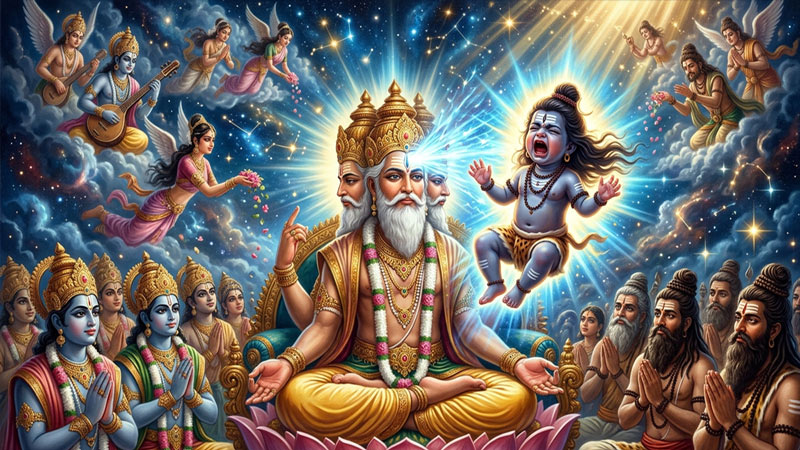
Then, without warning, the skin at the center of his brow split open. From that opening stepped a radiant being unlike anything Brahma had created before – glowing, powerful, and crying loudly the very moment he took shape, his voice echoing across the still-forming universe. He seemed to carry two natures within him at once: the strength of a fierce warrior on one side, and a gentleness as tender as a mother's on the other.
Startled by the wailing, Brahma asked the being why he wept so bitterly at the very moment of his birth. But the child only continued to cry, filling the still, empty sky with a sound that seemed to hold both sorrow and power in equal measure. Because he had wept from his very first breath, Brahma gave him a name built from that sound: Rudra, from a root word meaning 'one who cries' or 'one who roars.'
Eleven Forms for a Growing World
Once Rudra had calmed enough to speak, he asked Brahma directly why he had been called into being, and why his creator seemed so troubled. Brahma explained everything – his early hopes, his sons' refusal to help populate the world, and his growing fear that the universe would remain forever empty. He asked Rudra for help completing the task that had proven so difficult.
Rudra considered this for a long moment, and then, in response, divided himself – not into one helper, but into eleven powerful forms known as the Ekadasha Rudras, each one paired with a companion goddess, the Rudranis. Together, these twenty-two beings spread out across creation, taking charge of the great forces that keep a living universe moving: the breath that fills every creature, the senses that connect a being to the world around it, and the endless, necessary cycle of change that turns birth into growth, and growth into renewal once again.
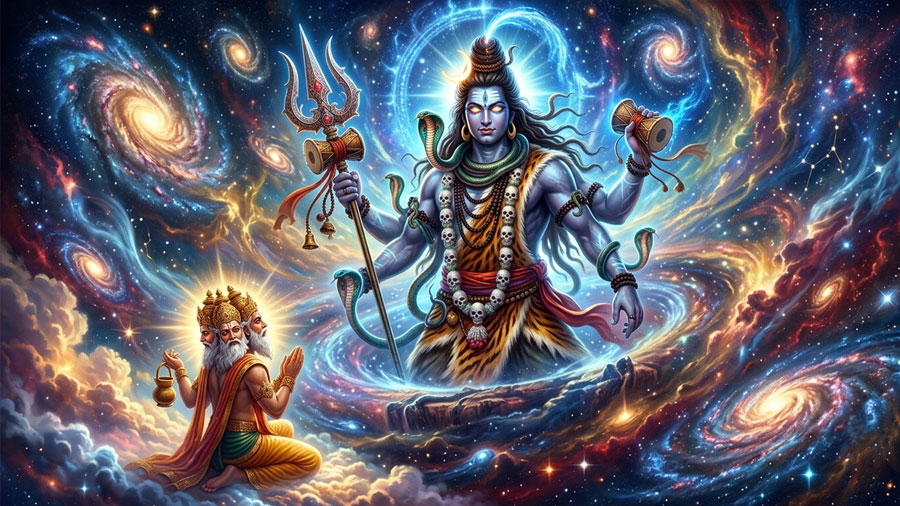
Watching this unfold, Brahma slowly came to understand something important. Rudra was not simply another child of his own making, shaped from thought the way his other sons had been. Rudra was Lord Shiva himself, choosing to appear in a form suited exactly to that moment of need – living proof that a universe cannot survive on birth and creation alone. It also needs the steady, sometimes fierce hand of change, without which everything would eventually grow still and stagnant.
Why This Story Matters
This story teaches that both creation and change are needed for life to continue – a garden needs new seeds, but it also needs pruning and the turning of seasons. Rudra represents that second, necessary force: the one that keeps the world from becoming still and stuck.
Quick Questions
Where did Rudra come from?
According to the Shiva Purana, Rudra appeared from the center of Brahma's forehead at a moment of great frustration, when Brahma's first sons refused to help populate the universe.
Why is Rudra important?
Rudra represents the force of change and renewal that balances creation, ensuring the universe keeps growing rather than standing still.