

Deucalion and Pyrrha
In the earliest ages of Greek mythology, humankind grew wicked and cruel, and reports of their bad behaviour reached Mount Olympus and troubled Zeus greatly. Wishing to see the truth for himself, Zeus came down to earth disguised as an ordinary traveller, and everywhere he went, he found that people had grown even worse than the rumours suggested.
Deeply angered by what he witnessed, Zeus decided that humankind needed a fresh beginning. He sent a flood of tremendous size across the earth, and the rivers rose and the rains poured until nearly every town, forest, and mountain valley disappeared beneath the water. Almost no one survived.
Among the very few who lived through the flood were a good and gentle couple, Deucalion and his wife Pyrrha. Deucalion was the son of Prometheus, the Titan who had once given fire to humankind, and he had been warned in advance of what was coming. Prometheus advised his son to build a large wooden chest, and Deucalion and Pyrrha climbed inside together just as the waters began to rise, floating safely upon the flood for nine long days and nights.
When the waters finally receded and the chest came to rest upon a mountaintop, Deucalion and Pyrrha climbed out to find the world around them empty and silent. Grateful to be alive but sorrowful to find themselves so completely alone, they prayed to the gods for guidance on how to go on.
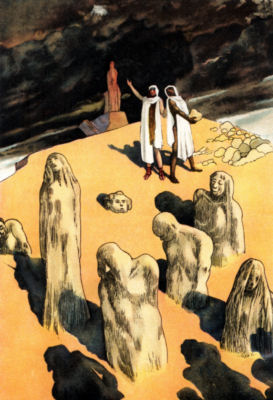
An oracle answered their prayer with a puzzling instruction: they were to cover their heads, loosen their robes, and cast the bones of their mother behind them as they walked. At first the couple was confused and troubled by such a strange command, until Deucalion realised what the oracle truly meant — their "mother" was the earth itself, and her "bones" were the stones scattered across the ground.
Following this new understanding, Deucalion and Pyrrha gathered stones and cast them over their shoulders as they walked. To their astonishment, each stone Deucalion threw softened and rose up as a man, while each stone Pyrrha threw became a woman. In this way, the earth was slowly repopulated once more, and Deucalion and Pyrrha became, in Greek mythology, the parents of a renewed human race.
Who's Who in This Story
- Deucalion — son of the Titan Prometheus, who survived the great flood with his wife
- Pyrrha — Deucalion's wife, who survived the flood alongside him
- Zeus — king of the gods, who sent the flood to cleanse the earth of wickedness
Did You Know?
- Flood stories similar to Deucalion and Pyrrha's appear in many cultures around the world, including the story of Noah's Ark.
- Deucalion is sometimes called the "Greek Noah" because of how closely their stories echo one another.
- The wordplay in the original Greek myth relies on the fact that the Greek words for "stone" (laas) and "people" (laos) sound alike.
The myth of Deucalion and Pyrrha reminds us that even after the greatest loss, it is kindness, patience, and a willingness to begin again that allow the world — and its people — to be rebuilt.