

Mythological Story: Prometheus, The Friend of Man
Long before the age of mortal heroes, there lived two brothers among the Titans: Prometheus, whose name meant Forethought, and Epimetheus, whose name meant Afterthought. When the great war between the Titans and the new gods of Olympus ended in Zeus's victory, most of the Titans were cast down into the underworld in chains — but Prometheus, who had been wise enough to side with Zeus, was spared.
Unlike the other immortals who lounged comfortably on Mount Olympus, Prometheus took a special interest in the small, shivering creatures called humans, whom he and his brother had shaped from clay. Humans in those early days had no fire, no tools, and no way to defend themselves against the cold or the wild animals that hunted them. Prometheus watched them suffer through freezing nights and pitied them deeply.
Zeus, however, had forbidden that fire — a power belonging only to the gods — ever be given to mortals. He worried that with fire, humans would grow too powerful and too proud, and might one day rival the gods themselves. But Prometheus could not bear to watch humankind struggle any longer. One night, he crept to the forge of Hephaestus, the god of fire and craftsmanship, and lit a hollow fennel stalk from a spark of the sacred flame.
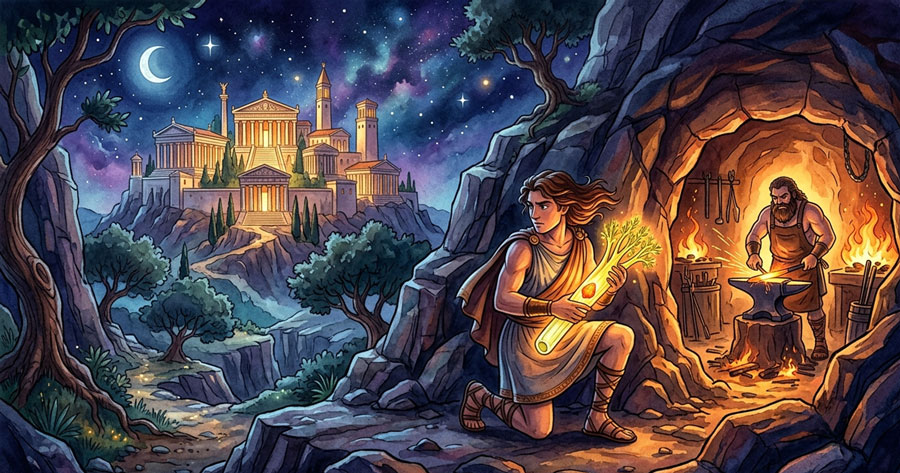
He carried the glowing stalk down from Olympus and pressed its ember into the very first human hearth. Overnight, everything changed. With fire, people could cook their food, warm their homes, forge metal into tools and weapons, and light the darkness. Villages began to glow at night across the earth, and Zeus, looking down from his throne, saw immediately what had happened.
Zeus's fury was terrible. He ordered Prometheus seized and chained to a remote mountain peak, where each day an eagle would swoop down and tear at his liver. Because Prometheus was immortal, his liver grew back every night, only for the torment to begin again the following morning. It was a punishment meant to last forever.
But Prometheus never once regretted his choice. Bound to the rock through storm and sun, he held firm in the belief that humankind's gift of fire — and everything it made possible — was worth the price he paid. Many generations later, the mighty hero Heracles, wandering near that same mountain during his own labours, took pity on the Titan. He shot down the tormenting eagle and broke the chains that had held Prometheus captive for so long, finally setting the Friend of Man free.
Who's Who in This Story
- Prometheus — a Titan who defied Zeus to give fire to humankind
- Epimetheus — Prometheus's brother, whose name means "Afterthought"
- Zeus — king of the Olympian gods, who forbade fire to mortals and punished Prometheus for defying him
- Heracles — the great Greek hero who eventually freed Prometheus from his chains
Did You Know?
- The word "Promethean" is still used today to describe bold, defiant creativity.
- In some versions of the myth, Prometheus also taught humans medicine, writing, mathematics, and how to read the stars.
- Prometheus's story inspired the title of Mary Shelley's novel Frankenstein, or The Modern Prometheus.
Prometheus's story asks us to think about courage of a quieter kind — the willingness to give something of great value to others, even when it comes at a personal cost.