

Mythological Story: The Story of Iphigenia
Before the Greek ships could ever sail for Troy, they gathered first at a harbour called Aulis, where hundreds of vessels waited, sails ready, for the wind that would carry them across the sea. But day after day, the wind refused to rise. The waters lay still and silent, and the great fleet sat trapped in the harbour while the soldiers grew restless and food supplies dwindled.
King Agamemnon, leader of the Greek forces, consulted with the seer Calchas to learn why the winds would not come. The goddess Artemis, Calchas explained, had been angered, and only a great act of devotion from the king's own family would persuade her to release the fleet. Agamemnon was told to send for his daughter, Iphigenia, who remained far away at home with her mother, Queen Clytemnestra.
Agamemnon wrestled painfully with what he had been asked to do, torn between his love for his daughter and his duty to the thousands of soldiers depending on him to lead the fleet to Troy. He wrote letters back and forth, wavering, unable to settle his heart on any single course. In the end, Iphigenia was sent for and arrived at the camp at Aulis, believing she had been brought there for a joyful occasion.
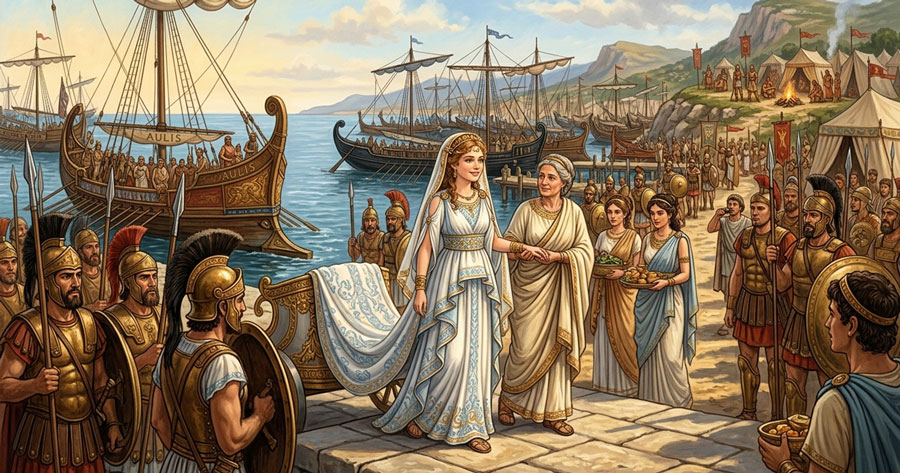
When Iphigenia learned the truth of why she had really been summoned, the ancient storytellers describe her not with despair, but with remarkable courage. Rather than beg to be spared, she resolved to accept her fate with dignity, understanding what her father's fleet and their long voyage meant for all of Greece. It is this steady, selfless bravery — rare even among the great heroes of Greek mythology — that made Iphigenia's story endure for thousands of years.
According to the oldest and gentlest versions of the myth, at the very last moment, the goddess Artemis took pity on Iphigenia's courage. In a flash of divine mercy, she spirited the girl away to become a priestess in a distant land, leaving a deer in her place, and it was this act of mercy — not sorrow — that finally satisfied the goddess and sent the long-awaited wind rushing into the waiting sails. The Greek fleet at last set out across the sea toward Troy.

Who's Who in This Story
- Iphigenia — the daughter of King Agamemnon, remembered for her courage and devotion
- Agamemnon — king and leader of the Greek forces bound for Troy
- Artemis — the goddess of the hunt and the wilderness, who held back the winds at Aulis
- Calchas — the seer who interpreted the will of the gods for the Greek army
Did You Know?
- Iphigenia's story has inspired countless plays and operas over the centuries, including works by the ancient Greek playwright Euripides.
- The port of Aulis where the story takes place was a real harbour in ancient Greece, still known by a similar name today.
- Artemis, the goddess in this story, was also the twin sister of Apollo, the god of the sun and music.
Iphigenia's story has been treasured for thousands of years as one of Greek mythology's clearest examples of quiet courage — choosing to act with grace and dignity even in the most difficult of circumstances.