
Christmas in Alaska
North Pole, Santa's mail, the Orthodox star and Christmas in the Arctic dark


Alaskans celebrate Christmas on 25 December, a federal and state holiday, and many also celebrate Russian Orthodox Christmas on 7 January with the starring tradition. The festive season falls in the darkest weeks of the year: in Utqiagvik the sun does not rise at all, and Fairbanks has under four hours of daylight. Near Fairbanks, the town of North Pole keeps Christmas all year and answers letters to Santa. In Alaska Native villages, Christmas brings community feasts of whale, caribou and akutaq, and games and races that run until New Year's Eve.
How Alaska celebrates Christmas
Christmas in Alaska follows the American pattern: the season opens after Thanksgiving, homes and streets are lit, families put up a tree, and Christmas Day, 25 December, is a federal holiday and an Alaska state holiday, with presents in the morning and a family dinner. Churches hold candlelight and midnight services on Christmas Eve.
What makes an Alaskan Christmas different is its setting and its mix of cultures. The holidays fall in the darkest weeks of the year, so lights matter more than almost anywhere else in the United States. Alaska has a long Russian Orthodox history, and many Alaska Native communities celebrate a second Christmas on 7 January. In the Arctic villages, Christmas is a time of shared feasts, Iñupiaq dancing and games, while settlers' traditions survive too, such as the Norwegian julebukking of Petersburg in Southeast Alaska.
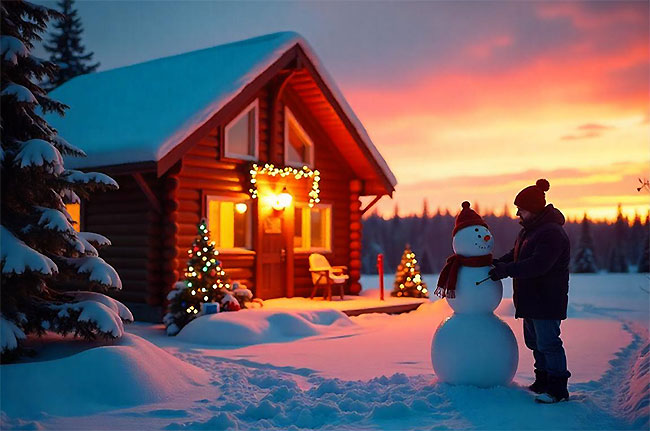
North Pole, Alaska: Christmas all year
About 13 miles (21 km) southeast of Fairbanks on the Richardson Highway lies North Pole, a small city of 2,243 people at the 2020 census. In 1952 the Dahl and Gaske Development Company bought the former Davis homestead, subdivided it and renamed it North Pole, hoping to attract a toy manufacturer. The city was incorporated on 15 January 1953 and has embraced the theme ever since: streets are called Santa Claus Lane, St. Nicholas Drive and Kris Kringle Drive, and the street lights are decorated as candy canes.
The town's best-known attraction is Santa Claus House, which began as a trading post opened by Con and Nellie Miller in 1952 and grew into a Christmas shop where Santa is in residence all year. A giant fibreglass Santa stands outside, and a small herd of reindeer is kept next door. From late November to early January, the Christmas in Ice park beside it fills with Christmas-themed ice sculptures from its carving competitions.
Letters to Santa and the North Pole postmark
Before Christmas, the North Pole post office receives hundreds of thousands of letters addressed to Santa, and thousands more people send their Christmas cards there to be stamped with the town's North Pole postmark. The ZIP code 99705 is promoted as Santa's ZIP code, a community programme answers letters sent to 1 Santa Claus Lane, and Santa Claus House sells personalised letters from Santa, posted with the North Pole postmark.
Christmas in the dark
Alaska's Christmas comes just after the winter solstice, 21 December. In Utqiagvik (formerly Barrow), the northernmost town in the United States, the sun sets in mid-November, around 18 November, and does not rise again until about 22 January: roughly 65 days of near-darkness, the polar night. Further south, the days are short but the sun does rise.
| Place | Daylight on 21 December |
|---|---|
| Utqiagvik | None: the sun stays below the horizon from mid-November to late January |
| Fairbanks | About 3 hours 39 minutes |
| Anchorage | About 5 hours 27 minutes |
| Juneau | About 6 hours 24 minutes |
Lights therefore play a large part in the season. Above Anchorage, the Star on the Mountain, about 300 feet across and lit with 350 bulbs, shines from the Chugach Mountains near Arctic Valley each winter. It began in 1958 as a 15-foot star put up by an Army captain at a nearby missile site, is maintained by crews from Joint Base Elmendorf-Richardson, and stays lit from late November until the last musher finishes the Iditarod sled dog race.
Russian Orthodox Christmas and starring
Orthodox Christianity reached Alaska in the 18th century with Russian fur traders, and missionaries arrived from 1795. The church took root among the Unangan (Aleut), Alutiiq (Sugpiaq), Yup'ik and Tlingit peoples, and it remains strong long after the United States bought Alaska in 1867. Alaska's Orthodox parishes keep the Julian church calendar, so they celebrate Christmas on 7 January and the Orthodox New Year on 14 January.
The heart of Orthodox Christmas in Alaska is starring, known as Slaviq, Selaviq or Slaaviq in Yup'ik communities and Slaawiq in Alutiiq; the name comes from the Slavonic slava, "glory". A large wooden star, covered in tinsel and with an icon of the Nativity at its centre, is spun on a pole while carollers sing hymns in Church Slavonic, English, Yup'ik and other languages. The star is carried from house to house, and each household welcomes the singers with food. In Bristol Bay, villages such as Dillingham and Aleknagik each have their own star, followed by the same families for generations, and singers kiss the icon at the end of the carols. Starring can last up to a week, and the star sometimes travels to neighbouring villages.
The custom came from the Carpathian Mountains of eastern Europe, where carollers carried a star at Christmas, and it has been kept in Alaska for more than a century. Starring is most elaborate in the Yukon-Kuskokwim Delta, but it is also celebrated in Kodiak, the Aleutian Islands, the Kenai Peninsula and Anchorage, where the choir of St. Innocent Cathedral brings the star and its hymns to the Alaska Native Medical Center each 7 January.
Feasts and games in the Arctic villages
In the Iñupiat communities of Alaska's far north, Christmas is a community event. In Kaktovik, on the Beaufort Sea coast, Christmas Day is an all-day feast that opens with a prayer and thanks to the hunters and whalers. The food includes caribou soup and doughnuts, frozen whale meat, whale tongue and flukes, and maktak from the successful whaling crews; Christmas songs are sung in Iñupiaq and English, and the night ends with aġġi, Iñupiaq drumming, singing and dancing.
In Utqiagvik, the Iñupiaq Christmas Games run from Christmas into the first days of the New Year, with daytime games for the youngest and evening games for adults. In Kivalina, the Qaatchiaq races run every day from 26 December to New Year's Eve, with snowmachine and foot races, a race with caribou skins tied to sleds, an egg-and-spoon race and the stake race, the highlight. The event began in the 1960s as a sled dog race.
Christmas around Alaska
| Place | Christmas highlights |
|---|---|
| North Pole | Santa Claus House, its giant Santa statue and reindeer; Christmas in Ice sculpture park, usually from late November to early January; Santa letters and the North Pole postmark |
| Anchorage | Holiday tree lighting in Town Square Park on the weekend after Thanksgiving; the lit Star on the Mountain above the city; Orthodox starring at St. Innocent Cathedral and the Alaska Native Medical Center |
| Kodiak | Harbor Lights boat parade of decorated fishing vessels in December; Orthodox Christmas at Holy Resurrection Cathedral and Alutiiq starring |
| Bristol Bay and the Yukon-Kuskokwim Delta | Slaviq starring with village stars in Dillingham, Aleknagik and neighbouring communities; carols in Yup'ik, Slavonic and English |
| Utqiagvik | Iñupiaq Christmas games from Christmas into the New Year; the polar night |
| Kaktovik | An all-day Christmas Day community feast with whale, maktak and Iñupiaq drumming and dancing |
| Kivalina | Qaatchiaq snowmachine and foot races from 26 December to New Year's Eve |
| Petersburg | Julebukking, a Norwegian-rooted custom of businesses opening their doors with food and drink in the week before Christmas |
In Anchorage, Alaska's largest city, the season opens with the holiday tree lighting in Town Square Park downtown on the weekend after Thanksgiving, when Santa arrives to meet families. In Kodiak, the Kodiak Maritime Museum's Harbor Lights parade sends about a dozen decorated fishing boats through the Near Island Channel, a celebration of the commercial fishing fleet. In Petersburg, a fishing town with Norwegian roots, local businesses invite people in for julebukking in the week before Christmas, serving drinks, pastries and dishes made with local fish.
Christmas food in Alaska
Most Alaskan homes serve a standard American Christmas dinner, but the holiday tables of Alaska Native communities are built on food from the land and sea. Akutaq, sometimes called Eskimo ice cream, is made by whipping fat or seal oil by hand with berries or fish; its name comes from a word meaning "to stir", and today some cooks use vegetable shortening in place of animal fat.
| Food | What it is | When or where |
|---|---|---|
| Christmas dinner | Turkey or ham with the usual American side dishes | Christmas Day in most homes |
| Akutaq | Fat or seal oil whipped by hand with berries such as salmonberries or blueberries, or with fish; the name comes from a word meaning to stir | Alaska Native gatherings and feasts |
| Maktak and whale meat | Whale skin and blubber, and frozen whale meat, shared from successful whaling crews | Christmas feasts in Iñupiat whaling villages such as Kaktovik |
| Caribou soup and doughnuts | A community-feast staple | Kaktovik's Christmas Day feast |
| Dry fish and seal oil | Traditional preserved foods of coastal villages | Orthodox Christmas and starring visits |
| Bidarkis (chitons) | Small sea molluscs, urritaq in Sugt'stun | Orthodox Christmas tables on the Kenai Peninsula |
| Pilot crackers with salmon eggs | Hard crackers topped with salmon roe and cream cheese | Starring visits in Nanwalek |
| Russian tea cakes | Powdery butter cookies | Served to carollers at Orthodox starring |
| Moose Milk | Liquor with vanilla ice cream, topped with nutmeg | Julebukking in Petersburg |
New Year in Alaska
Most of Alaska runs on Alaska Standard Time, nine hours behind UTC, and the western Aleutian Islands are ten hours behind, so Alaska is among the last places in the world to see in the New Year. In Kotzebue, the Knight Riders snowmachine race on the frozen lagoon on 31 December leads up to midnight fireworks, and in Kivalina the Qaatchiaq races finish on New Year's Eve. Because Alaskans' friends and family elsewhere reach midnight hours earlier, many send their wishes ahead of time; free cards, status images, quote cards and ready-to-send wishes can be found among these New Year's Eve greetings for 2027. For Orthodox families the celebrations continue to 7 January and the Orthodox New Year on 14 January.
Alaska Christmas season dates 2026–27
| Date | Occasion | What happens |
|---|---|---|
| Thanksgiving | Federal holiday; the Christmas season begins the following weekend | |
| Thanksgiving weekend | Anchorage's Town Square tree lighting is usually held this weekend | |
| Winter solstice | Shortest day: about 3 hours 39 minutes of daylight in Fairbanks | |
| Christmas Eve | Candlelight and midnight services | |
| Christmas Day | Federal and state holiday; community feasts in Arctic villages | |
| Start of the Arctic holiday games | Kivalina's races run daily to New Year's Eve | |
| New Year's Eve | Fireworks; snowmachine races in Kotzebue | |
| New Year's Day | Federal and state holiday | |
| Russian Orthodox Christmas | Church services and the start of starring (Slaviq) | |
| Orthodox New Year | End of the Orthodox Christmas season in many parishes |
Video: Christmas in Alaska
Christmas in Alaska: frequently asked questions
How is Christmas celebrated in Alaska?
Alaskans celebrate Christmas on 25 December with the trees, lights, church services, presents and family dinners familiar across the United States, but in deep winter darkness and with strong local traditions. The town of North Pole near Fairbanks keeps Christmas all year, Arctic villages hold community feasts and games, and Russian Orthodox parishes, many of them Alaska Native, celebrate a second Christmas on 7 January with the starring tradition.
Is there really a town called North Pole in Alaska?
Yes. North Pole is a small city about 13 miles (21 km) southeast of Fairbanks on the Richardson Highway. Developers renamed the former Davis homestead North Pole in 1952, hoping to attract a toy manufacturer, and the city was incorporated on 15 January 1953. Its streets include Santa Claus Lane and St. Nicholas Drive, and its street lights are decorated as candy canes.
Can you get a letter from Santa postmarked North Pole, Alaska?
Yes. Each year the North Pole post office receives hundreds of thousands of letters addressed to Santa, and thousands of people send cards there to receive the town's postmark. Santa Claus House, a gift shop opened as a trading post by Con and Nellie Miller in 1952, sells personalised letters from Santa with a North Pole postmark, and the ZIP code 99705 is promoted as Santa's ZIP code.
What is starring or Slaviq?
Starring, called Slaviq, Selaviq or Slaaviq in Yup'ik communities and Slaawiq in Alutiiq, is the Russian Orthodox Christmas custom of following a large, tinsel-covered spinning star with an icon of the Nativity at its centre from house to house. Carols are sung in Church Slavonic, English and Alaska Native languages, and each household welcomes the singers with food. It begins on Orthodox Christmas, 7 January, and can continue for several days, sometimes travelling between villages.
Why is Christmas celebrated on 7 January in parts of Alaska?
Alaska's Russian Orthodox parishes, which date from the Russian period before the United States bought Alaska in 1867, follow the Julian church calendar, on which 25 December falls on 7 January. The Orthodox Church spread among Unangan (Aleut), Alutiiq (Sugpiaq), Yup'ik and Tlingit communities, and the Orthodox New Year is kept on 14 January. Many families in these communities celebrate both Christmases.
How dark is it in Alaska at Christmas?
Very dark in the north. In Utqiagvik (formerly Barrow), the northernmost town in the United States, the sun sets in mid-November and does not rise again until late January, about 65 days later. On the winter solstice Fairbanks has about 3 hours 39 minutes of daylight, Anchorage about 5 hours 27 minutes and Juneau about 6 hours 24 minutes.
What do Alaskans eat at Christmas?
Many Alaskan families eat a standard American Christmas dinner, but local foods also play a big part. In Alaska Native communities, holiday tables can include akutaq (whipped fat or oil with berries or fish), dry fish, seal oil, salmon eggs and, in whaling villages such as Kaktovik, maktak (whale skin and blubber), whale meat and caribou soup. Russian tea cakes are served at Orthodox starring visits.
Is Christmas a public holiday in Alaska?
Yes. Christmas Day is both a federal holiday and an Alaska state holiday, and in 2026 it falls on Friday, 25 December. New Year's Day, Friday, 1 January 2027, is also a holiday. Russian Orthodox Christmas on 7 January is not a public holiday, so many Orthodox Alaskans take time off work to celebrate it.
Christmas in nearby countries
 CLAT Aspirants
 Diwali
 Thanksgiving
 Christmas
 Craft Ideas for Kids
 Fun and Jokes
 School Projects & Homework Help
 Hobbies

CLAT Preparation for Students
Class 12 Accounts Mock Papers
Thanksgiving Greetings
Chritmas Greeting Cards
Christmas Around the World
New Year 2027
Hanukkah Cards
7 Continents of the World
Moral Stories
Fairy Tales and Fables
Classic Stories
Betal Pachisi
Singhasan Battisi
Indian Mythology stories
School Projects
Quiz on Famous Footballers
Unsolved Mysteries
Pets & Pet Care
Wishes and Greetings in Many Languages