
Christmas in China
Shèngdàn kuàilè: peace apples, Shèngdàn Lǎorén and Christmas lights in Chinese cities


In mainland China, Christmas, Shèngdàn Jié, is not a public holiday and is celebrated mainly as a commercial and social occasion in the cities, with decorated malls, Christmas Eve nights out and apples given as gifts, while Christians attend church services. Christmas Eve is called Píng'ān Yè, "peaceful night", and because the word for apple, píngguǒ, sounds similar, wrapped "peace apples" have become a Christmas Eve gift. Christmas is a public holiday in Hong Kong and Macau. For most Chinese families the great winter festival is not Christmas but Chinese New Year, which in 2027 falls on 6 February.
How China celebrates Christmas
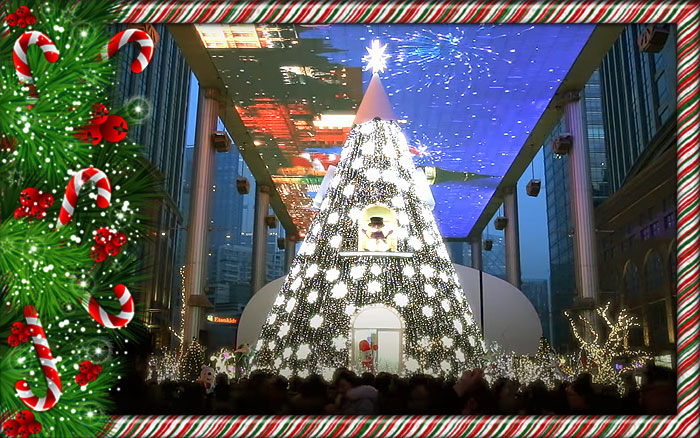
Christmas, Shèngdàn Jié (圣诞节, "holy birth festival"), is not a traditional Chinese festival, but it has become a familiar part of December in China's cities. In December, shopping malls, hotels, department stores and shopping streets put up Christmas trees, lights and displays, retailers build Christmas into their sales events, and songs such as "Jingle Bells" play in the shops. Christmas trees and decorations are still uncommon in most Chinese homes; the celebration happens mostly in public spaces.
For many young urban Chinese, Christmas is a fashionable social occasion. Christmas Eve is the main night, spent at restaurants, karaoke bars and parties with friends or a partner, and gifts are exchanged among friends. Christmas cards and hanging stockings have also been adopted by some. Shèngdàn Lǎorén (圣诞老人), "the old Christmas man", is the Chinese name for Santa Claus, and white-bearded Santas greet shoppers in malls and shop windows. A Peking University sociologist quoted by NBC News summed it up: Christmas in China "is not celebrated at home or in church, but in the mall".
Píng'ān Yè: apples on Christmas Eve
China's own contribution to Christmas is a pun. Christmas Eve is Píng'ān Yè (平安夜), literally "peaceful night" or "safe night". The word for apple, píngguǒ (苹果), begins with the same sound as píng'ān, so giving an apple on Christmas Eve has become a wish for peace and safety. Traders sell them as píng'ān guǒ (平安果), "peace fruit", wrapped in colourful paper. Giving apples is especially popular among teenagers and young adults, and it is sometimes said that the more elaborate the wrapping, the closer the friendship.
Christians and church services
Christians are a minority in China. In 2018 the State Council Information Office reported more than 44 million Christians, about 38 million Protestants and 6 million Catholics. Surveys reviewed by the Pew Research Center found that about 2% of Chinese adults formally identified as Christian between 2010 and 2018, although more said they held some Christian beliefs. Adults may legally worship in churches registered with the state-recognised bodies: the Three-Self Patriotic Movement and the China Christian Council for Protestants, and the Chinese Catholic Patriotic Association for Catholics. Many Christians also worship in unregistered house churches.
For Chinese Christians, Christmas is a religious feast marked with Christmas Eve services and choir performances. In Beijing, most of the city's Catholic and Protestant churches hold Christmas Eve and Christmas Day services and choir events, usually in the evening, and thousands attend Mass at St Joseph's Cathedral on Wangfujing Street, the East Church. The South Church at Xuanwumen, established in 1652, was the first Catholic church in Beijing, and the North Church at Xishiku, established in 1703 and rebuilt in 1900, houses the office of the Bishop of Beijing.
Public holidays and official attitudes
Christmas is not a public holiday in mainland China. The national holiday calendar, revised from 1 January 2025, has 13 days of public holidays: New Year's Day, four days for the Spring Festival, and holidays for the Qingming, Labour Day, Dragon Boat, Mid-Autumn and National Day festivals. On 25 December, offices, factories and shops work normally.
The picture is different in the two special administrative regions. In Hong Kong, Christmas Day and the first weekday after Christmas Day are general holidays; in 2026 they fall on Friday, 25 December and Saturday, 26 December. In Macau, both Christmas Eve and Christmas Day are public holidays, as is the Winter Solstice; none of these is an obligatory holiday, so private employers decide whether staff have the days off. Read more about Christmas in Hong Kong.
Official attitudes to Christmas on the mainland vary by place and year. Public Christmas decorations and commercial celebrations are widespread, but some local authorities and institutions have discouraged Christmas events, saying that more attention should be paid to traditional Chinese festivals. In 2014, for example, the education bureau of Wenzhou barred Christmas-related events in the institutions it oversaw, and Northwest University in Xi'an asked students to watch a film about Confucius instead of celebrating Christmas.
Christmas around China
| Place | Christmas highlights |
|---|---|
| Beijing | Lights and trees in malls and on Wangfujing Street; Christmas Eve services at the Catholic cathedrals, including St Joseph's (Wangfujing), the South Church at Xuanwumen (established 1652) and the North Church at Xishiku; hotel Christmas Eve galas |
| Shanghai | Decorated malls and hotels, Christmas markets and church services |
| Yiwu, Zhejiang | A centre of the world's Christmas decoration trade; Chinese state media reported in 2017 that the city's suppliers made about 60% of the world's Christmas decorations |
| Hong Kong | Christmas Day and the first weekday after it are general holidays; a large Christmas tree in Statue Square, Central; crowds in Tsim Sha Tsui, Causeway Bay and Lan Kwai Fong on Christmas Eve |
| Macau | 24 and 25 December are public holidays, and the Winter Solstice holiday falls on 22 December |
China is also a major source of the world's Christmas decorations. According to a 2017 China Daily report, manufacturers supplying the markets of Yiwu in Zhejiang province made about 60% of the world's Christmas decorations.
Christmas and winter festival food in China
There is no traditional Chinese Christmas meal. Christmas eating means apples, restaurant dinners and hotel buffets, while the foods with deep meaning belong to the Chinese winter festivals that surround it: Dōngzhì, the Winter Solstice, and the Spring Festival.
| Food | What it is | When it is eaten |
|---|---|---|
| Píng'ān guǒ (peace apples) | Apples wrapped in coloured paper or boxed and printed with greetings | Christmas Eve |
| Christmas Eve dinner out | Restaurant meals and karaoke with friends or a partner | Christmas Eve, in the cities |
| Hotel Christmas buffets | Western-style Christmas buffets at large hotels; reservations are usually needed | 24 and 25 December |
| Tangyuan and dumplings | Glutinous rice balls; dumplings whose name sounds like "reunion" | Dōngzhì, the Winter Solstice festival |
| Jiaozi | Dumplings said to resemble silver ingots, eaten at midnight | Chinese New Year's Eve, in northern China |
| Whole fish | Served but left partly uneaten, for "surplus every year" | Chinese New Year's Eve reunion dinner |
| Niangao | Sticky rice cake, also given to relatives and friends | Chinese New Year, especially in the south |
| Tangyuan | Sweet rice balls in soup | Lantern Festival |
New Year's Day and the Spring Festival
China celebrates two New Years. Yuándàn (元旦), 1 January, marks the start of the Gregorian year and is a one-day public holiday. Greetings for the Gregorian New Year are often sent by phone, and those wishing friends and colleagues in China and abroad a good year can share Happy New Year 2027 images and wishes, from greeting cards to ready-to-send messages.
The far bigger celebration is Chinese New Year, the Spring Festival or Chūn Jié (春节), which follows the lunar calendar. In 2027 it falls on Saturday, 6 February, beginning the Year of the Goat. Families gather for a reunion dinner on New Year's Eve, often travelling long distances during chūnyùn, the roughly 40-day travel season around the festival described as the largest annual human migration in the world. Married couples and elders give red envelopes, hóngbāo, to younger unmarried relatives, favouring amounts with the lucky number 8. The festivities traditionally end on the 15th day with the Lantern Festival, on 20 February 2027.
Christmas and New Year dates in China, 2026–27
| Date | Occasion | What happens |
|---|---|---|
| Dōngzhì (Winter Solstice festival) | Family meals with tangyuan or dumplings; a public holiday in Macau | |
| Píng'ān Yè (Christmas Eve) | Apples given as gifts; evenings out; church services; public holiday in Macau | |
| Shèngdàn Jié (Christmas Day) | Working day on the mainland; public holiday in Hong Kong and Macau | |
| First weekday after Christmas Day | General holiday in Hong Kong | |
| New Year's Eve | Eve of the Gregorian New Year | |
| Yuándàn (New Year's Day) | One-day public holiday | |
| Chinese New Year's Eve | Reunion dinner; first of the four Spring Festival public holiday days | |
| Chinese New Year (Chūn Jié) | Start of the Year of the Goat; red envelopes and family visits | |
| Lantern Festival (Yuánxiāo Jié) | Lanterns and tangyuan; the traditional end of the New Year season |
The official mainland holiday schedule for the 2027 Spring Festival, including any make-up working days, is published by the State Council, usually late in the preceding year.
Video: Christmas in China
Christmas in China: frequently asked questions
How is Christmas celebrated in China?
In mainland China, Christmas, Shèngdàn Jié, is mostly a commercial and social occasion in the cities rather than a religious or family holiday. Shopping malls, hotels and streets are decorated with trees and lights, young people go out with friends on Christmas Eve, and apples wrapped in coloured paper are given as gifts. Christians, a small minority, attend church services, and 25 December is an ordinary working day on the mainland.
Is Christmas a public holiday in China?
Christmas is not a public holiday in mainland China, where 25 December is a normal working day. It is a public holiday in Hong Kong, where Christmas Day and the first weekday after it are general holidays, and in Macau, where 24 and 25 December are both public holidays. In 2026 Hong Kong's two holidays fall on Friday 25 and Saturday 26 December.
Why do people give apples on Christmas Eve in China?
In Chinese, Christmas Eve is Píng'ān Yè, meaning "peaceful night" or "safe night", and the word for apple, píngguǒ, sounds similar to píng'ān. Apples given on Christmas Eve, often called píng'ān guǒ ("peace fruit"), are a wish for safety and peace in the year ahead. They are usually wrapped in colourful paper and are especially popular among teenagers and young adults.
What is Santa Claus called in China?
Santa Claus is called Shèngdàn Lǎorén (圣诞老人) in Chinese, which means "old Christmas man". He appears in shopping malls, shop windows and hotel lobbies across Chinese cities in December. Christmas itself is Shèngdàn Jié (圣诞节), and Merry Christmas is Shèngdàn kuàilè (圣诞快乐).
How many Christians are there in China?
In 2018 the State Council Information Office reported more than 44 million Christians in China, about 38 million Protestants and 6 million Catholics. Surveys reviewed by the Pew Research Center found that about 2% of Chinese adults formally identified as Christian between 2010 and 2018. Christians may legally worship in churches registered with the state-recognised Protestant and Catholic bodies.
Is Christmas banned in China?
No, Christmas is not banned in China, and malls, hotels and restaurants across the country celebrate it every year. However, some local authorities and institutions have discouraged Christmas events in certain years. In 2014, for example, the education bureau of Wenzhou barred Christmas-related events in the institutions it oversaw, and Northwest University in Xi'an asked students to watch a film about Confucius instead, citing the promotion of traditional Chinese festivals.
Is Chinese New Year the same as New Year's Day in China?
No. New Year's Day, Yuándàn, on 1 January, is a one-day public holiday marking the start of the Gregorian year. Chinese New Year, the Spring Festival or Chūn Jié, follows the lunar calendar and falls in late January or February; in 2027 it falls on Saturday, 6 February, beginning the Year of the Goat. The Spring Festival is China's most important family holiday, with four public holiday days.
How do you say Merry Christmas in Chinese?
Merry Christmas in Mandarin Chinese is Shèngdàn kuàilè, written 圣诞快乐 in simplified characters. In Cantonese, spoken in Hong Kong and Macau, it is Sing daan faai lok, written 聖誕快樂 in traditional characters.
Christmas in nearby countries
 CLAT Aspirants
 Diwali
 Thanksgiving
 Christmas
 Craft Ideas for Kids
 Fun and Jokes
 School Projects & Homework Help
 Hobbies

CLAT Preparation for Students
Class 12 Accounts Mock Papers
Thanksgiving Greetings
Chritmas Greeting Cards
Christmas Around the World
New Year 2027
Hanukkah Cards
7 Continents of the World
Moral Stories
Fairy Tales and Fables
Classic Stories
Betal Pachisi
Singhasan Battisi
Indian Mythology stories
School Projects
Quiz on Famous Footballers
Unsolved Mysteries
Pets & Pet Care
Wishes and Greetings in Many Languages