
Which countries celebrate Diwali?
Diwali is celebrated wherever Hindus, Sikhs and Jains live. Outside India, the main day is an official public holiday in Nepal, Sri Lanka, Myanmar, Malaysia, Singapore, Mauritius, Fiji, Guyana, Suriname, Trinidad and Tobago and Pakistan. The largest public celebrations outside South Asia are in Leicester and London in the UK, Trinidad's Divali Nagar, Singapore's Little India, and community festivals across the USA, Canada, Australia and New Zealand.
- At a glance
- Asia
- Caribbean
- Fiji and Mauritius
- United Kingdom
- USA and Canada
- Australia and New Zealand
- South Africa
- FAQ
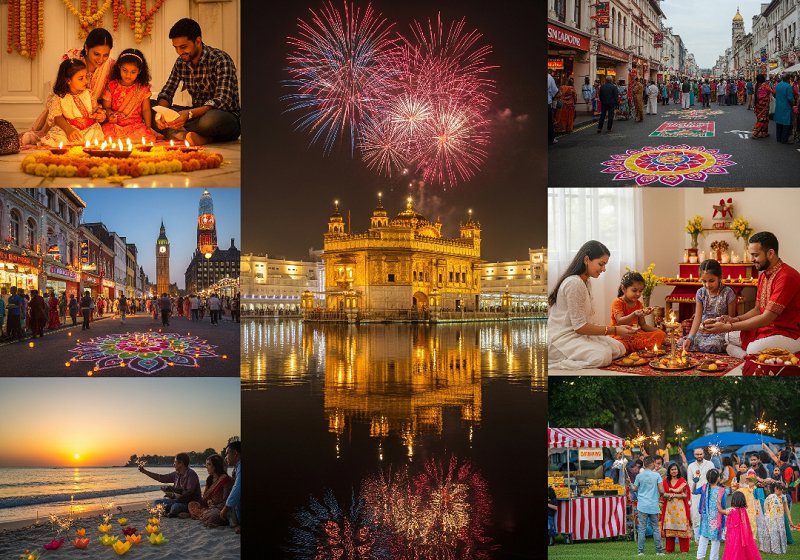
Diwali around the world at a glance
| Country | Local name | Public holiday | Highlights |
|---|---|---|---|
| Nepal | Tihar | Yes | Five days honouring crows, dogs, cows and oxen; Lakshmi Puja; Bhai Tika |
| Sri Lanka | Deepavali | Yes | Temple prayers and family celebrations among Tamil Hindus |
| Malaysia | Deepavali | Yes (except Sarawak) | Oil bath, temple visits and multi-faith open houses |
| Singapore | Deepavali | Yes | Little India's Serangoon Road lit up for weeks |
| Indonesia | Diwali | No | Celebrated by the Indian-origin community, especially in Medan |
| Fiji | Diwali | Yes | Homes lit with lights and diyas; shared by people of all faiths |
| Mauritius | Divali | Yes | Rows of lamps and Lakshmi Puja; about 48% of people are Hindu |
| Trinidad and Tobago | Divali | Yes, since 1966 | Divali Nagar fair for nine nights; bamboo deya displays |
| Guyana | Diwali | Yes | Diwali motorcades of illuminated floats |
| Suriname | Divali | Yes | Lamps, prayers and community celebrations |
| United Kingdom | Diwali | No | Leicester's Golden Mile lights; Diwali on the Square in London |
| United States | Diwali | State holiday in CT, PA and CA | Community fairs, a Diwali stamp and a New York City school holiday |
| Canada | Diwali | No | Community and civic celebrations, especially in the Toronto area |
| Australia | Diwali | No | Large fairs in Sydney and Melbourne |
| New Zealand | Diwali | No | Diwali festivals in Auckland and Wellington |
| South Africa | Diwali | No | Celebrated by the large Indian-origin community around Durban |
Diwali in Asia
Nepal: Tihar
In Nepal, Diwali is Tihar, also called Yamapanchak, a five-day festival that honours animals as well as gods:
- Kag Tihar: crows, seen as messengers of Yama, are offered grain and sweets.
- Kukur Tihar: dogs, both pets and strays, are fed, garlanded with marigolds and given a tika.
- Gai Tihar and Lakshmi Puja: cows are worshipped in the morning and Goddess Lakshmi is welcomed into lit homes at night.
- Goru Puja: oxen are worshipped; Govardhan Puja is observed, and the Newar community celebrates Mha Puja, the "worship of the self" that begins the Nepal Sambat new year.
- Bhai Tika: sisters apply a seven-coloured tika to their brothers and pray for their long life.
On the Tihar nights, groups go from house to house singing Deusi and Bhailo songs and are rewarded with money and sel roti.
Sri Lanka
Deepavali is a public holiday in Sri Lanka, celebrated mainly by the Tamil Hindu community with temple prayers, an early oil bath, new clothes, sweets and lamps, much as in neighbouring Tamil Nadu.
Malaysia
About 6% of Malaysians are Hindu, and Deepavali is a public holiday in every state except Sarawak. The day begins with an oil bath and prayers at home and at the temple. The best-known Malaysian custom is the open house: Hindu families welcome friends and neighbours of every ethnicity and religion to share Indian food and sweets. Fireworks are regulated, and only approved types may be sold.
Singapore
Deepavali is Singapore's only Hindu public holiday; about 5% of residents are Hindu. For several weeks beforehand, Serangoon Road in Little India is decorated with festive street lights and arches, and the area's markets fill with shoppers buying sweets, flowers, clothes and decorations. On the day, families visit temples such as Sri Srinivasa Perumal and Sri Veeramakaliamman on Serangoon Road.
Indonesia
Indonesia's name comes from the Greek Indos (Indian) and nesos (islands). Diwali there is celebrated mainly by the Indian-origin community, the largest of which is in Medan in North Sumatra. Bali's Hindus follow their own Balinese traditions, whose major festivals are Galungan and Nyepi, so Diwali is not a major Balinese festival.
Divali in the Caribbean
Indentured labourers brought the festival to the Caribbean in the 19th century, and there it is usually spelled Divali.
Trinidad and Tobago
Divali has been a national public holiday in Trinidad and Tobago since 1966. Its centrepiece is Divali Nagar, the "city of lights" in Chaguanas, started in 1986, which runs for nine nights up to Divali with Indian music, dance, food and exhibitions. Towns and villages build elaborate displays of split and bent bamboo lined with clay deyas, lit with coconut oil, and families share food with neighbours of every faith.
Guyana and Suriname
Diwali is a public holiday in both Guyana and Suriname. In Guyana it is known for the Diwali motorcade, a night-time parade of illuminated floats, alongside lamps, prayers and the sharing of sweets.
Diwali in Fiji and Mauritius
Fiji
Diwali is a public holiday in Fiji, where the Indo-Fijian community is descended mainly from indentured labourers. Homes are cleaned and lit with strings of lights, diyas and candles, sweets are exchanged, and people of other faiths often join the celebrations.
Mauritius
In Mauritius, where about 48% of the population is Hindu (2022 census), Divali is a public holiday. Rows of clay lamps line houses and gardens, Lakshmi is worshipped, and families share sweets such as gato patate with neighbours.
Diwali in the United Kingdom
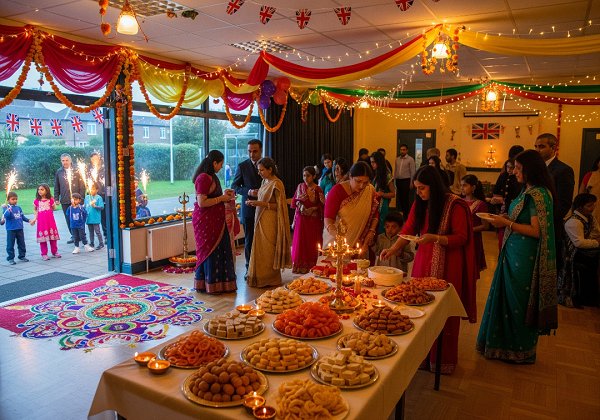
Leicester is often described as hosting one of the largest Diwali celebrations outside India. Its Golden Mile on Belgrave Road, a centre of the city's Gujarati community, is lit with thousands of lights; the 2022 switch-on drew about 20,000 people, followed by a fireworks display on Diwali Day itself. In London, the Mayor's Diwali on the Square brings music, dance, food stalls and workshops to Trafalgar Square, and temples such as BAPS Shri Swaminarayan Mandir in Neasden hold large celebrations.
Diwali in the USA and Canada
United States
Diwali is not a federal holiday in the US, but recognition has grown fast:
- The US Postal Service issued a Diwali Forever stamp on 5 October 2016.
- President Barack Obama became the first president to light a diya in the Oval Office, in 2016.
- New York City public schools have closed for Diwali since 2024, after Governor Kathy Hochul signed the law in November 2023.
- Diwali is a state holiday in Connecticut, Pennsylvania and California; California's law was signed in October 2025.
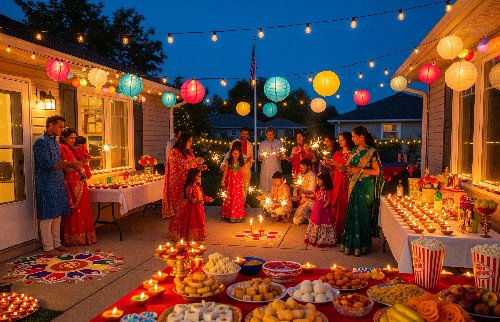
Across the country, Indian-American communities hold Diwali fairs, temple celebrations and cultural shows with music, dance, food stalls and fireworks.
Canada
Canada's large Indo-Canadian population celebrates Diwali with temple festivities and community events, especially in the Greater Toronto Area and around Vancouver, and it is regularly marked by federal and provincial politicians.
Diwali in Australia and New Zealand
Australia
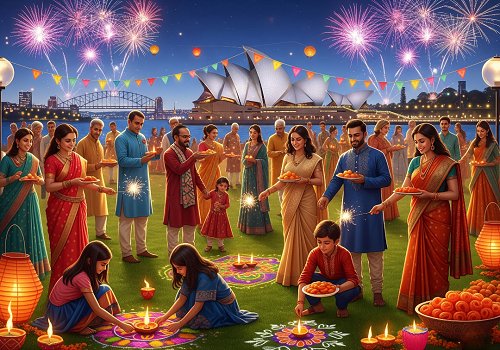
Hinduism is one of Australia's fastest-growing religions: the 2021 census counted 684,002 Hindus, 2.7% of the population. Diwali has grown from private celebrations into large public fairs in Sydney and Melbourne, with food stalls, Bollywood and classical music, dance and fireworks.
New Zealand
In New Zealand, Diwali festivals in Auckland and Wellington, supported by the Asia New Zealand Foundation and local councils, draw large crowds on the weekends around Diwali with Indian dance, music, crafts and food.
Diwali in South Africa
South Africa has one of the largest Indian-origin communities in Africa, concentrated around Durban in KwaZulu-Natal, where Diwali is celebrated with lamps, prayers, sweets and fireworks.
For how the festival is celebrated within India, read Diwali celebrations across India; for its meaning and key facts, see About Diwali.
Diwali around the world: frequently asked questions
Which countries celebrate Diwali?
Diwali is celebrated wherever Hindus, Sikhs and Jains live. Beyond India, the biggest celebrations are in Nepal, Sri Lanka, Malaysia, Singapore, Fiji, Mauritius, Trinidad and Tobago, Guyana, Suriname, the United Kingdom, the United States, Canada, Australia, New Zealand and South Africa.
In which countries is Diwali a public holiday?
The main day of Diwali is an official public holiday in India, Nepal, Sri Lanka, Myanmar, Malaysia (except Sarawak), Singapore, Mauritius, Fiji, Guyana, Suriname, Trinidad and Tobago and Pakistan. In the United States it is a state holiday in Connecticut, Pennsylvania and California, and a public school holiday in New York City.
Where is the biggest Diwali celebration outside India?
Leicester in England is often described as hosting one of the biggest Diwali celebrations outside India. Its Golden Mile on Belgrave Road is lit with thousands of lights, and the 2022 lights switch-on drew about 20,000 people. Trinidad's Divali Nagar, which runs for nine nights before Divali, is the largest in the Caribbean.
How is Diwali celebrated in Nepal?
In Nepal, Diwali is Tihar, a five-day festival. Crows are honoured on the first day, dogs on the second, cows in the morning and Goddess Lakshmi at night on the third, oxen on the fourth, along with Govardhan Puja and the Newar Mha Puja, and brothers and sisters on the fifth day, Bhai Tika. Groups of young people go from house to house singing Deusi and Bhailo songs.
Is Diwali a holiday in the USA?
Diwali is not a federal holiday in the United States, but it is a state holiday in Connecticut, Pennsylvania and California, and New York City public schools have closed for Diwali since 2024. The US Postal Service issued a Diwali Forever stamp in 2016.
How is Deepavali celebrated in Malaysia?
In Malaysia, Deepavali is a public holiday everywhere except Sarawak. Hindu families take an early oil bath, pray at home and at the temple, and hold open houses where friends of every ethnicity and religion are welcomed with food and sweets. Fireworks are regulated, and only approved types may be sold.
Why is it spelled Divali in Trinidad?
Divali is the usual spelling in Trinidad and Tobago, Mauritius and the Caribbean, reflecting how the word was carried by indentured Indian labourers in the 19th century. In Trinidad and Tobago, Divali has been a national public holiday since 1966.
Usage terms
Images on this page are © KidsGen.com and may be shared for personal, non-commercial use with a link back to this page. Please do not resell them, republish them on other websites or use them in advertising.
 CLAT Aspirants
 Durga Puja
 Craft Ideas for Kids
 Benefits of Yoga for Kids
 Fun and Jokes
 Stories for Kids
 School Projects & Homework Help
 Hobbies

