
Christmas in the UK
Crackers, carols and the King's speech: a British Christmas in England, Scotland, Wales and Northern Ireland


Christmas in the UK is celebrated on 25 December, followed by Boxing Day on 26 December, and both are bank holidays in all four nations. The British Christmas mixes old English customs with traditions the Victorians made popular: the decorated tree, Christmas cards and crackers. The day itself centres on presents from Father Christmas in the morning, a roast turkey dinner with crackers and paper crowns, Christmas pudding and the King's Christmas message at 3pm. Around it come carol services, pantomimes, mince pies and Boxing Day football, while Scotland, Wales and Northern Ireland each add customs of their own.
How the British celebrate Christmas
The British Christmas season gets going in November. Christmas puddings are traditionally made on Stir-up Sunday, the last Sunday before Advent, high streets switch on their lights, and Christmas markets open in towns and cities. From 1 December, Advent calendars count down the days, and churches light Advent wreaths on the four Sundays before Christmas. Churches and community groups stage nativity plays, carol singers go from door to door or gather in town squares, and offices hold Christmas parties.
On Christmas Eve, many people attend a carol service or midnight Mass, and stockings are hung at the end of the bed or by the fireplace. A mince pie and a glass of sherry are left out for Father Christmas, with a carrot for his reindeer. Father Christmas is an old English figure of good cheer who merged with the American Santa Claus in the Victorian era; today the two names mean the same gift-bringer.
The Victorian Christmas: trees, cards and crackers
Much of the modern British Christmas took shape under Queen Victoria. Her German husband, Prince Albert, made the decorated Christmas tree fashionable: in 1848 the Illustrated London News published an engraving of the royal family around a tree hung with ornaments, and families across the country copied it. In 1843, Sir Henry Cole, later the founding director of the V&A, commissioned the first commercial Christmas card, printed in a run of 1,000. In the same decade the London confectioner Tom Smith invented the Christmas cracker, a twist of paper that later gained its "bang", a paper crown and a joke. Charles Dickens's A Christmas Carol, also published in 1843, helped make Christmas a festival of family, generosity and feasting.
Christmas Day in the UK
Christmas morning begins with stockings and presents under the tree. Some families go to church; the royal family attends a morning service at St Mary Magdalene Church on the Sandringham estate in Norfolk. The main event is Christmas dinner, usually eaten at lunchtime or in the early afternoon: roast turkey with all the trimmings, eaten in paper crowns from the crackers pulled at the start of the meal. The Christmas pudding is brought in last, often doused in brandy and set alight.
At 3pm, many households stop to watch or listen to the King's Christmas message. The royal Christmas broadcast began in 1932, when King George V spoke on the radio from Sandringham, and Queen Elizabeth II's message was first shown on television in 1957. The rest of the day is for Christmas television specials, games, walks and more food. In London, members of the Serpentine Swimming Club race in the cold water of Hyde Park's lake on Christmas morning, as they have since 1864, for a trophy first given by J. M. Barrie, the author of Peter Pan.
Christmas in England, Scotland, Wales and Northern Ireland
| Nation | Signature traditions | Merry Christmas |
|---|---|---|
| England | Trafalgar Square's Norwegian tree; London's Regent Street and Oxford Street lights; Nine Lessons and Carols from King's College, Cambridge; Christmas markets in Manchester, Birmingham, Bath and York | Merry Christmas |
| Scotland | A quiet Christmas for centuries; Hogmanay and first-footing at New Year; Edinburgh's Christmas markets | Nollaig Chridheil (Scottish Gaelic) |
| Wales | Plygain carol services; the Mari Lwyd; Noson Gyflaith toffee-making; calennig at New Year | Nadolig Llawen (Welsh) |
| Northern Ireland | Belfast's Christmas market at City Hall; the Black Santa sit-out at St Anne's Cathedral | Nollaig Shona (Irish) |
England
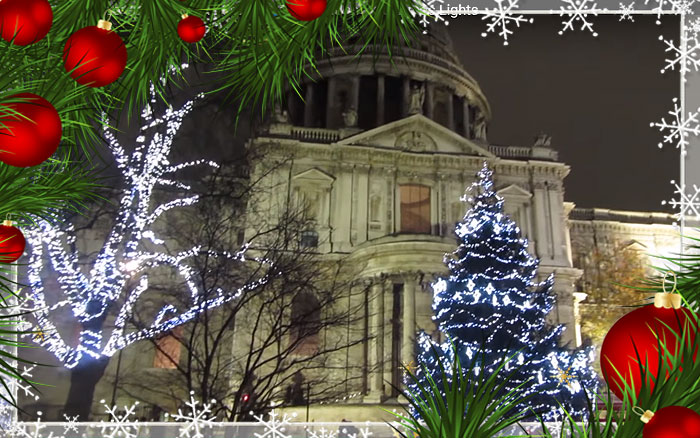
England's best-known Christmas sight is the Trafalgar Square Christmas tree, a Norway spruce given by the city of Oslo every year since 1947 as thanks for Britain's help to Norway in the Second World War. It is lit on the first Thursday of December. London's Regent Street and Oxford Street lights, department-store windows, ice rinks and the Winter Wonderland fair in Hyde Park draw crowds, and cities including Manchester, Birmingham, Bath and York host large Christmas markets. In January, cider-makers in Somerset and Herefordshire hold wassails, singing to apple trees to bless the coming harvest.
Scotland
For about 400 years Scotland barely celebrated Christmas. After the Protestant Reformation of 1560 the Kirk discouraged it as a Catholic feast, and in 1640 the Scottish Parliament abolished the Yule holiday. Christmas Day only became a public holiday in Scotland in 1958, and Boxing Day in 1974. As a result, Hogmanay, New Year's Eve, became Scotland's great winter festival, with first-footing: the first visitor after midnight brings luck, traditionally with gifts of coal, shortbread, black bun or whisky. Christmas is now celebrated much as in the rest of the UK, and Scotland keeps an extra bank holiday on 2 January. Read more about Christmas in Scotland.
Wales
Wales has two remarkable winter customs. The Plygain, strongest in Montgomeryshire and mid-Wales, was once an early-morning service on Christmas Day; today about 50 Plygain services are held each December and January, at which groups of singers come forward in turn to sing old unaccompanied Welsh carols in close harmony. The Mari Lwyd, from south Wales, is a horse's skull on a pole, draped in a white sheet and decorated with ribbons, carried from house to house over the Christmas season. Its party must win a contest of improvised verses, the pwnco, before being let in for food and drink. Welsh families also once held Noson Gyflaith, a toffee-making evening, and on New Year's Day the young went from door to door collecting calennig, New Year gifts. Read more about Christmas in Wales.
Northern Ireland
In Northern Ireland, Christmas is widely observed by both Protestant and Catholic communities, with church services playing a large part. Belfast's Christmas market fills the grounds of City Hall, and since 1976 the Dean of Belfast has sat out on the steps of St Anne's Cathedral in the days before Christmas, collecting for charities. The tradition is known as the Black Santa sit-out, after the black cloak the first dean wore. See also Christmas in Ireland.
Lights, carols and pantomime
Carols are at the heart of the British Christmas. On Christmas Eve at 3pm, A Festival of Nine Lessons and Carols is broadcast live on BBC radio from King's College, Cambridge. First held in 1918 and broadcast since 1928, it always opens with a solo chorister singing the first verse of "Once in Royal David's City". Churches, cathedrals and community choirs across the country hold their own carol services through December.
Pantomime is a uniquely British Christmas theatre tradition. From late November to January, theatres stage comic versions of fairy tales such as Cinderella, Aladdin or Jack and the Beanstalk, with a pantomime dame played by a man, slapstick, songs and audience shouts of "He's behind you!" and "Oh no it isn't!". Other seasonal fixtures include the race for the Christmas number one single, Christmas television specials and Christmas jumpers.
Traditional British Christmas food
| Food | What it is | When it is eaten |
|---|---|---|
| Roast turkey | The centrepiece of Christmas dinner, with stuffing and gravy | Christmas Day |
| Pigs in blankets | Small sausages wrapped in bacon | Christmas Day |
| Roast potatoes, parsnips and Brussels sprouts | The essential trimmings | Christmas Day |
| Cranberry and bread sauce | Sharp fruit sauce; milky spiced bread sauce | Christmas Day |
| Christmas pudding | Steamed fruit pudding, flamed with brandy and served with brandy butter or custard | Made on Stir-up Sunday, eaten on Christmas Day |
| Mince pies | Pastry tarts filled with spiced dried fruit | All season; one is left out for Father Christmas |
| Christmas cake | Rich fruit cake with marzipan and white icing | All season |
| Trifle and Yule log | Layered custard, fruit and sponge dessert; chocolate log cake | Christmas and Boxing Day |
| Cold turkey and bubble and squeak | Leftovers fried into a cake of potato and vegetables | Boxing Day |
| Shortbread and black bun | Butter biscuits; rich fruit cake in pastry | Scotland, especially at Hogmanay |
A silver coin was once stirred into the Christmas pudding, and whoever found it in their portion was promised good luck for the year.
Boxing Day
Boxing Day, 26 December, is a bank holiday across the UK. The name is usually traced to the "Christmas boxes" of money or gifts once given to servants, apprentices and tradespeople the day after Christmas. Today it is a day for visiting family, eating leftovers and walking off the feast. It is one of the biggest days in the sporting calendar, with a full programme of football and horse racing, including the King George VI Chase at Kempton Park, and it marks the start of the post-Christmas sales. In 2026, Boxing Day falls on a Saturday, so the bank holiday is moved to .
UK Christmas season dates 2026
| Date | Occasion | What happens |
|---|---|---|
| Stir-up Sunday | Christmas puddings are made | |
| First Sunday of Advent | Advent wreaths and calendars begin | |
| Trafalgar Square tree lighting | The Norwegian tree is lit on the first Thursday of December | |
| Letters to Santa deadline | Royal Mail's date for letters to arrive for a reply | |
| Christmas Eve | Nine Lessons and Carols at 3pm; midnight Mass; stockings hung | |
| Christmas Day | Bank holiday; presents, Christmas dinner, the King's message at 3pm | |
| Boxing Day | Football, racing and sales | |
| Boxing Day bank holiday (substitute day) | Bank holiday across the UK | |
| New Year's Eve and Hogmanay | Fireworks; first-footing in Scotland after midnight | |
| New Year's Day | Bank holiday across the UK | |
| 2 January bank holiday (substitute day) | Bank holiday in Scotland only | |
| Twelfth Night | Decorations traditionally come down |
Video: Christmas in the UK
Video: Things to do in London at Christmas
Christmas in the UK: frequently asked questions
How is Christmas celebrated in the UK?
In the UK, Christmas is celebrated with Advent calendars, decorated trees, lights on high streets, carol services and nativity plays. On Christmas Eve, stockings are hung for Father Christmas. Christmas Day brings presents in the morning, a roast turkey dinner with crackers and Christmas pudding, and the King's Christmas message at 3pm. Boxing Day follows on 26 December.
What do British people eat for Christmas dinner?
A traditional British Christmas dinner is roast turkey with stuffing, roast potatoes, pigs in blankets (sausages wrapped in bacon), Brussels sprouts, parsnips, carrots, cranberry sauce, bread sauce and gravy. It is followed by Christmas pudding with brandy butter or custard, and mince pies and Christmas cake are eaten throughout the season.
What is Boxing Day?
Boxing Day, 26 December, is a bank holiday across the UK. Its name is usually traced to the Christmas boxes of money or gifts once given to servants and tradespeople. Today it is a day for family visits, leftovers, football and horse racing, and big sales. In 2026, 26 December falls on a Saturday, so the bank holiday is Monday 28 December.
What time is the King's Christmas message?
The King's Christmas message is broadcast at 3pm on Christmas Day on television, radio and online. The tradition began with King George V's first radio broadcast in 1932, and Queen Elizabeth II's message was first televised in 1957.
What is a Christmas cracker?
A Christmas cracker is a paper tube, twisted at both ends, that two people pull apart at the Christmas table. It breaks with a small bang and releases a paper crown, a small gift and a joke. Crackers were invented in London in the 1840s by the confectioner Tom Smith.
Why does Norway give London a Christmas tree?
Since 1947 the city of Oslo has given a Norway spruce to London every year as thanks for Britain's support for Norway during the Second World War. The tree stands in Trafalgar Square and is lit on the first Thursday of December.
How is Christmas different in Scotland, Wales and Northern Ireland?
Christmas was discouraged in Scotland for centuries after the Reformation and only became a public holiday there in 1958, so Hogmanay on New Year's Eve has long been the bigger festival. Wales has the Plygain carol services and the Mari Lwyd, a horse's skull carried from door to door. In Northern Ireland, Belfast's City Hall Christmas market and the Black Santa charity sit-out at St Anne's Cathedral are seasonal fixtures.
When should Christmas decorations come down in the UK?
By tradition, Christmas decorations in the UK come down on Twelfth Night, the end of the Twelve Days of Christmas, and keeping them up longer is said to bring bad luck. Some count Twelfth Night as 5 January and others as 6 January.
What is Stir-up Sunday?
Stir-up Sunday is the last Sunday before Advent, when families traditionally make their Christmas pudding, each person stirring the mixture and making a wish. The name comes from the church prayer for that day, which begins "Stir up, we beseech thee, O Lord". In 2026 it falls on 22 November.
Usage terms
All images on this page are free to download for personal, non-commercial use, such as copying them at home or printing them as a reference. Please do not resell them, republish them on other websites or use them in advertising. Images © KidsGen.com.
Christmas in nearby countries
 CLAT Aspirants
 Diwali
 Thanksgiving
 Christmas
 Craft Ideas for Kids
 Fun and Jokes
 School Projects & Homework Help
 Hobbies

CLAT Preparation for Students
Class 12 Accounts Mock Papers
Thanksgiving Greetings
Chritmas Greeting Cards
Christmas Around the World
New Year 2027
Hanukkah Cards
7 Continents of the World
Moral Stories
Fairy Tales and Fables
Classic Stories
Betal Pachisi
Singhasan Battisi
Indian Mythology stories
School Projects
Quiz on Famous Footballers
Unsolved Mysteries
Pets & Pet Care
Wishes and Greetings in Many Languages